Industry-Verified Manufacturing Data (2026)

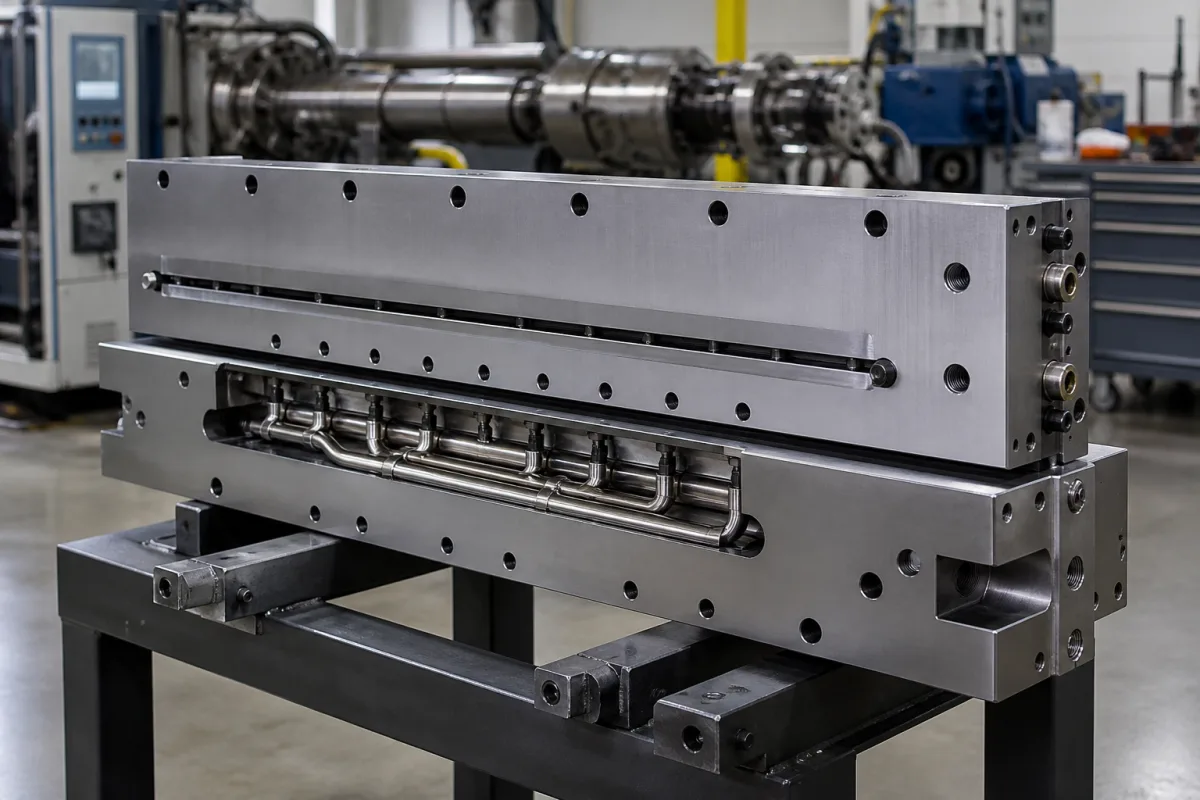
Polymer Extrusion Die Plate

Based on aggregated insights from multiple verified factory profiles within the CNFX directory, the standard Polymer Extrusion Die Plate used in the Plastics in Primary Forms Manufacturing sector typically supports operational capacities ranging from standard industrial configurations to heavy-duty production requirements.

Technical Definition & Core Assembly

A canonical Polymer Extrusion Die Plate is characterized by the integration of Orifice Array and Mounting Flange. In industrial production environments, manufacturers listed on CNFX commonly emphasize Tool Steel construction to support stable, high-cycle operation across diverse manufacturing scenarios.

Precision-machined plate that shapes molten plastic into specific profiles during extrusion.

Product Specifications

Technical details and manufacturing context for Polymer Extrusion Die Plate

Definition
A critical component in plastic extrusion systems that determines the final cross-sectional shape of extruded plastic products. This precision-machined plate features carefully designed orifices through which molten polymer is forced, creating continuous profiles like sheets, pipes, or custom shapes. In B2B supply chains, extrusion die plates enable manufacturers to produce consistent, dimensionally accurate plastic profiles for construction, automotive, and packaging industries. Their design directly impacts product quality, material efficiency, and production throughput in primary plastics manufacturing operations.
Working Principle
Molten plastic is forced through precisely machined openings in the die plate under pressure, taking the shape of the orifice as it exits, then cooled to maintain the formed profile.
Common Materials
Tool Steel, Stainless Steel, Hardened Aluminum
Technical Parameters
  • Maximum deviation from specified orifice dimensions (mm) Standard Spec
  • Surface finish quality of flow channels (Ra) Standard Spec
Components / BOM
  • Orifice Array
    Shapes molten plastic into desired profile
    Material: Tool Steel
  • Mounting Flange
    Secures die plate to extruder barrel
    Material: Stainless Steel
  • Thermal Equalization Channels Optional
    Maintains uniform temperature distribution
    Material: Same as plate
Engineering Reasoning
15-45 MPa pressure, 180-280°C temperature, 0.1-2.0 mm/s extrusion velocity
Yield strength exceedance at 310 MPa (AISI 4140 steel), thermal expansion differential >0.15 mm/m at 300°C, surface roughness degradation beyond Ra 0.4 μm
Design Rationale: Thermal-mechanical fatigue from cyclic heating (ΔT=120°C) causing microcrack initiation at stress concentrations (Kt=2.8), polymer degradation products (carbon black accumulation) accelerating abrasive wear via three-body mechanism
Risk Mitigation (FMEA)
Trigger Non-uniform thermal gradient exceeding 15°C/mm across plate cross-section
Mode: Differential thermal expansion induces plate warpage >50 μm, causing profile dimensional deviation beyond ±0.1 mm tolerance
Strategy: Integrate multi-zone cartridge heaters with PID control maintaining gradient <5°C/mm, implement Inconel 718 thermal break layers at mounting points
Trigger Polymer melt filtration failure allowing >100 μm contaminant particles
Mode: Abrasive particle impingement creates localized erosion craters >0.3 mm depth, disrupting laminar flow and causing surface defects
Strategy: Install dual-stage filtration (100 μm screen + 40 μm sintered metal) with differential pressure monitoring triggering automatic bypass at ΔP>1.2 MPa

Industry Taxonomies & Aliases

Commonly used trade names and technical identifiers for Polymer Extrusion Die Plate.

Industrial Ecosystem & Supply Chain DNA

Complementary Systems
Downstream Applications
Specialized Tooling

Application Fit & Sizing Matrix

Operational Limits
pressure: Up to 70 MPa (10,000 psi) maximum operating pressure
flow rate: 0.5-500 kg/hr (depends on profile complexity)
temperature: 150-350°C (typical polymer processing range)
slurry concentration: Not applicable (designed for molten polymers, not slurries)
Media Compatibility
✓ Polyethylene (HDPE/LDPE) ✓ Polypropylene (PP) ✓ Polyvinyl Chloride (PVC)
Unsuitable: Abrasive-filled composites (e.g., glass fiber reinforced polymers above 30% filler content)
Sizing Data Required
  • Required profile dimensions and tolerances
  • Polymer melt flow index (MFI) or viscosity
  • Target production rate (kg/hr)

Reliability & Engineering Risk Analysis

Failure Mode & Root Cause
Thermal fatigue cracking
Cause: Repeated heating and cooling cycles during extrusion processes cause thermal expansion and contraction stresses, leading to micro-cracks that propagate through the die plate material, especially at stress concentration points like bolt holes and flow channels.
Flow-induced erosion and corrosion
Cause: High-velocity polymer flow containing abrasive additives or corrosive byproducts gradually wears away critical flow surfaces, altering die geometry and causing dimensional inaccuracies in extruded products, exacerbated by improper material selection for the die plate.
Maintenance Indicators
  • Visible polymer degradation or charring at die exit edges indicating poor thermal control or material hang-up
  • Audible hissing or irregular flow sounds suggesting internal leakage or pressure imbalances within die channels
Engineering Tips
  • Implement controlled heating/cooling protocols with gradual temperature ramping to minimize thermal shock and maintain uniform die plate temperature distribution during operation and shutdowns
  • Apply specialized surface treatments (like nitriding or hard chrome plating) to critical flow surfaces and establish regular dimensional inspections using precision gauges to detect early wear before it affects product quality

Compliance & Manufacturing Standards

Reference Standards
ISO 9001:2015 - Quality management systems ASTM D638 - Standard Test Method for Tensile Properties of Plastics DIN 16901 - Extrusion dies for plastics and rubber
Manufacturing Precision
  • Bore diameter: +/-0.01mm
  • Parallelism of flow channels: 0.05mm
Quality Inspection
  • Coordinate Measuring Machine (CMM) dimensional verification
  • Surface roughness measurement (Ra ≤ 0.4μm)

Factories Producing Polymer Extrusion Die Plate

Verified manufacturers with capability to produce this product in China

✓ 96% Supplier Capability Match Found

T Technical Director from Australia Jan 02, 2026
★★★★★
"Impressive build quality. Especially the Orifice Diameter (mm) is very stable during long-term operation."
Technical Specifications Verified
P Project Engineer from Singapore Dec 30, 2025
★★★★☆
"As a professional in the Plastics in Primary Forms Manufacturing sector, I confirm this Polymer Extrusion Die Plate meets all ISO standards. (Delivery took slightly longer than expected, but technical support was excellent.)"
Technical Specifications Verified
S Sourcing Manager from Germany Dec 27, 2025
★★★★★
"Standard OEM quality for Plastics in Primary Forms Manufacturing applications. The Polymer Extrusion Die Plate arrived with full certification."
Technical Specifications Verified
Verification Protocol

“Feedback is collected from verified sourcing managers during RFQ (Request for Quote) and factory evaluation processes on CNFX. These reports represent historical performance data and technical audit summaries from our B2B manufacturing network.”

7 sourcing managers are analyzing this specification now. Last inquiry for Polymer Extrusion Die Plate from Mexico (33m ago).

Frequently Asked Questions

What materials are best for polymer extrusion die plates?

Tool steel offers durability for high-volume production, stainless steel provides corrosion resistance, and hardened aluminum is lightweight with good thermal conductivity for specific applications.

How do thermal equalization channels improve extrusion die performance?

Thermal equalization channels distribute heat evenly across the die plate, preventing material flow inconsistencies and ensuring uniform plastic profile dimensions during continuous extrusion.

What specifications should I consider when selecting an extrusion die plate?

Key specifications include operating temperature range, orifice diameter for your profile, plate thickness for structural integrity, pressure rating for your extrusion system, and surface hardness for wear resistance.

Can I contact factories directly on CNFX?

CNFX is an open directory, not a transaction platform. Each factory profile provides direct contact information and production details to help you initiate direct inquiries with Chinese suppliers.

Get Quote for Polymer Extrusion Die Plate

Request technical pricing, lead times, or customized specifications for Polymer Extrusion Die Plate directly from verified manufacturing units.

Your business information is encrypted and only shared with verified Polymer Extrusion Die Plate suppliers.

Thank you! Your message has been sent. We'll respond within 1–3 business days.

Need to Manufacture Polymer Extrusion Die Plate?

Connect with verified factories specializing in this product category

Add Your Factory Contact Us
Previous Product
Polymer Extrusion Barrel Liner
Next Product
Polymer Extrusion Melt Filter Screen