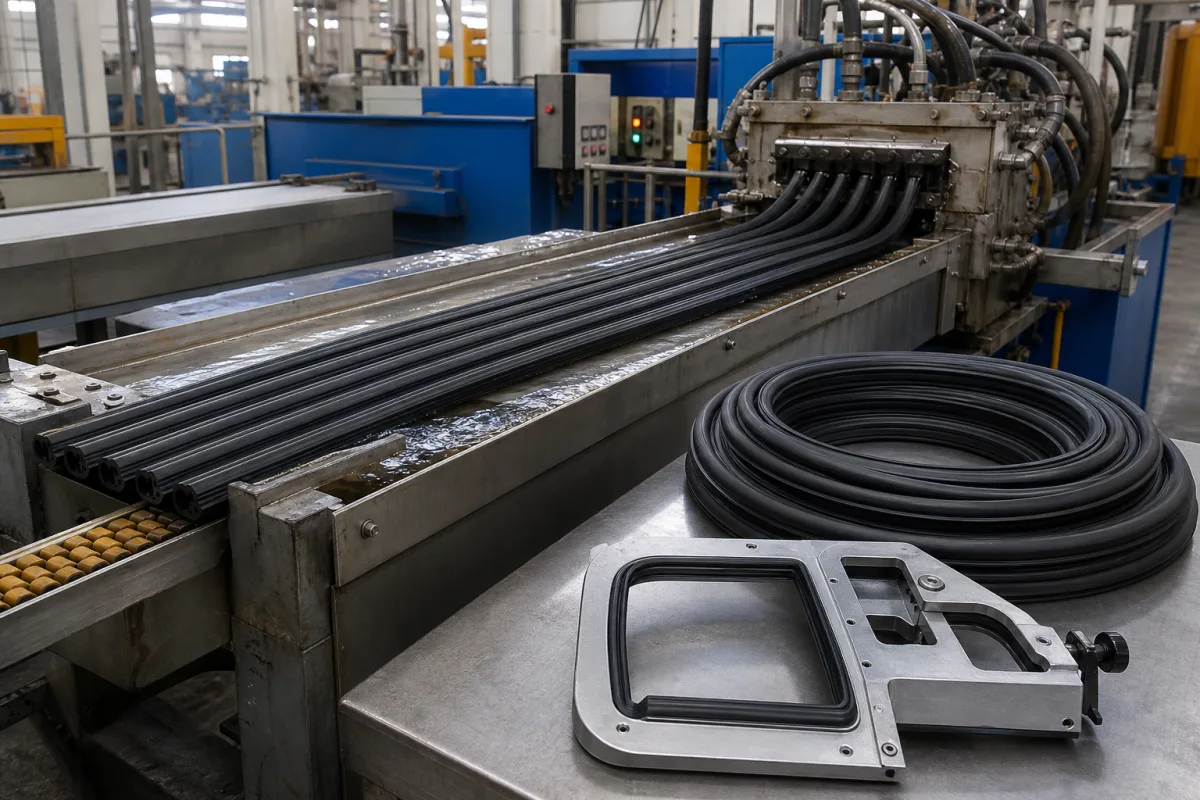
Automotive weatherstrips · Sponge bulb compression set, blown density and compression load deflection, dense carrier and test conditions
An automotive weatherstrip is an extruded rubber or thermoplastic elastomer profile, such as a soft sponge bulb on a dense rubber mounting body, fitted around doors, windows, boot lids and bonnets to keep out water, air, dust and noise. Ask three things first: how well the sponge bulb recovers after long compression, what blown density and compression load deflection (CLD) the bulb is made to, and under which test conditions each value is measured.
Extruded EPDM and TPE door, window, trunk and body weatherstrips for passenger cars and commercial vehicles, with dense carriers and sponge bulbs. Moulded corner pieces alone, building and appliance seals and glazing gaskets for buildings are outside this page.
CNFX editorial research · Sources checked October 12, 2026 · 4 sources
A patent assigned to DRB Holding, Hyundai Motor and Kia Motors describes the door weatherstrip as a soft sponge section compressed by the car body joined to a hard solid section, and states that compression set is the key characteristic of the sponge section, because sealing must be maintained after long use. [1]
Its EPDM sponge compound uses an EPDM with a Mooney (ML 1+8 at 125 °C) of 90 or more and an ENB content of 9 wt% or more with free sulphur and a BDBzTH accelerator, claiming compression set reduced to about 12% or less and better heat resistance against discoloration. Compression set was measured on discs at 70 °C for 22 h to JIS K 6301; in its table comparing three EPDM grades, compression set was 16.6–17.2% and Shore A hardness 58–59. Heat ageing ran at 70 °C for 70 h after vulcanisation at 155 °C for 20 min. [1]
Editorial note: compression set values only compare when temperature, time, specimen and recovery method match; ask suppliers to quote compression set with the full test condition, and to test the finished sponge profile as well as moulded discs.
Give the supplier the vehicle position (door, window, trunk, body), profile drawing with bulb and carrier, material (EPDM, TPE), sponge density and hardness, CLD target and test method, compression set limit and condition, colour and surface finish, length or closed-loop joining, clip or adhesive fixing, OEM material specifications, and annual volume.
02
Set blown density and compression load deflection
A Cooper Standard Automotive patent on low-gravity sponge rubber notes that weatherstrip weight reduction must be balanced against surface quality and stiffness, which suffer as blown specific gravity approaches or falls below about 0.60 g/cm³. Its formulation B reached an average blown specific gravity of 0.384 against 0.532 for a conventional formulation A, with Shore A hardness of 42 against 29 and water absorption of 8.63 against 26.81. [2]
The patent measures CLD as the force per unit area needed to compress a cured, blown rubber tube, calling it part-specific and a measure of suitability as a resilient seal; formulation B gave 0.1970 N/mm² against 0.1478 for A, and its claims cover a sponge bulb CLD of 0.1833–0.2120 N/mm² and blown specific gravity down to 0.358 g/cm³. It also cites a 2 N/mm minimum tear strength required on some parts. [2]
Editorial calculation: going from 0.532 to 0.384 g/cm³ cuts sponge mass by about 28%; for an assumed 150 mm² bulb section 4 m long, that is about 319 g down to 230 g of sponge. The section and length are assumed examples. [2]
A Toyoda Gosei patent on a door weatherstrip, US 8,353,130 B2, makes the mounting base and the hollow seal from one EPDM sponge so that only one extrusion material is needed. It claims a sponge with a specific gravity of 0.36–0.44, a low stretch stress (measured to JIS K 6254) of 200–230 kPa and an average foam cell diameter of 180–220 µm. The patent says below 0.36 the 200 kPa stress is hard to reach, a cell size of 220 µm or less gives a fine surface skin, and below 180 µm the density and stress targets are hard to meet together. [3]
It contrasts this with an earlier design in which the base used sponge below 0.45 and the seal used sponge of 0.45–1.0, and it avoids adding resin such as polyethylene to the base because that can increase permanent set. Its EPDM blend pairs a high-molecular-weight polymer with a Mooney viscosity ML 1+4 (125 °C) of 100–180 with a lower-molecular-weight one. [3]
For a general material call-out, ASTM D1056-20 covers flexible cellular rubber known as sponge rubber and expanded rubber made from synthetic, natural or reclaimed rubber, excluding latex foam and ebonite cellular rubber, and categorises it by Types 1 and 2, Classes A, B, C and D and Grades 0 to 5, each grade with specified physical properties. Its listed test methods are accelerated ageing, compression-deflection, oil immersion (open-cell sponge), fluid immersion (closed cell), water absorption, density and low-temperature flex, and it notes ISO 6916-1 as similar. ASTM adds that extruded or moulded shapes too small for cutting standard test specimens are difficult to classify or test by these methods and that such parts may need special testing procedures, and that a detailed product specification or test method takes precedence over the general specification in case of conflict. [4] Editorial note: for a weatherstrip bulb, that means a D1056 grade can describe the sponge compound, while CLD on a cured tube or on the finished profile, as in the Cooper Standard patent, and the OEM's own specification govern the part. [4][2]
03
D, P, E and I profiles, custom extrusions and EPDM compounds
Listings include door and window weatherstripping in D, P, E and I profiles, custom EPDM extrusions and compounds, and automotive rubber seals; ask each for compression set, density and CLD on the exact profile.
04
Sponge bulb, dense carrier, insert and finish
Only the sponge bulb and dense body rows rest on the patents; reinforcement, surface finish and corner joining are drawing items to agree with the supplier. [1][2]
Nangong Letu lists D, P, E and I door and window profiles; Zhongxiang (ZYX Rubber) lists EPDM seal strips and weather stripping; Hebei Shida lists EPDM extrusions and compounds.
Guangdong Zhongxiang New Materials Co., Ltd. (ZYX Rubber)
Manufacturing site to be confirmed for the order
Lists automotive rubber seals, EPDM seal strips and weather stripping.
Explore company information and manufacturing capabilities, then discuss the scope of your project with a relevant supplier.
Share this page
Compiled and source-reviewed by the CNFX editorial team.
Each manufacturer above links to the page on that company's own website where the product is listed, with the date we checked it. How we source and review
· Page last updated 13 October 2026
Buyer questions
Which sponge property does the Hyundai–Kia patent call key?
A Hyundai–Kia patent names compression set, because sealing must last after long use. [1]
How is weatherstrip compression set tested?
The Hyundai–Kia patent tested discs at 70 °C for 22 h to JIS K 6301, reaching about 12% or less. [1]
How light can weatherstrip sponge be?
A Cooper Standard patent reached blown specific gravity of 0.384 g/cm³ and claims down to 0.358. [2]
What is compression load deflection (CLD)?
Per Cooper Standard, the force per unit area to compress a blown rubber tube; its claims cover 0.1833–0.2120 N/mm². [2]
Can the weatherstrip base and bulb use the same sponge?
Toyoda Gosei's US 8,353,130 B2 claims one EPDM sponge of specific gravity 0.36–0.44 with 180–220 µm cells for both the mounting base and the hollow seal. [3]
Which standard classifies sponge rubber for seals?
ASTM D1056-20 classifies sponge and expanded rubber by Types 1–2, Classes A–D and Grades 0–5 and lists compression-deflection, ageing, fluid immersion, water absorption, density and low-temperature flex tests; small extruded shapes need special test procedures. [4]
Sources and what still needs a direct check
Sources checked 2026-10-12. Three sources are patents from vehicle and seal makers (Hyundai–Kia with DRB Holding; Cooper Standard; Toyoda Gosei) describing their own compounds, tests and designs, and ASTM D1056 gives the general classification of sponge rubber; OEM material specifications govern actual parts.