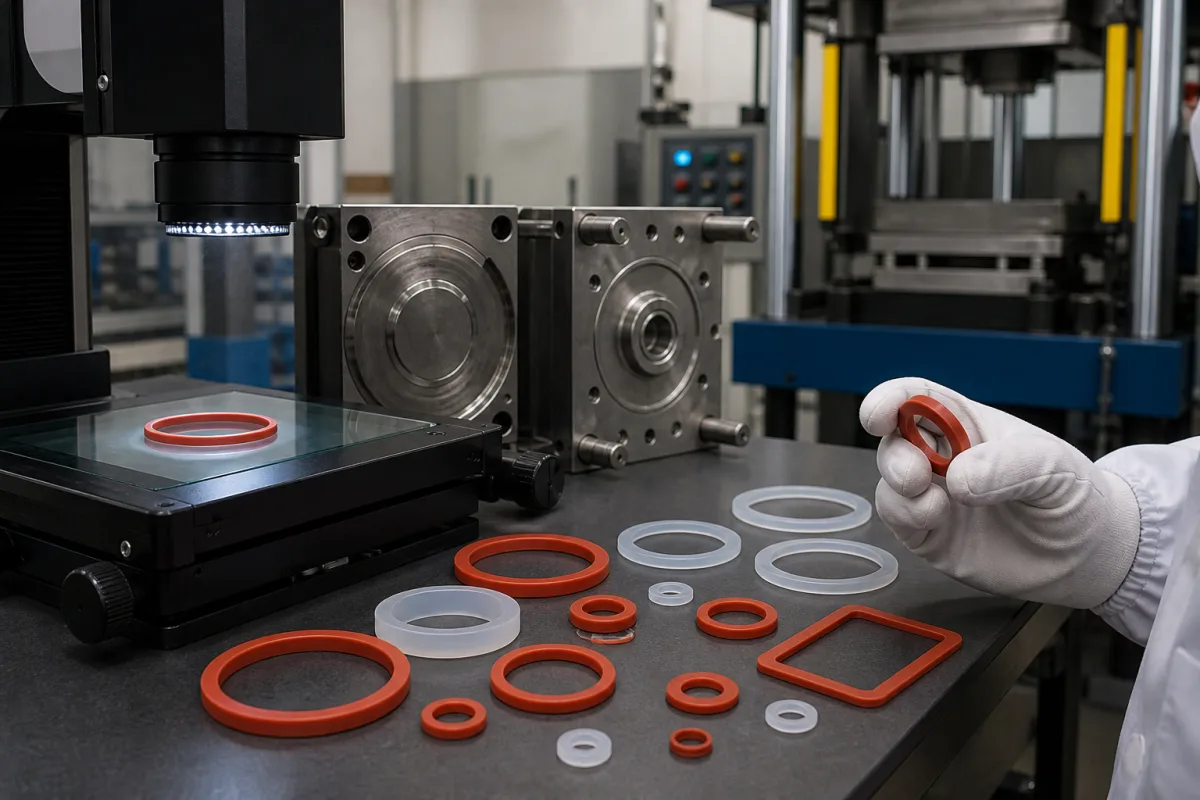
Moulded silicone gaskets · LSR moulding and flash, post-curing, compression set and squeeze, food-contact extraction limits
A high-precision silicone gasket is a seal moulded from solid or liquid silicone rubber (LSR is injection-moulded in a heated tool) to tight dimensions for housings, connectors, appliances and food or medical equipment. Ask three things first: how the moulder controls flash and dimensions, whether and how the gaskets are post-cured, and what compression set and compliance data are available for the finished part.
Moulded silicone gaskets and seals made from liquid or solid silicone rubber, including flat, profiled and overmoulded gaskets. Silicone raw materials, extruded silicone strips, O-ring cord, and gaskets of other elastomers are outside this page.
CNFX editorial research · Sources checked October 11, 2026 · 4 sources
Wacker's processing guidelines for solid and liquid silicone rubber give 150 to 200 °C as the processing range for ELASTOSIL liquid silicone rubber, note that cured silicone can stick to the mould until, "After multiple cycles, a release layer resulting from the silicone rubber forms on the mold surface", and describe demoulding with ejector pins and brush or blower units. Its troubleshooting table lists, as possible causes of overpacking or flash, mould temperature too low, a defective mould, clamping force too low, injection too fast, holding pressure too high or too long, and an incorrect switchover point to holding pressure. [1]
Wacker explains that post-curing improves mechanical properties such as compression set and removes volatiles, and is recommended for platinum-cured grades in food-contact or medical use, where FDA, BfR or European Pharmacopoeia rules apply. Post-cure in a circulating-air oven with fresh air of 100–120 l/min per kg of silicone to avoid deflagration; Wacker gives 4 hours at 200 °C for sheets 2 mm thick, thicker parts a slower start, and never more than 225 °C or 8 hours, to avoid thermal ageing and embrittlement. [1]
Editorial calculation: a post-cure batch of 20 kg of gaskets would need about 2,000–2,400 litres per minute of fresh air (2–2.4 m³/min) by Wacker's rate. [1]
Give the supplier the drawing with critical dimensions and tolerances, hardness and colour, service temperature and media, compression in the joint, compliance required (FDA, BfR, medical), whether post-curing is required, flash and parting-line limits, inspection method, annual volume and packaging.
02
Prove compression set and food-contact compliance
ERIKS's O-ring handbook lists its standard 70 IRHD silicone compound at −60 to +220 °C with compression set of at most 40% after 22 hours at 200 °C under 25% squeeze, against 18–19% for its FKM compounds at the same temperature, and defines compression set as the share of deflection the elastomer fails to recover. It gives about 0.175 mm as the minimum squeeze for O-rings, since very light squeeze leads almost all elastomers quickly to 100% compression set. [2]
Under US 21 CFR 177.2600, silicone elastomers are among the rubbers permitted for repeated food contact. For aqueous food the finished food-contact surface, extracted with distilled water at reflux, may yield no more than 20 mg/in² in the first 7 hours and 1 mg/in² in the next 2 hours; for fatty food, n-hexane extraction allows 175 mg/in² then 4 mg/in². Articles must be cleansed before first use with food. [3]
Editorial calculation: those limits are about 3.1 and 0.16 mg/cm² for aqueous food and 27.1 and 0.62 mg/cm² for fatty food. [3] Wacker's note that post-curing can be essential to meet food-contact rules is a reason to test extraction on post-cured production parts. [1]
03
Read a compression set test on moulded LSR
Marl et al. (Materials, 2024) injection-moulded two 40 Shore A liquid silicone rubbers, Momentive Silopren LSR 2040 and ShinEtsu KEG-2000-40, at a mould temperature of 180 °C, and post-cured half of the LSR samples for 4 h at 200 °C, "since post-curing achieves complete cross-linking". They measured compression set to DIN ISO 815-1: three specimens each compressed by 25%, held at 175 °C for 22 h, then relaxed for 0.5 h before the recovered thickness was measured, with compression set = (h0 − h1) ÷ (h0 − hs) × 100. [4]
The authors report that for both LSRs the non-post-cured samples had a significantly higher compression set than the post-cured samples, which they attribute to cross-linking sites left after moulding that then form in the deformed state during the 175 °C test. Over about 200 days of storage they found no significant change in compression set for the Momentive grade. [4] Editorial note: this supports asking for compression set results measured on post-cured parts, and comparing grades only when squeeze, temperature and time match, since ERIKS quotes its figure at 200 °C and 25% squeeze while this study used 175 °C. [2]
Test item
Value in the study
Use in a gasket order
Compression set method
DIN ISO 815-1, 25% compression, 175 °C, 22 h, 0.5 h recovery. [4]
Name the standard, squeeze, temperature and time on the drawing.
Disk type A moulding
180 °C mould; 105 s (LSR 2040) and 110 s (KEG-2000-40) vulcanization. [4]
Ask for cure time and mould temperature of the production tool.
Xiamen Better lists LSR precision housing seals and gaskets; Qingdao Todo lists moulded silicone seals and gaskets; FromRubber lists silicone seals among its rubber products.
Xiamen Better Silicone Rubber Co., Ltd.
Manufacturing site to be confirmed for the order
Lists LSR precision silicone housing seals and gaskets.
Explore company information and manufacturing capabilities, then discuss the scope of your project with a relevant supplier.
Share this page
Compiled and source-reviewed by the CNFX editorial team.
Each manufacturer above links to the page on that company's own website where the product is listed, with the date we checked it. How we source and review
· Page last updated 13 October 2026
Buyer questions
What causes flash on moulded silicone gaskets?
Wacker lists low mould temperature, a defective mould, low clamping force, fast injection, excessive holding pressure or time and an incorrect switchover point. [1]
How are silicone gaskets post-cured?
In a fresh-air oven, at least 4 hours at 200 °C after heat-up, never above 225 °C or 8 hours, per Wacker. [1]
What compression set does silicone have?
ERIKS lists up to 40% after 22 hours at 200 °C for its standard 70 IRHD silicone. [2]
Does post-curing change the compression set of LSR gaskets?
Marl et al. measured a significantly higher compression set on non-post-cured samples of two LSRs than on samples post-cured for 4 h at 200 °C, in a 25% / 175 °C / 22 h DIN ISO 815-1 test. [4]
Sources and what still needs a direct check
Sources checked 2026-10-11. Wacker is a silicone maker (its guidelines are read from a copy hosted by a parts maker, Modus Advanced); ERIKS values are for its own compounds; a 2024 peer-reviewed study (Materials, open access in PMC) gives measured compression set conditions for two moulded LSRs; 21 CFR 177.2600 is the US rule and other markets have their own.