Strukturierte Fertigungsdaten · 2026

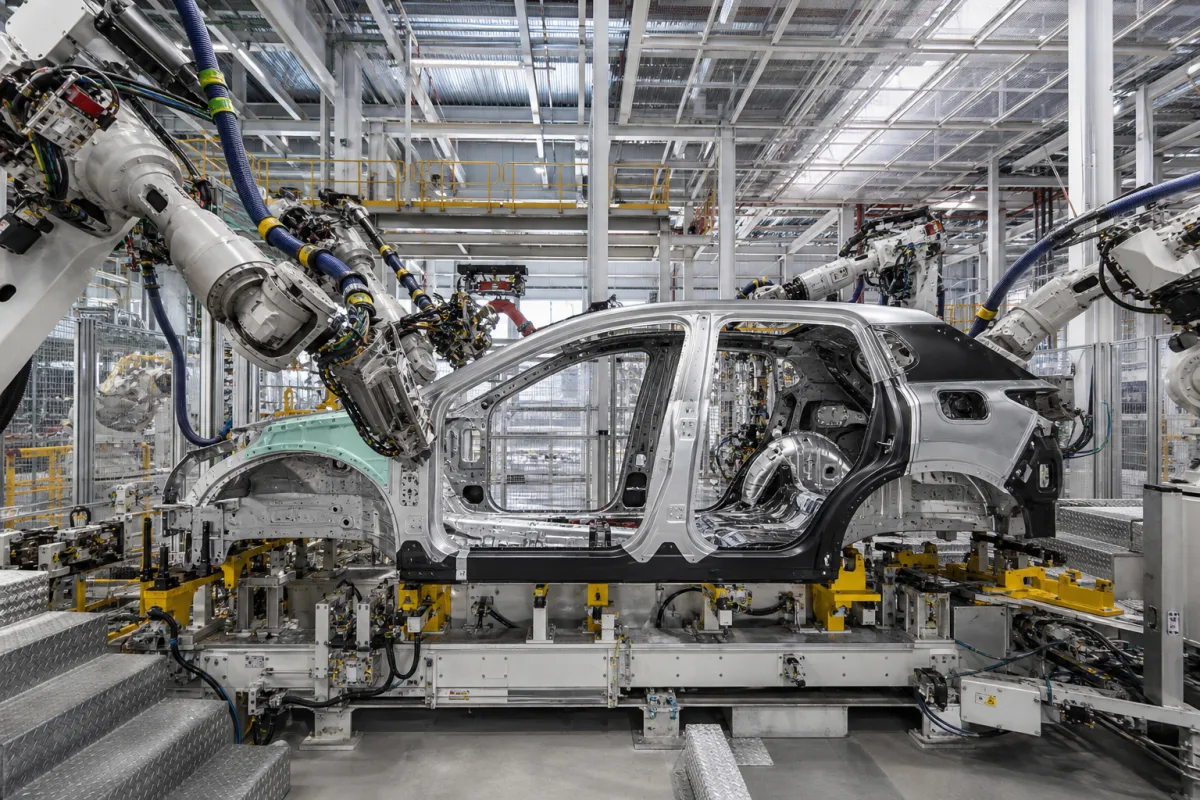
Automated Multi-Material Vehicle Body Assembly System

Auf Basis strukturierter CNFX-Herstellerprofile wird Automated Multi-Material Vehicle Body Assembly System im Bereich Herstellung von Karosserien für Kraftfahrzeuge anhand von Maximaler Durchsatz bis Systemgrundfläche eingeordnet.

Technische Definition und Kernbaugruppe

Ein typisches Automated Multi-Material Vehicle Body Assembly System wird durch die Baugruppe aus Roboter-Schweißstation und Klebstoffapplikationsmodul beschrieben. Für industrielle Anwendungen werden Materialauswahl, Fertigungsprozess und Prüfbarkeit gemeinsam bewertet.

Integrated production line for assembling vehicle body structures from multiple materials

Technische Definition

A comprehensive industrial system designed for the automated assembly of motor vehicle bodies (coachwork) using mixed material construction. This integrated production line coordinates multiple specialized modules to handle steel, aluminum, and composite components through precise joining processes. The system enables high-volume manufacturing with consistent quality control across all assembly stages. It represents a complete industrial solution for modern vehicle body production facilities.

Funktionsprinzip

Coordinated robotic stations sequentially assemble body components through automated material handling, precise positioning, and advanced joining technologies including welding, adhesive bonding, and mechanical fastening.

Technische Parameter

Maximaler Durchsatz
Maximale Produktionskapazität unter optimalen BedingungenEinheiten/Stunde
Systemgrundfläche
Gesamte benötigte Grundfläche für die vollständige InstallationQuadratmeter
Leistungsaufnahme
Durchschnittlicher elektrischer Leistungsbedarf im BetriebKilowatt
Maximale Nutzlastkapazität
Maximales Bauteilgewicht, das von Materialflusssystemen gehandhabt werden kannKilogramm
Positionierwiederholgenauigkeit
Roboter-Positionierkonsistenz über wiederholte OperationenMillimeter
Systemverfügbarkeit
Betriebsverfügbarkeitsprozentsatz über den StandardproduktionszeitraumProzent

Hauptmaterialien

High-strength steel Aluminum alloys Carbon fiber composites Structural adhesives

Komponenten / BOM

Führt automatisierte Schweißoperationen an Stahl- und Aluminiumkomponenten durch
Material: Stahlrahmen mit Roboterarmen
Appliziert strukturelle Klebstoffe für die Verbundstoffverbindung
Material: Gehäuse aus Edelstahl mit Dosiersystemen
Transportiert und positioniert Karosseriekomponenten zwischen Montagestationen
Material: Aluminiumschienen mit servogetriebenen Trägern
Führt automatisierte Maßprüfung und Fehlererkennung durch
Material: Aluminiumrahmen mit Bildverarbeitungssystemen
Koordiniert alle Systemmodule und ermöglicht Betriebsüberwachung
Material: Industrie-PC mit SPS-Steuerungen

FMEA · Fehleranalyse

Ursache → Fehlermodus → Engineering-Maßnahme

Servo motor encoder feedback loss due to electromagnetic interference from welding operations Robot arm overshoot beyond programmed path causing collision with adjacent fixtures Shielded encoder cables with ferrite cores, physical separation of 2 meters from welding stations, differential signal encoding
Adhesive dispensing nozzle clogging from particulate contamination exceeding 50 μm Incomplete adhesive bead application causing structural bond failure under 15 kN shear load 5 μm filtration system with pressure differential monitoring, automated nozzle cleaning cycle every 100 cycles, real-time bead profile laser scanning

Technische Bewertung

Betriebsbereich
Betriebsbereich
0.8-1.2 MPa clamping pressure, 0.1-0.5 mm positioning accuracy, 20-80°C ambient temperature
Belastungs- und Ausfallgrenzen
Clamping pressure exceeds 1.5 MPa causing material deformation, positioning error exceeds 1.0 mm causing misalignment, ambient temperature exceeds 100°C causing adhesive failure
Yield strength of aluminum alloys (typically 200-400 MPa) exceeded by excessive clamping force, thermal expansion coefficient mismatch (23×10⁻⁶/°C for aluminum vs 11×10⁻⁶/°C for steel) causing stress concentrations, adhesive glass transition temperature (typically 80-120°C) exceeded
Fertigungskontext
Automated Multi-Material Vehicle Body Assembly System wird innerhalb von Herstellung von Karosserien für Kraftfahrzeuge nach Material, Prozessfenster und Prüfanforderungen bewertet.

Weitere Produktbezeichnungen

vehicle body assembly line automotive coachwork production system mixed-material body-in-white line

Taxonomie und Suchbegriffe

Suchbegriffe, Aliase und technische Bezeichnungen für diesen CNFX Datensatz.

Eignung und Auslegungsdaten

Betriebsgrenzen
Traglast:0.5-1.2 MPa (clamping/holding systems)
other spec:Material feed rate: 2-15 m/min, Positioning accuracy: ±0.1 mm, Cycle time: 45-180 seconds per station
Einsatztemperatur:15-35°C (operating environment)
Montage- und Anwendungskompatibilität
Aluminum alloy sheetsHigh-strength steel componentsCarbon fiber reinforced polymer panels
Nicht geeignet: Highly corrosive chemical processing environments (e.g., acid baths, salt spray testing chambers)
Auslegungsdaten
  • Annual production volume (units/year)
  • Maximum part dimensions (L×W×H in mm)
  • Material mix ratio (percentage of each material type)

Zuverlässigkeits- und Risikoanalyse

Ausfallmodus und Ursache
Misalignment of robotic welding arms
Cause: Wear in servo motor encoders and harmonic drive gears leading to positional drift
Clamping fixture degradation
Cause: Fatigue failure from cyclic loading and contamination buildup in pneumatic cylinders
Wartungsindikatoren
  • Inconsistent weld quality with visible spatter or incomplete fusion
  • Abnormal high-pitched whining from servo motors during positioning
Technische Hinweise
  • Implement laser alignment verification at start of each shift with automated compensation
  • Establish predictive maintenance using vibration analysis on transfer system bearings and thermal monitoring on welding transformers

Compliance & Manufacturing Standards

Reference Standards
ISO 9001:2015 - Quality Management SystemsANSI/ASME B5.54-2005 - Methods for Performance Evaluation of Computer Numerically Controlled Machining CentersDIN EN 1090-1:2018 - Execution of steel structures and aluminium structures
Manufacturing Precision
  • Positional Accuracy: +/-0.05mm for robotic arm end-effectors
  • Surface Flatness: 0.2mm per meter for assembly fixture plates
Quality Inspection
  • Laser Tracker Metrology for 3D spatial accuracy verification
  • Force/Torque Sensor Calibration for robotic assembly process validation

Hersteller, die dieses Produkt fertigen

Herstellerprofile mit passender Produktionsfähigkeit in China.

Die Herstellerliste dient der Vorrecherche und Einordnung von Fertigungskapazitäten. Sie ist keine Zertifizierung, kein Ranking und keine Transaktionsgarantie.

Beispielhafte Bewertungskriterien aus Einkaufsprozessen

Keine Kundenbewertung und keine Echtzeitdaten. Die Werte zeigen typische Prüfkriterien in RFQ- und Lieferantenbewertungsprozessen.

Technische Dokumentation
4/5
Fertigungsfähigkeit
4/5
Prüfbarkeit
5/5
Lieferantentransparenz
3/5

Die Kriterien dienen als Orientierung für technische Einkaufsprüfungen. Konkrete Kunden, Länder, Bewertungsdaten oder Live-Nachfragen werden nur angezeigt, wenn entsprechende belastbare Daten vorliegen.

Häufige Fragen

What materials can this automated assembly system handle?

This system is designed for multi-material vehicle body assembly, specifically handling high-strength steel, aluminum alloys, carbon fiber composites, and structural adhesives in an integrated production line.

What are the key components included in this assembly system?

The system includes an adhesive application module, automated material handling system, control and monitoring system, quality inspection station, and robotic welding station for complete vehicle body assembly.

What industries is this assembly system designed for?

This automated multi-material assembly system is specifically engineered for the manufacture of bodies (coachwork) for motor vehicles, supporting automotive manufacturers in producing modern, lightweight vehicle structures.

Kann ich Hersteller direkt kontaktieren?

CNFX ist ein offenes Verzeichnis, keine Handelsplattform und kein Beschaffungsagent. Herstellerprofile und Formulare helfen bei der Vorbereitung des direkten Kontakts.

CNFX Industrial Index v2.6.05 · Herstellung von Karosserien für Kraftfahrzeuge

Datenbasis

CNFX-Herstellerprofile, technische Klassifikation, öffentlich verfügbare Produktinformationen und fortlaufende Plausibilitätsprüfung.

Vorläufige technische Einordnung
Diese Seite dient der strukturierten Vorbereitung von Recherche, RFQ und Lieferantenbewertung. Sie ersetzt keine Lieferantenqualifizierung, keine Normenprüfung und keine technische Freigabe durch den Käufer.

Beschaffungsinformationen anfragen für Automated Multi-Material Vehicle Body Assembly System

Informationen zu Einsatzbereich, Spezifikationsgrenzen, Lieferantentypen und RFQ-Vorbereitung anfragen.

Ihre Geschäftsdaten werden nur zur Bearbeitung dieser Anfrage verwendet.

Vielen Dank. Ihre Anfrage wurde gesendet.
Vielen Dank. Ihre Anfrage wurde empfangen.

Fertigung für Automated Multi-Material Vehicle Body Assembly System?

Herstellerprofile mit passender Produkt- und Prozesskompetenz vergleichen.

Herstellerprofil anlegen Kontakt
Erstes Produkt
Nächstes Produkt
Intelligentes Roboter-Karosserie-in-Weiß-Montagesystem