What FULLPCBA offers
Its rigid-flex service page describes coordination of board fabrication, materials and layer construction through qualified manufacturing partners, together with downstream assembly support. The offer is a sourcing-and-integration service, rather than a claim that every bare-board process takes place in Ruisi’s assembly facility.
The company’s main service catalogue includes component sourcing, surface-mount and through-hole assembly, testing and box build. For buyers, the useful conversation is therefore not only “Can you supply this board?” but also “Which assembly and enclosure-integration steps should this project include?” Agree that scope in the quotation.
The company introduction identifies Guangzhou Ruisi Electronics as the manufacturing operation and Guangzhou Ruiyan Electronic Technology as the export arm. Use the company and contracting details stated in your quotation when arranging an order.
Rigid, flexible or rigid-flex: what is the difference?
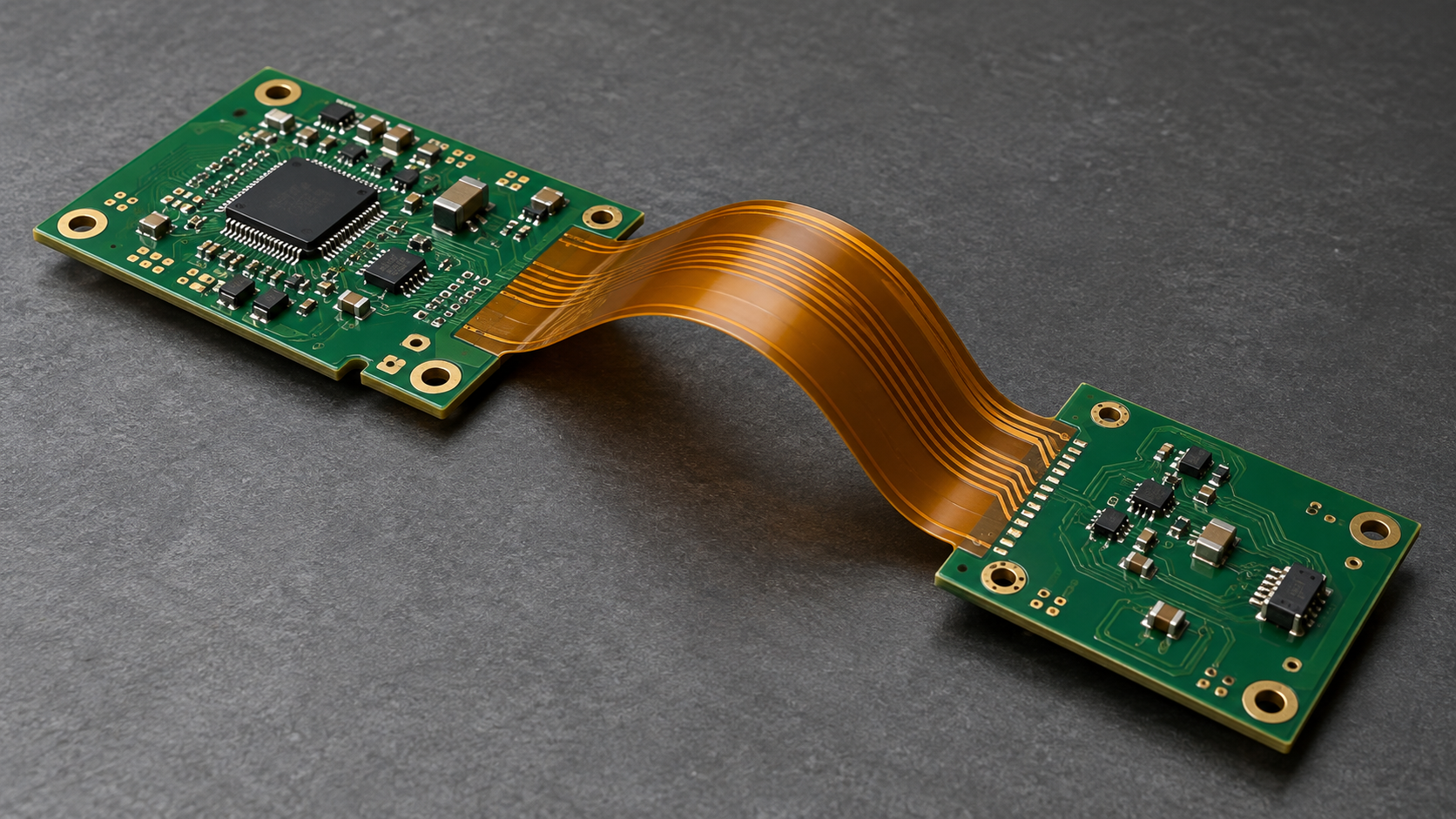
A rigid PCB provides a non-flexing board structure. A flexible PCB uses a flexible circuit substrate. Rigid-flex construction combines rigid areas and flexible interconnections in one board structure, allowing an assembly to occupy more than one plane. This is the basic distinction described in TTM’s flex and rigid-flex overview.
That arrangement can be useful when a product’s circuit sections need to fit around its mechanical layout. It does not mean any finished board can be repeatedly bent. Describe whether the flex is positioned during installation or moves during use; the board construction and validation must fit that duty.
A project brief built around the enclosure
For a compact instrument, a control module or another space-constrained electronic product, start by showing where the circuit sections sit. These are illustrative project types, not a list of FULLPCBA customer deliveries. The following worksheet is a practical way to organise an enquiry:
| Your project decision | Include in the enquiry | Ask FULLPCBA to return |
|---|---|---|
| Board layout inside the product | Board outline, enclosure drawing and intended installed position | Questions about fit and the proposed procurement/assembly scope |
| Flex section duty | Installation-only bending or movement in service; your mechanical requirements | The proposed construction and an agreed way to validate that duty |
| Bare board or assembled board | Fabrication files, revision and whether components are included | A quote that separates board supply, parts and assembly |
| Enclosure integration | Interfaces, mounting details and any supplied mechanical parts | Included box-build tasks and items supplied by the buyer |
| Prototype and repeat orders | Initial quantity, later quantity estimate and required delivery date | A project-specific schedule, commercial terms and revision-control approach |
The worksheet is not a manufacturing specification. Let your design team define the electrical and mechanical requirements, and ask the supplier to confirm a feasible build against those requirements.
From board files to an assembled product
- Define the deliverable. State whether you want bare rigid-flex boards, populated assemblies or an assembly fitted into an enclosure. This prevents a board-only quote being compared with a completed product quote.
- Send a consistent file set. Include the board revision, fabrication information, bill of materials and assembly information relevant to the requested scope. Add the mechanical layout rather than relying on a flat board picture to explain its installed shape.
- Agree the first-build checks. Before ordering, specify the fit checks, electrical tests and deliverables your project needs. Review the supplier’s proposal with your engineer; do not assume a generic testing service covers every product function.
- Keep the approved configuration together. After evaluating the first build, retain the accepted drawings, component list and agreed test requirements as one revision-controlled package for repeat orders.
This is CNFX’s suggested enquiry workflow, not a promise of a particular FULLPCBA lead time or a substitute for the project’s engineering review.
Explore the relevant products on CNFX
Use the platform’s Rigid-Flex PCB page for the combined board category, or Flexible PCB when a flexible circuit is the relevant starting point. Both are product categories associated with FULLPCBA’s CNFX record. General directory descriptions are not model-specific specifications for your order.
FULLPCBA also describes a flexible PCB sourcing service with fabrication partners and assembly integration. If you have not settled the board construction, share the enclosure layout and required function first, then request the appropriate proposal rather than ordering solely by a category label.
Questions before your enquiry
Can I ask for both the rigid-flex board and its assembly?
Yes. FULLPCBA presents board sourcing with assembly integration as part of its offer. State the desired deliverable and request confirmation of the included processes for your design.
Does “flexible” mean the board is suitable for constant movement?
No. The movement requirement needs to be part of the design and agreed validation. A circuit arranged once during installation and one that moves in service should not be treated as the same requirement.
What should I send if the design is still being developed?
Start with the intended product, available drawings, board dimensions, flex-duty description and estimated quantities. Clearly identify what is provisional and ask what additional information is needed for a firm quotation.
Send your project brief to Guangzhou Ruisi Electronics Co., Ltd. (FULLPCBA)
Sources and scope
Company services were checked against the linked FULLPCBA pages on 14 September 2026. This spotlight describes the published service offer, not an independently audited factory assessment. Material choices, bend requirements, test coverage, quantities and delivery terms remain project-specific.