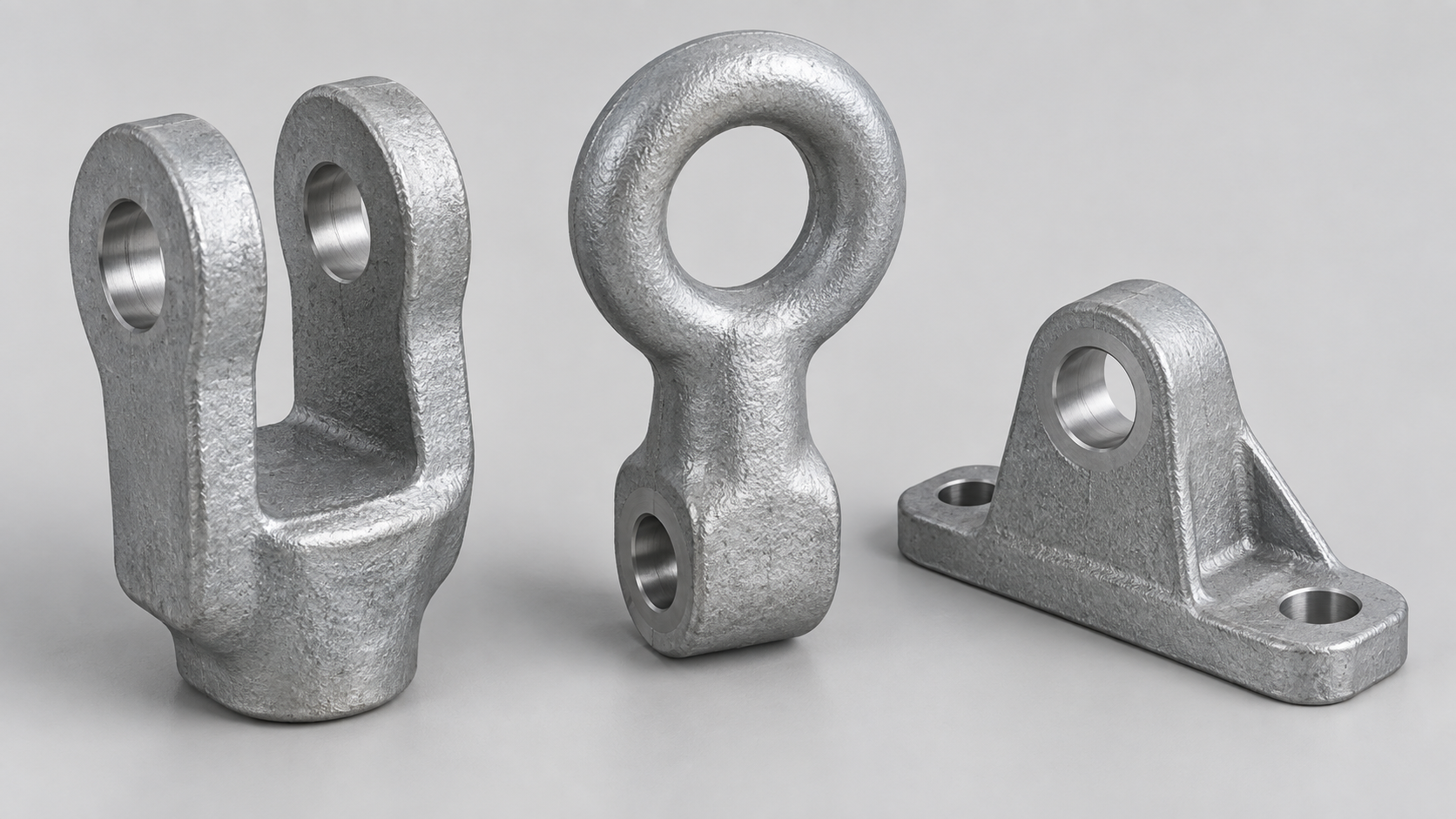
Four product families, one drawing-based supply route
A hardware assembly can contain several individually sourced components. Jiangkai’s offering focuses on the cast body and its specified machining, rather than assuming that every enquiry requires a complete stocked assembly. This makes the range relevant to hardware brands, component buyers and assembly businesses developing their own parts.
The company’s power-line hardware page identifies these product families. The table below is a practical way to organise an enquiry around them; it is not a catalogue of standard dimensions or load ratings.
| Product family | What to discuss with Jiangkai | A useful drawing view |
|---|---|---|
| Clevis-style bodies | The forked body, pin interface and whether any mating pieces belong in the order | Section through both ears and the pin connection |
| Eye and link fittings | The connection shape, opening and contact faces required by your assembly | Opening profile with the mating part identified |
| Cast clamp bodies | The body geometry and the surfaces that meet the rest of the clamp | Assembly section distinguishing the body from bolts and other pieces |
| Connection brackets | The cast shape, mounting pattern and machined seating faces | Mounting view with the drawing datums marked |
Casting and machining brought into the same enquiry
Jiangkai lists resin-coated sand casting, lost-wax investment casting and CNC machining among its manufacturing capabilities. Its regular material scope includes carbon steel, ductile iron and grey iron. The production route and grade are selected for the individual drawing, not simply from the product family’s name.
For the buyer, the useful conversation is about the finished component. Ask the supplier to distinguish the surfaces left as cast from those to be machined, and to return a quotation against one agreed drawing revision. A clevis body, for example, should be described by both its cast form and its finished connection interfaces. A photograph alone does not communicate those interfaces.
You can also separate finishing from the basic casting-and-machining scope. If your drawing requires a coating, include the finish specification and any surfaces that must be protected or treated differently. Jiangkai’s published scope allows these requirements to be discussed per order; it does not establish one universal coating or performance level for the whole range.
Who this range is suited to
Hardware brands developing their own component: start with the controlled design and request the casting and machining scope needed for that part. This keeps the discussion focused on your product rather than on a visually similar catalogue item.
Assembly businesses sourcing a cast body: identify the items you will supply or assemble elsewhere. A body-only quotation can then be compared with an expanded scope without confusing the two.
Buyers preparing a repeat order: keep the drawing number, revision and agreed finish together in the purchase record. If the part changes, send the updated requirements instead of relying on the appearance of a previous sample.
Jiangkai is based in Gaomi, Shandong, China. Its company introduction describes a build-to-print business. Buyers looking for an immediately available standard SKU should ask about that requirement explicitly; this article does not present the illustrated shapes as stock items.
A simple way to compare two supply options
Suppose your business is developing a clevis connection and already sources the pin. Request Option A: finished cast body only. If you also want Jiangkai to quote additional pieces, request Option B: the same body plus an itemised list of those pieces. This is an illustrative purchasing example, not a reported customer project.
Keep the body drawing unchanged between the options. Put quantity, machining, finish and required inspection records beside each option. Then ask the supplier to identify what is included, what needs clarification and the proposed sample process. The comparison becomes useful because the difference in scope is visible, not because one headline unit price looks smaller.
Before authorising production, your responsible engineering team should approve the part design and its intended application. Review any proposed changes to material or interfaces through that team. At sample review, match the part identification and supplied inspection records to the approved drawing. This article is a product introduction, not an installation procedure or an approval for use on an energised line.
Questions about power-line hardware
What is power-line hardware?
It is the hardware used to support or connect components in an overhead line system. In this spotlight, the term refers specifically to Jiangkai’s cast and machined fitting bodies. It does not mean electronic power-line filters, and it does not imply that Jiangkai supplies every item in a complete line system.
Does Jiangkai manufacture the utility pole itself?
The product offering reviewed here is for fitting components, not wood utility poles. If your project includes poles, insulators and cast fittings, keep those requirements separate so each supplier can answer for its actual scope.
Can I order from the illustration?
Use the illustration to recognise the product families, then send your drawing or technical specification. Exact geometry, material, finishing and acceptance requirements must be agreed for the real part.
Explore Jiangkai on CNFX
See Shandong Jiangkai Metal Products Co., Ltd.’s manufacturer profile for its listed product lines and contact route. For broader material terminology, CNFX also has a ductile iron casting reference; its general figures are not Jiangkai product specifications. If you have a clevis, eye/link, clamp-body or bracket project, introduce the part and drawing revision in your enquiry. The factory can then respond to a defined manufacturing request.
Sources and scope
Prepared by CNFX from the linked Jiangkai company and capability pages, checked on 15 September 2026. The two-option enquiry example is an editorial planning aid, not a customer case study. Final configuration and commercial terms are agreed with the supplier. Suggest a correction.