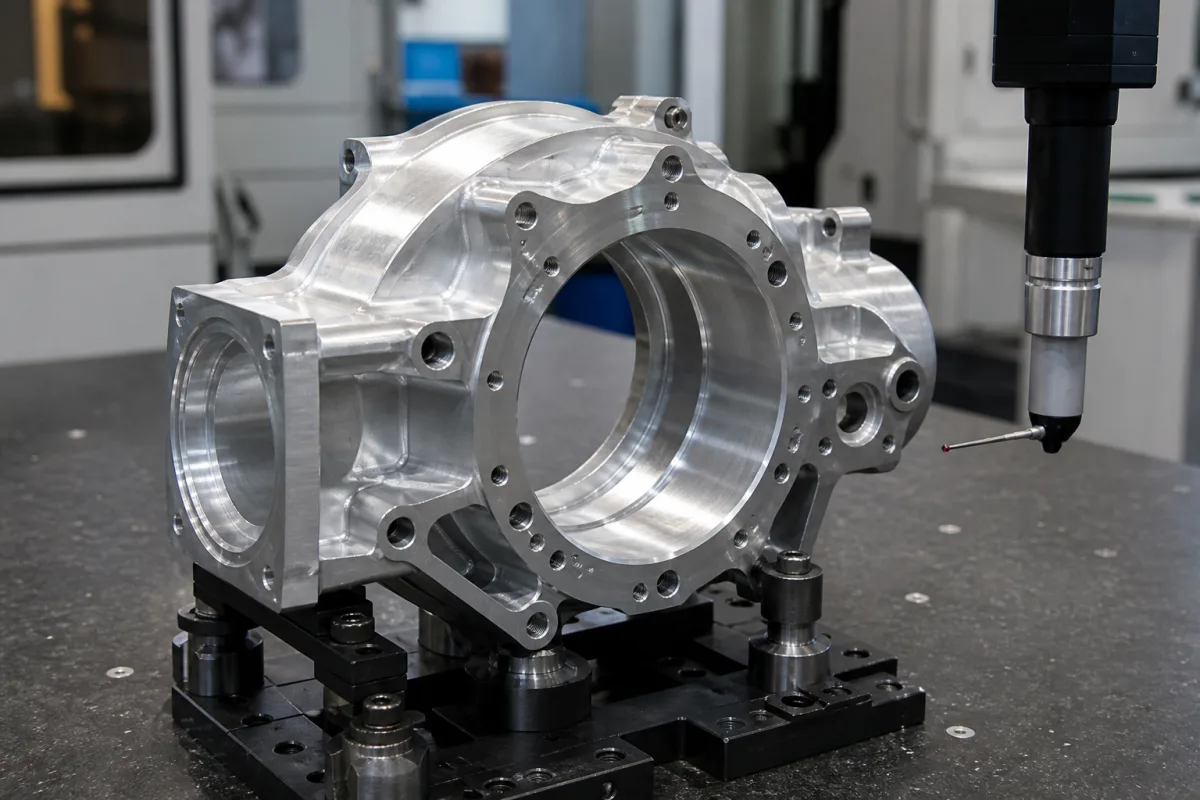
Aluminium CNC-machined bearing housing: bored seats for steel bearings, fit against thermal expansion, and bore accuracy
Machined aluminium bearing seats · fit class chosen for a steel outer ring in a housing that expands about twice as fast, bore form and finish, and tolerance rings when the fit runs loose
A bearing housing milled and bored from aluminium is lighter than cast iron and can carry flanges, mounting faces and two or more bearing seats in one part, but the bearing inside is steel. As the assembly warms, the aluminium bore grows faster than the outer ring, so a fit that is tight at room temperature can turn loose in service and let the ring creep. The order has to state the seat size and fit class with the operating temperature in mind, the form and finish of the bore, and how the outer ring is retained.
Custom one-piece aluminium housings machined from billet, plate or castings with bored seats for steel rolling bearings: gearbox and drive housings, motor end housings, flanged and block-type housings made to a drawing, including the bearing seat fit, bore form and finish, and outer ring retention. Standard split plummer block and UCP mounted units in cast iron or steel are covered on the Pillow block housing page, heavy-duty split housings on the Heavy-duty split bearing housings page, pressing the bearing into its housing on the Bearing assembly page, and machined aluminium brackets without bearing seats on the Aluminum mounting bracket page.
CNFX editorial research · Sources checked October 12, 2026 · 5 sources
Choosing the seat fit when the housing expands about twice as fast as the outer ring
Dynaroll's table of linear expansion coefficients lists 52100 chrome bearing steel at 12 ppm/°C and aluminium at 23 ppm/°C. [4] JTEKT's recommended housing fits for radial bearings run from H7 and G7 for a stationary outer ring that must slide, through JS7 and K7 for indeterminate loads, to M7, N7 and P7 for rotating outer ring loads, but its remarks state the table is applicable to cast iron or steel housings. [1]
NTN lists housing material among the questions to answer before consulting fit tables, noting that an aluminium housing expands with temperature. It warns that too loose a fit lets the ring slip or creep, causing wear or vibration and in the worst cases ring fracture or seizure, while an excessive press fit eliminates the bearing's internal clearance and raises operating temperature. [3] Editorial calculation: with Dynaroll's coefficients, the seat of a 52 mm outer ring opens relative to the ring by 52 mm × (23 − 12) × 10⁻⁶ ≈ 0.57 µm for every °C both parts rise, so a 40 °C rise takes away about 23 µm of interference. [4]
USA Tolerance Rings gives a measured case: a 6205 ball bearing (about 2.00 in OD) pressed into an aluminium housing with 0.0012 in interference needed 500 lb to install and became loose at 170 °F. [5] Editorial calculation: 0.0012 in is about 30 µm; at 0.57 µm per °C that interference is used up after about 53 °C of rise, which from an assumed 70 °F (21 °C) assembly temperature is about 74 °C (165 °F), close to the 170 °F reported. [5][4]
Editorial note: raising the room-temperature interference to cover the hot case makes the fit tighter when cold and the press-in force higher, so give the supplier both the lowest and highest housing temperatures and ask for the fit to be checked at each.
State the bearing designation and outer diameter, which ring rotates relative to the load, the load level, the housing temperature range at assembly and in service, and whether the outer ring must slide axially.
02
Bore roundness, cylindricity, shoulder runout and roughness for the seat
JTEKT says housing fitting surfaces may be finished by turning or fine boring under general operating conditions, but need a ground finish where minimum vibration and noise are required or conditions are severe. [2]
For miniature precision ball bearings up to 30 mm outside diameter JTEKT gives the housing bore in micrometres: +2.5/−2.5 µm under a rotating outer ring load, giving 2.5 µm interference to 7.6 µm clearance with an ABMA 5P bearing, and +5/0 µm for a rotating inner ring at middle or high speed, giving 0 to 10.1 µm clearance. [1]
Editorial calculation: measured with a steel gauge, a 20 mm aluminium bore reads about 20 × (23 − 12) × 10⁻⁶ ≈ 0.22 µm larger for each °C above the reference temperature, so a 5 °C difference uses about 1.1 µm, roughly a fifth of a 5 µm band. [4] Ask for the inspection report to give bore diameter, roundness and cylindricity from a coordinate measuring machine, with the measuring temperature.
Put the bearing class, fit class, roundness, cylindricity, shoulder runout and Ra on the drawing for each seat, and state whether bores in line must be machined in one setup.
03
Holding the outer ring with a tolerance ring instead of a press fit
USA Tolerance Rings describes AN-style rings, with waves on the inside, for securing a bearing outer race to a housing bore, and states that unless the housing material has an expansion coefficient similar to the bearing races, a press fit or slip fit at room temperature can loosen at higher temperatures, first letting the outer race slip and then destroying the bearing. [5]
In its 6205 test, the same bearing with a tolerance ring needed 320 lb to install and still had 230 lb of axial retention at about 270 °F. [5] It says tolerance rings allow housing diameter tolerances to be relaxed from a few ten-thousandths of an inch to a few thousandths, and recommends 8% to 12% initial wave compression with a safety factor of at least two for cyclic loads; rings in 301 stainless are stable to 450 °F and in hardened carbon steel to 250 °F. [5]
Editorial note: a tolerance ring needs its own groove or bore size in the housing, so the choice between press fit and tolerance ring has to be made before the housing is machined.
04
Information for an aluminium bearing housing quote
Paste it into your enquiry below or into an email to a maker, then replace every bracket.
Housing: [drawing; alloy and temper; billet, plate or casting]
Seats: [bearing designation; outer diameter; fit class or limits; in-line bores]
Temperature: [assembly; minimum and maximum in service]
Load: [rotating ring; load level; outer ring axial float]
Bore quality: [roundness; cylindricity; shoulder runout; Ra; measuring temperature]
Retention: [press fit; tolerance ring; other]
Inspection: [CMM report per seat]
Explore company information and manufacturing capabilities, then discuss the scope of your project with a relevant supplier.
Share this page
Compiled and source-reviewed by the CNFX editorial team.
Each manufacturer above links to the page on that company's own website where the product is listed, with the date we checked it. How we source and review
· Page last updated 13 October 2026
Buyer questions
Can I use a standard bearing fit table for an aluminium housing?
JTEKT states its recommended housing fits apply to cast iron or steel housings, and NTN names housing material among the questions to answer before using fit tables. [1][3]
How fast does an aluminium bore open around a steel bearing?
By editorial calculation from Dynaroll's 23 and 12 ppm/°C, about 0.57 µm per °C on a 52 mm seat. [4]
When does a press-fitted bearing come loose in aluminium?
In USA Tolerance Rings' test a 6205 bearing with 0.0012 in interference came loose at 170 °F. [5]
Sources and what still needs a direct check
Sources checked 2026-10-12. JTEKT (Koyo), NTN and Dynaroll publish bearing engineering guidance; USA Tolerance Rings publishes test data for its own tolerance rings.