Editorial Technical Reference

Aluminum CNC Machining Cell

This page explains how Aluminum CNC Machining Cell is classified within Aluminum CNC Machining. Technical values and manufacturer relationships are research references; confirm the current specification and supplier evidence for each order.

Technical Definition & Core Assembly

The Aluminum CNC Machining Cell is a modular production system that integrates multiple CNC machines, material handling, and automation for aluminum parts manufacturing.
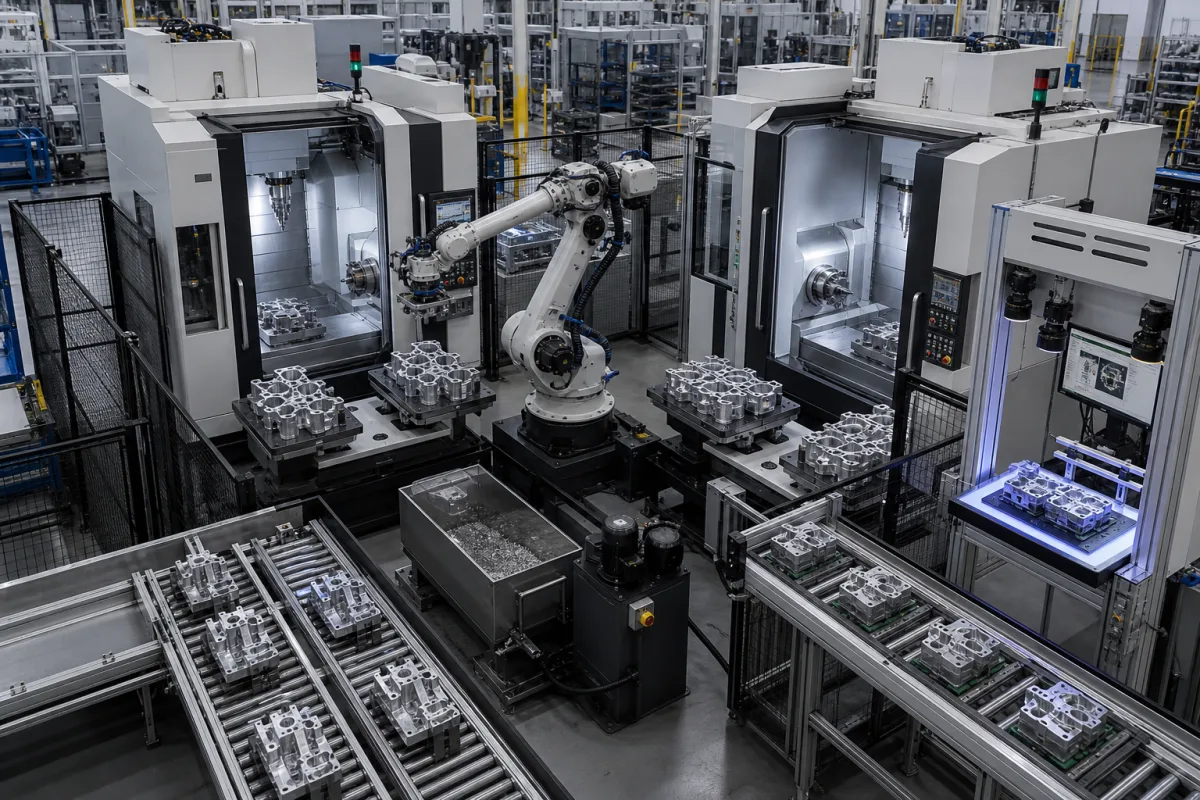
Representative product image. Confirm appearance and specifications with the manufacturer.

Product Specifications

Technical details and manufacturing context for Aluminum CNC Machining Cell

Definition
The Aluminum CNC Machining Cell is a modular production system that integrates multiple CNC machines, material handling, and automation for aluminum parts manufacturing. It coordinates milling, turning, and drilling operations through automated work transfer and centralized control. The system enables continuous production flow with minimal manual intervention while maintaining precision tolerances. This integrated solution optimizes floor space utilization and production efficiency for aluminum component manufacturing.

The cell typically comprises 4 to 8 processing stations, each capable of performing specific operations. The maximum workpiece size is 800×800×400 mm. The control system is based on Siemens 840D, providing centralized coordination of all operations. The spindle speed ranges from 12,000 to 24,000 rpm, suitable for high-speed aluminum machining. Positioning accuracy is ±0.005 mm per axis, and repeatability is ±0.003 mm per axis, both per ISO 230-2. Rapid traverse rate is 30–60 m/min on X/Y/Z axes. The system requires a power supply of 380 kW ±10% per IEC 60038. Operating temperature range is 5–40 °C, and humidity range is 20–80% RH (non-condensing), per IEC 60721-3-3. Protection class is IP54–IP65 for the control cabinet, per IEC 60529. Machine weight is 8,000–12,000 kg depending on configuration, and footprint is approximately 3500×2500×2800 mm.

Materials used in construction include aluminum alloy for structural components, steel for the frame, industrial-grade plastics for covers and guides, and copper wiring for electrical systems. The system is designed for continuous production with minimal manual intervention, but it requires proper setup, programming, and maintenance. For specific applications, verify model-specific values and standards with the legal manufacturer or supplier.
Working Principle
Automated material handling transfers aluminum workpieces between CNC machines for sequential milling, turning, and drilling operations under centralized control system coordination. The system uses a robotic or gantry-based loader to move parts from one station to the next, ensuring precise positioning and timing. The Siemens 840D controller manages the entire process, synchronizing machine operations and material flow. This allows for unattended production runs, reducing labor costs and increasing throughput. The system is designed to maintain tight tolerances and high surface quality, typical for aluminum components.
Common Materials
aluminum alloy, steel structural frame, industrial-grade plastics, copper wiring
Technical Parameters
ParameterTypical rangeNotes & selection driver
Maximum Workpiece SizeRequired800×800×400 mmLargest processable dimension
Number of StationsRequired4–8 unitsProcessing stations in system
Control System TypeRequiredSiemens 840DAutomation controller brand/type
Power RequirementRequired380 ±10% kWTotal system power consumptionIEC 60038
Spindle Speed12000–24000 rpmHigh speed for aluminum
Positioning Accuracy±0.005 mmPer axisISO 230-2
Repeatability±0.003 mmPer axisISO 230-2
Rapid Traverse Rate30–60 m/minX/Y/Z axes
Operating Temperature5–40 °CAmbientIEC 60721-3-3
Humidity Range20–80 % RHNon-condensingIEC 60721-3-3
Protection ClassIP54–IP65Control cabinet IP65IEC 60529
Machine Weight8000–12000 kgDepending on configuration
Footprint (L×W×H)3500×2500×2800 mmApproximate

Ranges are indicative industry figures for RFQ preparation, not a supplier commitment. Confirm every value and standard with the legal manufacturer before ordering.

Components / BOM

Industry Taxonomies & Aliases

Commonly used trade names and technical identifiers for Aluminum CNC Machining Cell.

Industrial Ecosystem & Supply Chain Structure

Complementary Systems
Downstream Applications
Specialized Tooling

Application Fit & Sizing Matrix

Operational Limits
pressure: Atmospheric (no pressure containment required)
other spec: Max part size: 500x400x300mm, Max spindle speed: 24,000 RPM, Max feed rate: 30 m/min, Chip load: 0.1-0.3 mm/tooth
temperature: 15-35°C (operating environment)
Media Compatibility
✓ Aluminum alloys (6061, 7075, etc.) ✓ Plastics (ABS, Nylon, Delrin) ✓ Soft metals (brass, copper)
Unsuitable: Hardened steels (>45 HRC) or abrasive composites
Sizing Data Required
  • Maximum part dimensions (LxWxH)
  • Required production volume (parts/hour)
  • Tolerance requirements (± mm)

Reliability & Engineering Risk Analysis

Failure Mode & Root Cause
Tool wear and breakage
Cause: High-speed machining of aluminum generates heat and chips that cause abrasive wear on cutting tools, leading to premature failure and potential catastrophic breakage during operation.
Spindle bearing degradation
Cause: Continuous high-RPM operation combined with aluminum chip contamination in lubrication systems leads to bearing pitting, overheating, and eventual seizure or vibration issues.
Maintenance Indicators
  • Unusual high-pitched whining or grinding noises from spindle during operation
  • Visible aluminum buildup or discoloration on spindle housing indicating overheating
Engineering Tips
  • Implement predictive maintenance through vibration analysis and thermal imaging to detect spindle bearing issues before catastrophic failure
  • Optimize cutting fluid filtration and chip management systems to prevent aluminum chip recirculation that accelerates tool and component wear

Indicative industry ranges for design and RFQ preparation. Confirm the exact figures and applicable standard with the manufacturer before specifying.

Compliance & Manufacturing Standards

Applicable Standards
ISO 2768-1:1989 (General tolerances for linear and angular dimensions) ANSI B4.1-1967 (Preferred Limits and Fits for Cylindrical Parts) ASTM B221-21 (Standard Specification for Aluminum and Aluminum-Alloy Extruded Bars, Rods, Wire, Profiles, and Tubes)

Quoted from the published standard.

Manufacturing Precision
  • Bore: +/-0.02mm
  • Flatness: 0.1mm
Quality Inspection
  • Dye Penetrant Test
  • Spectrographic Analysis

Manufacturers of Aluminum CNC Machining Cell

Manufacturer profiles associated with Aluminum CNC Machining Cell.

Sourcing Aluminum CNC Machining Cell from China?
Tell us your specification and target quantity — we will match it against manufacturer records and come back with the factories that fit.
Request manufacturers We manufacture this

Manufacturer listings support early research and capability understanding. They are not certification, ranking, or transaction guarantees.

Technical documentation
Request current drawings, revision history, and a signed specification sheet.
Manufacturing capability
Verify equipment lists, process limits, capacity, and representative production evidence.
Inspection readiness
Confirm test methods, calibrated equipment, sampling plans, and traceable reports.
Supplier transparency
Check the legal entity, factory address, ownership, certifications, and direct contacts.

CNFX does not score or rank suppliers. Buyers must verify all claims and documents with the legal manufacturer before ordering.

Frequently Asked Questions

What is the maximum workpiece size the cell can handle?

The maximum processable dimension is 800×800×400 mm. This is a reference value; confirm with the manufacturer for your specific workpiece.

What control system does the cell use?

The control system is based on Siemens 840D. This is a standard configuration; verify the exact version and options with the supplier.

What are the positioning accuracy and repeatability?

Positioning accuracy is ±0.005 mm per axis, and repeatability is ±0.003 mm per axis, both per ISO 230-2. These values are reference and should be verified for the actual model.

What are the environmental operating conditions?

The cell operates in ambient temperatures of 5–40 °C and humidity of 20–80% RH (non-condensing), per IEC 60721-3-3. Ensure your facility meets these conditions.

Data Basis

Editorial classification, named public sources where available, and source-reviewed manufacturer records.

Preliminary Technical Classification
This page supports structured research, RFQ preparation, and supplier evaluation. It does not replace buyer-led supplier qualification, standards review, or technical approval.
Buyer enquiry

Request manufacturing insight for Aluminum CNC Machining Cell

Ask for use case, specification boundaries, supplier type, and RFQ preparation information for this product.

Where it goes
Straight to the CNFX editorial desk, and to the manufacturer if this product is linked to a claimed profile. Nothing is broadcast to a supplier list.
Your details stay here
We do not sell or rent enquiry data, and we do not add you to a mailing list. Used only to answer this request.
No commission, no middleman
CNFX is a directory. We take no cut of any order and never negotiate on a supplier's behalf.
What we don't claim
A listing is not an endorsement. Qualify every supplier and verify every figure yourself before ordering.

Your business information is used only to process this request.

Thank you! Your message has been sent. We'll respond within 1–3 business days.
Sorry, we couldn't send your message. Please try again, or email us at contact@cnfx.com.

Need to Manufacture Aluminum CNC Machining Cell?

Compare manufacturer profiles with relevant product and process capability.

Previous Product
Aluminum CNC Machined Bearing Housing
Next Product
Aluminum CNC Multi-Axis Machining Center
Get QuotesChat