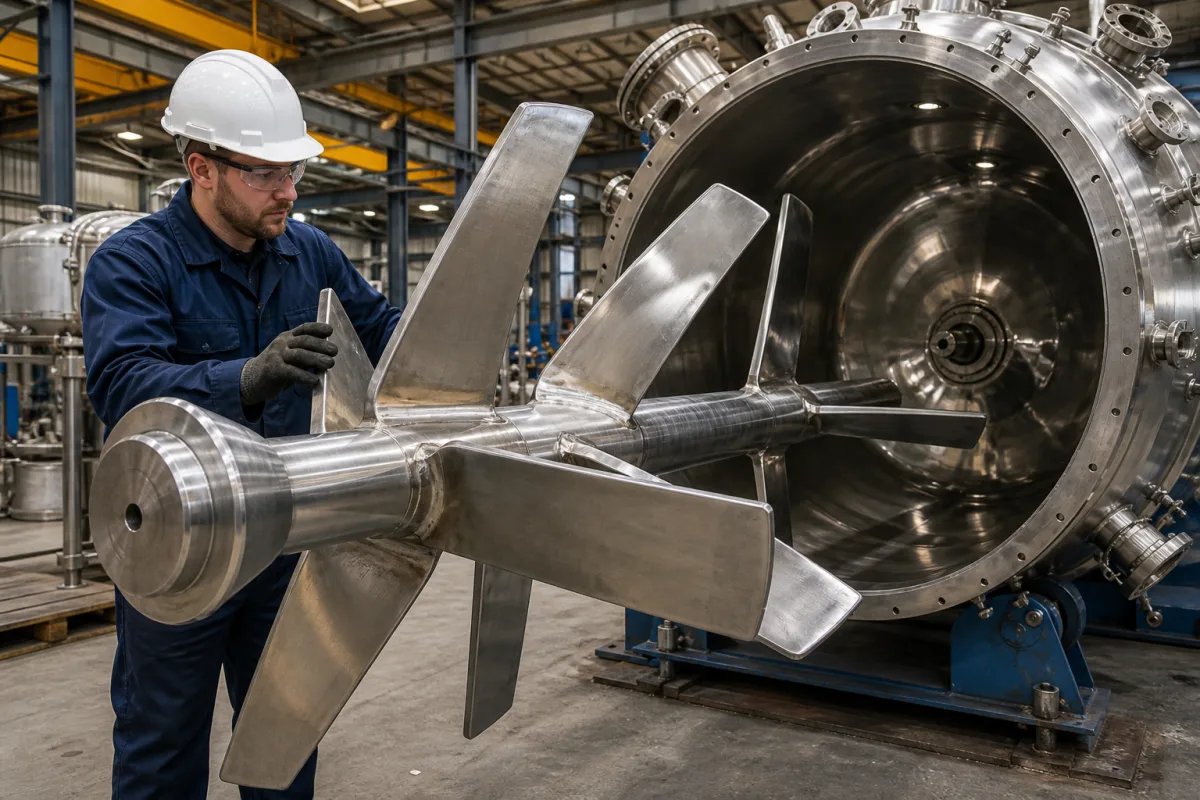
Chemical reactor agitator blade (agitator impeller)
Agitator impellers and blades for chemical reactors · Radial (Rushton) versus axial (pitched-blade) types, power number and power draw, pitch angle and blade count, baffles, diameter, material and balancing
An agitator blade, or impeller, mounted on a reactor's agitator shaft moves and shears the liquid to blend, suspend solids, disperse gas or transfer heat; radial-flow turbines such as the Rushton turbine push liquid outward and, with power numbers above 3, generate high turbulence, while pitched-blade turbines and propellers drive axial flow. Ask three things first: which flow pattern and shear the process needs, how much power the impeller will draw at your speed and diameter, and which material, construction and balance suit the reactor.
Impellers and agitator blades for chemical reactors and stirred tanks: radial turbines, pitched-blade turbines, propellers and hydrofoils, welded or bolted to the shaft. Complete agitator drives, shafts and seals, ribbon and anchor agitators for viscous products and static mixers are outside this page except where compared.
CNFX editorial research · Sources checked October 12, 2026 · 4 sources
A study of disc-blade impellers in the Brazilian Journal of Chemical Engineering defines the power number as Np = P/(ρN³D⁵) and the impeller Reynolds number as Re = ND²ρ/μ, and summarises published values: radial-flow Rushton turbines about 4 to 6, pitched-blade axial-flow turbines 1.5 to 3.0, with low-power-number impellers (0.1–0.5) giving moderate flow and high-power-number impellers (above 3) high turbulence. In its own tests, power number rose linearly with disc-blade intercepting angle from 30° to 90° and fell beyond 90°. [1]
Editorial calculation: a 1.0 m impeller at 100 rpm (1.67 rev/s) in water (1,000 kg/m³) has ρN³D⁵ ≈ 4,630 W, so a pitched-blade turbine at Np 1.5–3.0 draws about 7–14 kW and a Rushton turbine at Np 4–6 about 19–28 kW, before motor and gearbox losses. Ask the supplier for the power number of the offered impeller in your vessel geometry. [1]
Editorial note: describe the process duty (blending, solids suspension, gas dispersion, heat transfer, viscosity range) so the supplier can propose the impeller type.
A maker's impeller line shows how blade geometry is matched to duty. Lightnin (ITT Flow Technologies) lists the A200 as a classic 45° pitched-blade turbine balancing axial flow and shear for general mixing; the A320 high-solidity hydrofoil for blending across a wide viscosity range with modest shear, for which it claims blend times reduced by up to 50%; the A315 for gas–liquid dispersion, which it claims improves mass transfer by up to 30% against Rushton turbines while cutting shear rates by up to 75% and energy use by up to 45%; and the A340 up-pumping hydrofoil for multi-phase duties such as fermentation, polymerisation and hydrogenation, with gas induction from the surface and foam control. [4] Editorial note: these percentages are the maker's own comparisons; ask for power number, flow number and test data on a fluid like yours before relying on them, and compare with the independent power-number measurements above. [4][1]
Give the supplier the vessel diameter and liquid height, baffles, liquid density and viscosity range, process duty, existing shaft diameter and speed, impeller type and number on the shaft, clearance from the bottom, materials of construction and corrosion allowance, operating temperature and pressure, attachment (welded hub, bolted, split), balancing and documentation needed.
02
Fit the impeller to the vessel and baffles
A study published on PMC tested eight high-speed impellers (Rushton and Smith turbines, pitched-blade turbines with six or three blades at 90°, 60°, 45° and 30°, and a propeller) with a diameter one-third of the vessel diameter in a 0.6 m vessel with tubular baffles. It found the highest power numbers with the radial-flow Rushton turbine, that baffle geometry affected the Rushton system the strongest, and that power numbers fell as the clearance between baffles and vessel wall increased where axial-radial circulation was promoted. [2]
The BJCE study's standard set-up used four full baffles of width T/10, an impeller diameter of T/3 and a clearance of T/3 from the vessel bottom. [1] Editorial note: give the supplier the vessel's baffle number, width and position, since power draw and flow depend on them, and ask for the impeller's balancing grade and weld inspection for large stainless impellers.
03
Compare impellers by the power needed to lift solids off the bottom
For solids suspension duty, a Czech Technical University study in Chemical and Process Engineering compared a standard pitched four-blade turbine with three hydrofoil designs (a profiled high-solidity blade, a trapezoidal folded blade and a modified propeller) in a 300 mm dish-bottomed vessel with four radial baffles of width 0.1·D, a vessel-to-impeller diameter ratio of 3 and liquid height equal to vessel diameter. The impellers pumped downward, with the turbine set at 0.5 d and the hydrofoils at 0.75 d above the bottom. Glass particles of 0.18 mm to 0.9 mm were tested at volumetric concentrations from 0.025 to 0.4. The measured turbulent power numbers were 1.52 for the pitched-blade turbine, 0.9 for the two folded or profiled hydrofoils and 0.65 for the modified propeller. [3]
The authors found that the pitched-blade turbine needed the highest power for off-bottom suspension and ranked the profiled high-solidity hydrofoil lowest, a ranking they do not claim for every particle size and concentration, which they link to its higher pumping efficiency; they add that this impeller is heavier and costlier to make, so for less concentrated suspensions the lighter hydrofoils were recommended. The modified propeller needed the highest speed to suspend particles. Their power numbers from clear liquids can be applied to suspensions by using the suspension density. [3] Editorial note: for slurry reactors, ask the supplier for the just-suspended speed and the power at that speed for your solids size and concentration, not only the power number.
04
Blades, disc, hub and the baffles they work against
Explore company information and manufacturing capabilities, then discuss the scope of your project with a relevant supplier.
Share this page
Compiled and source-reviewed by the CNFX editorial team.
Each manufacturer above links to the page on that company's own website where the product is listed, with the date we checked it. How we source and review
· Page last updated 13 October 2026
Buyer questions
What is the power number of a Rushton turbine versus a pitched-blade turbine?
Published values summarised in BJCE are about 4–6 for Rushton turbines and 1.5–3.0 for pitched-blade axial turbines. [1]
How do I estimate impeller power?
P = Np × ρ × N³ × D⁵, with N in rev/s and D in metres (BJCE). [1]
Do baffles change agitator power?
Yes; the PMC study found baffle geometry changed power number, the strongest for the Rushton turbine. [2]
Does a hydrofoil impeller use less power than a pitched-blade turbine for suspending solids?
In a Chemical and Process Engineering study, the pitched-blade turbine (power number 1.52) needed the highest power for off-bottom suspension, and the authors rank a profiled high-solidity hydrofoil (power number 0.9) lowest, a ranking they do not claim for every particle size and concentration. [3]
Which impeller suits gas–liquid dispersion in a reactor?
Makers offer dedicated gas-handling hydrofoils; one claims up to 30% better mass transfer than a Rushton turbine with up to 75% lower shear and 45% less energy, which should be checked with test data. [4]
Sources and what still needs a direct check
Sources checked 2026-10-12. Both sources are peer-reviewed open-access studies; power numbers depend on geometry, so confirm values for your vessel.