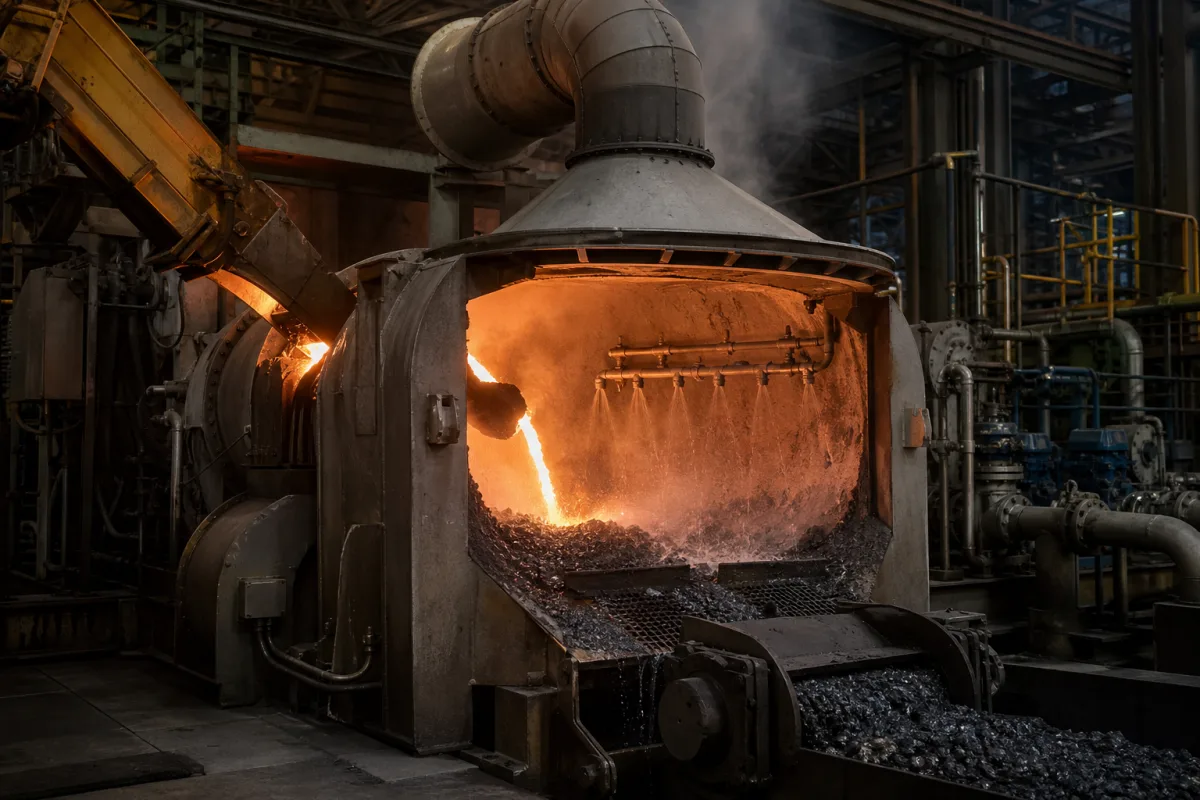
Slag granulation chamber for blast furnace slag: the blowing box, nozzle plate and quench zone where a molten slag stream is broken into glassy granules by water jets, or by a spinning cup in dry granulation
Where blast furnace slag meets the water jets · blowing box and nozzle plate, water-to-slag ratio, slag and water temperatures, and what they do to the density and size of the granules; the rotary-cup dry route that skips the water
A blast furnace releases roughly 300 kg of molten slag for every tonne of iron. To turn it into a glassy sand that cement and concrete makers will buy, the slag stream leaving the runner is hit by high-velocity water from a blowing box, breaks into droplets and freezes before it can crystallise; the slurry then runs to an agitation tank and a dewatering filter or drum. What comes out — density, grain size, how much is glass — is set in the first metre, by the temperature of the slag, the temperature and velocity of the water, the water-to-slag ratio and the layout of holes in the nozzle plate. A dry alternative throws the slag off a spinning cup into air, recovering heat instead of making steam.
The granulation zone of blast furnace slag treatment: blowing boxes and nozzle plates, the granulation chamber or head where slag and water meet, the cold runner and agitation tank immediately after it, the operating conditions that set granule density and size, and dry granulation by rotary cup atomiser. Blast furnaces with their casthouse and slag runners are covered on the Blast furnace page; BOF and EAF steel slag handling, pit cooling and ageing on the Steel slag handling and processing system page; hot slag conveyors on the Slag conveyor and Slag cooling conveyor pages; spray headers for urea and sulphur melt granulation drums on the High-pressure nozzle array for melt granulation drums page; electroslag remelting furnaces on their own page.
CNFX editorial research · Sources checked October 13, 2026 · 3 sources
Slag temperature, water temperature and water/slag ratio: what moves granule density and size during a tap
JFE Steel researchers sampled granulated slag every 20 minutes during tapping at No. 6 blast furnace, East Japan Works (Chiba), recording slag surface temperature, blowing water flow and temperature, and the water/slag ratio, then repeated the conditions in a laboratory granulator. Over a tap the taphole widens, slag flow rises and the water/slag ratio falls, while slag and water temperatures climb; the unit weight of the granules fell as the tap went on. [1]
The study's central finding is a conflict: coarse grains came with low density and fine grains with high density, so the existing plant could make either small dense grains or large light ones, but not the coarse, dense granules needed for concrete fine aggregate, which calls for a unit weight of 1.45 kg/l or more. Steam films around the hot droplets and gas released from the slag foam the grains and increase their diameter. [1]
Temperatures in the paper are in kelvin. Editorial calculation: 1,673 K is 1,400 °C, 1,773 K is 1,500 °C, and the 343 K blowing water used in the laboratory and in the new line is 70 °C. [1] Editorial calculation, with an example value: at the roughly 300 kg of slag per tonne of pig iron cited in an earlier ISIJ paper, a water/slag ratio of 10 by weight means about 3 t of blowing water for each tonne of iron tapped. [2][1]
Change in condition (JFE Steel, ISIJ International 2015)
Effect reported
Molten slag above 1,673 K
Unit weight falls as slag temperature rises; at 1,673 K or less it stays constant at about 1.4 kg/l (plant data)
Slag 100 K cooler, 1,773 → 1,673 K (laboratory)
Unit weight +0.1 to 0.2 kg/l; average diameter +0.2 to 0.7 mm
Blowing water 20 K cooler (laboratory, slag at 1,673 K)
Unit weight +0.05 to 0.25 kg/l; average diameter 0 to 0.3 mm smaller
Warmer blowing water (plant)
Coarser grains, lower density
Lower blowing water velocity
Coarser grains; the highest-density, largest-grain plant result came at 11 m/s
Specify the slag flow range over a tap, slag temperature at the blowing box, blowing water flow, pressure, temperature and velocity, the water/slag ratio by weight, and the granule density and grain size targets for the intended use (cement or fine aggregate).
02
The blowing box nozzle plate: multi-hole against slit, 20 mm against 35 mm holes, and the D/L ratio
In JFE's laboratory granulator (water/slag ratio 12, slag 1,673 K, water 60 kPa, 343 K and 60 l/min), multi-hole nozzles with 2–5 mm holes at 5–12 mm spacing were compared with a slit nozzle. The slit produced small, low-density grains, and a large number of grains were seen flying over the water stream without entering it; with multi-hole nozzles the grains flowed into the water in the cold runner. [1]
Because the molten slag stream in the laboratory was about 3–4 mm across, it always met water when hole spacing was up to 4 mm but not necessarily beyond that, so the authors deduced an optimum hole diameter to spacing ratio D/L; the largest average diameter came at D/L = 0.5. In the plant, a shower nozzle with 20 mm holes gave denser slag than 35 mm holes, and the slit nozzle again lowered both unit weight and diameter compared with multi-hole plates. [1]
The dedicated line JFE built from these results adds a new blowing box and agitation tank to the existing system, returning slag and water to the existing cold runner and dewatering on a filter. Slag is charged to a slag ladle first so that it is granulated at 1,673 K or less, the nozzle plate uses D/L = 0.44, the water/slag ratio is 10 and the water is kept at 343 K or more; a low blowing velocity gives an average diameter of 2.0 mm or more at 1.40 kg/l or more, and grinding then yields the 1.5–1.7 kg/l and 1.5–1.7 mm required for concrete fine aggregate. [1]
Ask for the nozzle plate drawing with hole diameter, spacing and D/L, the blowing water velocity at the plate, and how the box is changed or cleaned; agree the granule quality test (unit weight and size distribution) and sampling interval.
03
Dry granulation without water: a spinning cup at 900 to 3,000 rpm and glassy beads with twice the crushing strength
Water granulation wastes the slag's sensible heat (around 1,823 K), needs a drying step afterwards, and lets alkalis and sulfide escape to water and air. Osaka Prefecture and Tohoku University researchers instead poured molten blast furnace slag onto a rotary cup atomiser (100 mm cup, up to 50 rps / 3,000 rpm) with compressed air sprayed 10 mm outside the cup lip, at 1,673–1,823 K and 10 g/s of slag. [2]
A later JFE Steel and Hokkaido University study with a 140 mm cup (maximum 83.3 s⁻¹) on JFE Chiba slag at about 1,723 K found particle size controlled by both cup diameter and rotating speed, collected over 80 mass % of each 3 kg charge as granules, and described the water-granulated slag for comparison as flake-like with a wide size spread that needs grinding, which the cup-made beads do not. [3]
Editorial note: the dry route is a laboratory result in both papers, at slag rates of grams per second; a plant chamber would have to keep the hot beads from sticking to its walls (in the 2004 trials, on average 83 % of the collected slag was recovered outside the collector box, from the wall of the cup cover) while passing air over them to recover heat. [3][2]
Rotary cup result
Value
15 rps (900 rpm)
Drops 5–6 mm average, shapes ranging from spheres to sticks with distance from the cup [2]
For a dry granulation trial, state the slag rate, cup diameter and speed range, air flow, and how bead size, glass content and recovered heat will be measured.
04
Granulation details to send
Paste it into your enquiry below or into an email to a maker, then replace every bracket.
Slag: [flow over a tap; temperature at the blowing box; chemistry]
Water: [flow; pressure; temperature; velocity at the plate; water/slag ratio]
Nozzle plate: [multi-hole or slit; hole diameter; spacing; D/L]
Downstream: [cold runner; agitation tank; dewatering]
Product: [use; unit weight; grain size; glass content]
Dry route: [cup size and speed; air flow; heat recovery]
Explore company information and manufacturing capabilities, then discuss the scope of your project with a relevant supplier.
Share this page
Compiled and source-reviewed by the CNFX editorial team.
Each manufacturer above links to the page on that company's own website where the product is listed, with the date we checked it. How we source and review
· Page last updated 13 October 2026
Buyer questions
How does slag temperature affect granulated blast furnace slag?
In JFE Steel's plant data the unit weight fell as slag temperature rose above 1,673 K and stayed at about 1.4 kg/l at 1,673 K or less. [1]
What water/slag ratio is used in slag granulation?
JFE's laboratory trials used a ratio of 12, and its dedicated line for coarse, dense granules runs at 10 with water at 343 K or more. [1]
Does the nozzle plate design matter?
Yes: JFE found slit nozzles gave smaller, lighter grains than multi-hole plates, 20 mm holes gave denser slag than 35 mm, and it chose D/L = 0.44. [1]
Can blast furnace slag be granulated without water?
In laboratory trials a rotary cup atomiser made 5–6 mm drops at 900 rpm and under 1 mm at 3,000 rpm, and the beads were glassy with twice the compression strength of water-granulated slag. [2][3]
Sources and what still needs a direct check
Sources checked 2026-10-13. Three sources from two publishers: two ISIJ International papers, JFE Steel's 2015 study of water granulation conditions and nozzles and the 2001 rotary cup atomiser feasibility study, and a 2004 Materials Transactions (Japan Institute of Metals) paper on glass beads made by rotary cup atomiser.