Magnesium alloy billets for extrusion and forging · AZ31B, AZ61A, AZ80A and ZK60A compositions and impurity limits, which alloys suit extrusion and forging, preheat temperature, forging speed and grain growth, and what to require on certificates
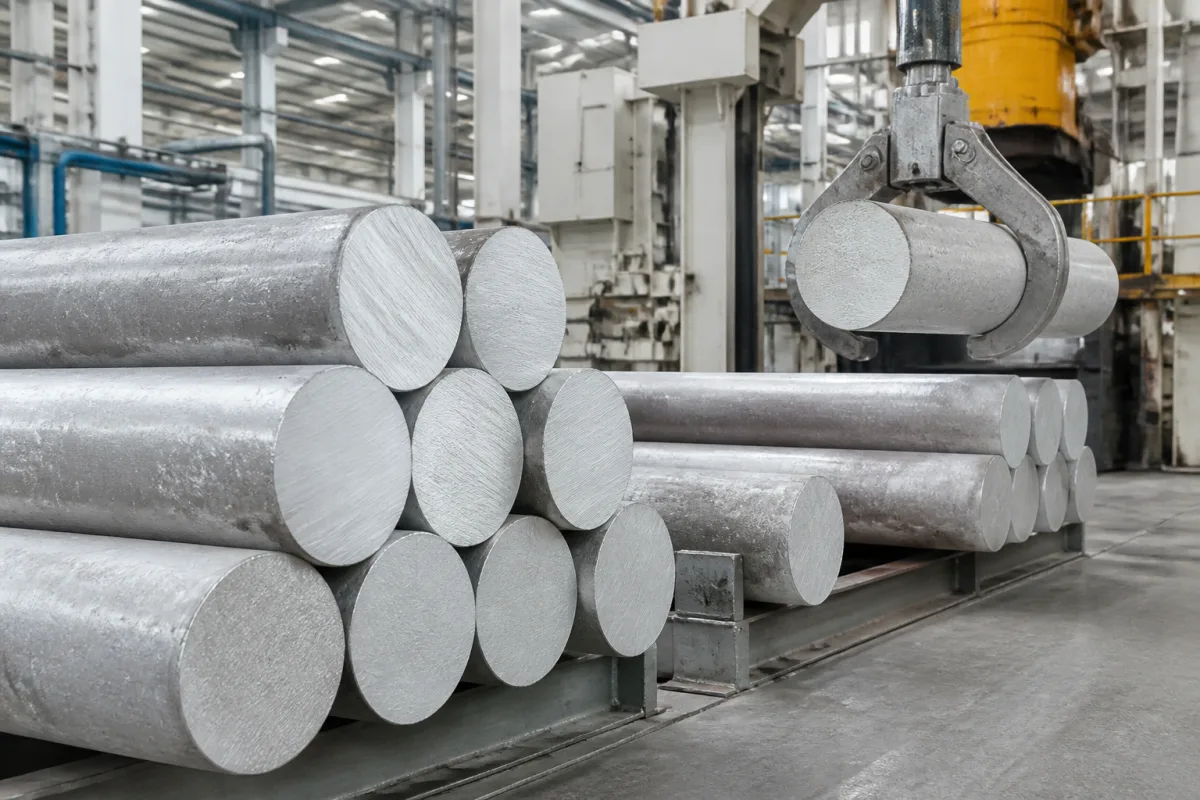
A magnesium alloy billet is a cast or extruded round bar (or slab) of a wrought magnesium alloy supplied as feedstock for extrusion, forging or rolling, chosen for its alloy, purity, structure and size. Ask three things first: which alloy the finished part's strength and the forming route require, which impurity limits and billet condition (cast, homogenised or extruded) the process needs, and what size, tolerances, certificates and handling come with each lot.
Magnesium alloy billets, logs and bar stock for extrusion and forging, cast or pre-extruded, in AZ, ZK, WE and similar wrought alloys. Pure magnesium ingot, magnesium die castings (see magnesium die casting), magnesium sheet and plate, finished forgings and extrusions are outside this page except where compared.
CNFX editorial research · Sources checked October 18, 2026 · 4 sources
Gontarz and co-authors (Lublin and Częstochowa Universities of Technology and ZOP forging plant, Materials 14:32, 2021) give compositions for three Mg-Al-Zn alloys: AZ31B with 2.5–3.5% Al, 0.6–1.4% Zn and 0.2–1.0% Mn; AZ61A with 5.8–7.2% Al, 0.4–1.5% Zn and 0.15–0.5% Mn; and AZ80A with 7.8–9.2% Al, 0.2–0.8% Zn and 0.12–0.5% Mn; each with at most 0.005% Fe, 0.10% Si, 0.05% Cu and 0.005% Ni. They describe AZ31B as suitable for hot working, at about 240 MPa tensile strength, 150 MPa yield, 9% elongation and 50–55 HB; the tabulated aluminium contents differ by alloy. Round bars are the usual forging billet, with slabs or cast preforms for flatter parts. [1]
TMS’s MgWrought charts list AZ31B, AZ61A, AZ80A and ZK60A among both extrusion and forging alloys, with WE43A and WE54A also shown. The charts describe their groupings as illustrative and partly subjective; they do not provide the chemical-composition table for certifying a delivered billet. [2]
Editorial note: name the alloy designation and the specification it must meet, because the impurity limits for iron, nickel and copper govern corrosion behaviour; ask for a cast or lot analysis covering every listed element.
A 2026 Materials study reports a Φ330 mm billet cast by differential-phase electromagnetic semi-continuous casting at 760–770 °C and 31–35 mm/min. Its title, abstract and Table 2 identify Mg-9.4Gd-5.8Y-1Zn-0.5Zr, while its Conclusions name Mg-9Gd-5.6Y-1Zn-0.5Zr. These are different composition labels within the source; obtain the authors’ clarification and actual location-specific analysis before specifying that research alloy. As-cast grain sizes are about 121, 117 and 130 µm at centre, half-radius and edge. Its reported Gd/Y segregation is within ±3%. [3]
For the homogenisation experiments, the authors cut specimens from half-radius, treated them at 470 or 520 °C for 5, 10, 15 or 20 h, and immediately water-quenched them. The 520 °C/5 h condition gave 208.4 MPa tensile strength and 24.4% elongation in room-temperature specimens parallel to the casting direction. This is not a guarantee that a whole delivered billet will have those properties after an unspecified treatment. Request location, heat treatment and test orientation with the certificate. [3]
For a rare-earth wrought grade sold as feedstock, Luxfer MEL Technologies lists Elektron RotaMag 43 (UNS M18434, ASTM WE43C) with 3.7–4.3% yttrium, 2.3–3.5% rare earths and at least 0.2% zirconium, supplied as rolled plate, forging feedstock and extruded bar, section and profile under AMS 4485 and ASTM B107/B107M for extrusions. For extruded bar in the artificially aged T5 condition it gives longitudinal specification minima (A-basis) of 195 MPa 0.2% proof stress, 303 MPa tensile strength and 6% elongation, states that T5 properties depend on the extruded profile, and reports up to 300 MPa proof, 375 MPa tensile strength and 11% elongation demonstrated. Listed physical values are specific gravity 1.83, modulus 44.1 GPa, melting range 540–640 °C and Brinell hardness 70–90, with an axial fatigue value (ASTM E466, R=0.1) of 195 MPa at 50 million cycles for extruded bar; Luxfer rates the alloy for use up to 250 °C. [4]
Give the supplier the alloy designation and specification, forming route (extrusion, forging, rolling), billet condition (as-cast, homogenised, extruded), diameter or section and tolerance, cut length, surface condition (as-cast, scalped, machined), grain size or structure requirement, ultrasonic or other inspection, chemical and mechanical certificates, packing against moisture, and quantity per lot.
02
Set preheat, forging speed and structure
Gontarz et al. tested cylindrical specimens 20 mm in diameter and 30 mm high, preheated at 350, 410 or 450 °C, upset to 10 mm height with tools near 300 °C. The screw press operated at about 0.5 m/s and the hammer at about 5 m/s. At 410 °C AZ31B gave acceptable specimens on both machines; AZ61A worked on the screw press but hammer specimens showed small cracks, motivating a lower-strain limitation. AZ80A did not give acceptable results at the tested high speeds and temperatures; this does not exclude low-speed/isothermal forging of that alloy. [1]
For air-cooled AZ31B upset specimens, the paper assigns ASTM grain-size number 12 at 350 °C; at 450 °C it reports 8–11 for screw-press specimens and 10–11 for hammer specimens. Its reference Table 2 maps numbers 12, 11 and 8 to average diameters of 5.6, 7.9 and 22.5 µm. These are grain-number correspondences and study observations, not a general multiplier for commercial billet grain growth. [1]
The paper’s Introduction relays earlier guidance to reduce successive forging temperatures by approximately 15–20 °C for grain-growth-sensitive alloys and water-cool to stop recrystallisation. Its own Results §3.1 instead recommend air cooling for the examined specimens because the measured grain-size difference was small and water cooling could add residual stress. Keep the cited general guidance separate from that study-specific recommendation and confirm the production route with the forger. [1]
03
Agree the feedstock certificate before the forming trial
A billet lot needs chemistry, condition and inspection records distinct from the finished forging or extrusion certificate. The research forging tests used extruded-bar specimens, while Luxfer’s stated longitudinal T5 minima belong to extruded products and depend on profile; those values do not certify an as-cast blank. [1][4]
For the three AZ alloys tabulated in the 2021 paper: Fe ≤0.005%, Ni ≤0.005%, Cu ≤0.05%, Si ≤0.10%; other alloy families need their own limits. [1]
Certified analysis.
Condition
State delivered condition. The rare-earth paper’s 520 °C/5 h experiment used half-radius specimens, not an unspecified whole-billet furnace qualification. [3]
Air-cooled AZ31B study: no.12 at 350 °C, no.8–11 (screw press) or 10–11 (hammer) at 450 °C after upset forging; a separate cast rare-earth billet had 117–130 µm as-cast grains. [1][3]
Billet grain size.
Size
Round bar or slab; e.g. 330 mm diameter semi-continuous cast billet. [1][3]
Diameter, length, tolerance.
Certificates
Composition and properties; e.g. AMS 4485 or ASTM B107/B107M for extruded Elektron RotaMag 43. [4]
Mill certificate per lot.
Segregation
The rare-earth Φ330 mm research billet reported Gd and Y segregation within ±3%; this is a study result, not every magnesium billet’s tolerance. [3]
Values at centre, mid-radius, edge.
06
Send the alloy, route and size together
Paste it into your enquiry below or into an email to a maker, then replace every bracket.
Explore company information and manufacturing capabilities, then discuss the scope of your project with a relevant supplier.
Share this page
Compiled and source-reviewed by the CNFX editorial team.
Each manufacturer above links to the page on that company's own website where the product is listed, with the date we checked it. How we source and review
· Page last updated 13 October 2026
Buyer questions
What did the high-speed forging study find for AZ31B and AZ80A?
In Gontarz et al.’s specified upset tests, AZ31B specimens at 410 °C were acceptable with both approximately 0.5 m/s screw-press and 5 m/s hammer speeds. AZ80A did not give acceptable specimens under the tested conditions; the paper discusses lower-speed forming separately. [1]
Which impurity limits did the AZ-alloy study tabulate?
For its AZ31B, AZ61A and AZ80A table, Fe and Ni are each at most 0.005%, Cu at most 0.05% and Si at most 0.10%. Other magnesium-alloy families require their own specified chemistry and lot analysis. [1]
Which magnesium alloys are used for extrusion and forging?
TMS lists AZ31B, AZ61A, AZ80A and ZK60A among both extrusion and forging alloys. [2]
What large-billet example does the rare-earth casting paper report?
It reports a Φ330 mm billet with as-cast grain sizes about 121, 117 and 130 µm from centre through half-radius to edge, and Gd/Y segregation within ±3%. Its title/abstract/Table 2 call the alloy Mg-9.4Gd-5.8Y-1Zn-0.5Zr, whereas Conclusions use Mg-9Gd-5.6Y-1Zn-0.5Zr; confirm the composition with the authors rather than treating the example as a catalogue limit. [3]
What strength does an extruded rare-earth magnesium bar reach?
Luxfer gives longitudinal T5 minima of 195 MPa proof stress, 303 MPa tensile strength and 6% elongation for extruded Elektron RotaMag 43, and notes that properties depend on the extruded profile. [4]
Sources and what still needs a direct check
Sources checked 2026-10-18. The Materials papers report laboratory and plant casting and forging tests; TMS charts summarise alloy uses; the Luxfer MEL Technologies datasheet gives specification minima and physical data for one rare-earth wrought grade. Specifications and certified values for your order come from the applicable standard and the supplier.