Industry-Verified Manufacturing Data (2026)

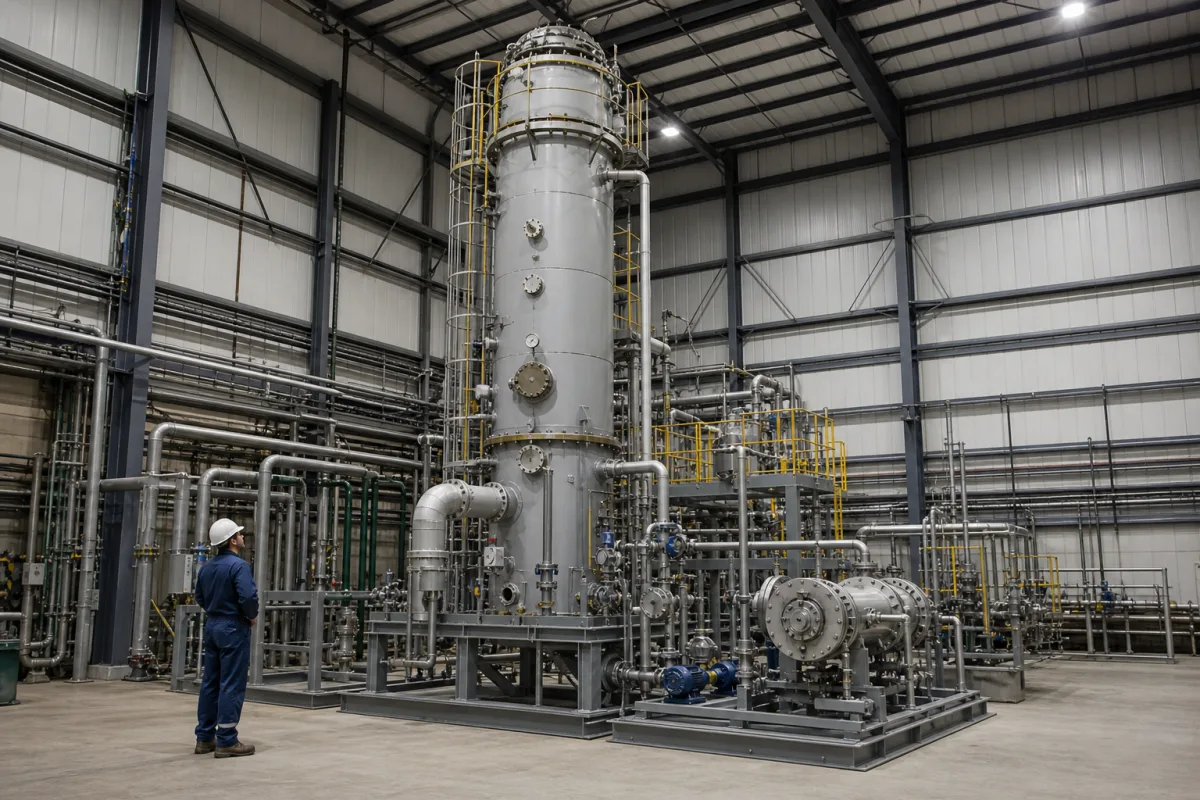
Absorption Column System

Based on aggregated insights from multiple verified factory profiles within the CNFX directory, the standard Absorption Column System used in the Chemical Manufacturing sector typically supports operational capacities ranging from standard industrial configurations to heavy-duty production requirements.

Technical Definition & Core Assembly

A canonical Absorption Column System is characterized by the integration of Column Shell and Packing Material. In industrial production environments, manufacturers listed on CNFX commonly emphasize Stainless steel (typically 304L or 316L) construction to support stable, high-cycle operation across diverse manufacturing scenarios.

A critical component in nitric acid production that absorbs nitrogen oxides into water to form nitric acid.

Product Specifications

Technical details and manufacturing context for Absorption Column System

Definition
The Absorption Column System is a key unit within the Integrated Nitric Acid Production and Concentration System where nitrogen oxides (NOx) from the oxidation process are absorbed into water under controlled conditions to produce nitric acid. It typically consists of multiple absorption stages with cooling to maximize acid concentration and minimize nitrogen oxide emissions.
Working Principle
Nitrogen oxide gases (primarily NO and NO₂) are introduced into the absorption column where they react with water in a counter-current flow arrangement. The absorption process involves chemical reactions where nitrogen oxides dissolve in water to form nitric acid and nitrous acid, with oxygen present to oxidize NO to NO₂ for more efficient absorption. Cooling is applied to remove the exothermic heat of reaction and improve absorption efficiency.
Common Materials
Stainless steel (typically 304L or 316L), Specialty alloys for corrosive environments, Ceramic packing materials
Technical Parameters
  • Column diameter and height dimensions (mm) Per Request
Components / BOM
  • Column Shell
    Main pressure vessel containing the absorption process
    Material: Stainless steel
  • Packing Material
    Provides surface area for gas-liquid contact and mass transfer
    Material: Ceramic or metal structured packing
  • Liquid Distributor
    Evenly distributes water/acid solution across the packing
    Material: Stainless steel
  • Gas Inlet
    Introduces nitrogen oxide gases into the column
    Material: Stainless steel
  • Cooling Coils
    Removes heat generated during the exothermic absorption reaction
    Material: Stainless steel
  • Demister
    Separates liquid droplets from exit gas stream
    Material: Stainless steel mesh
Engineering Reasoning
0.8-1.2 MPa pressure, 20-40°C temperature, 60-80% nitric acid concentration
Pressure exceeding 1.5 MPa causes vessel rupture, temperature below 15°C leads to crystallization, concentration above 85% initiates autocatalytic decomposition
Design Rationale: Stress corrosion cracking from nitric acid-chloride interaction at 304L stainless steel grain boundaries, thermal fatigue from 20-40°C cyclic operation, cavitation at pump discharge exceeding 3.5 m/s fluid velocity
Risk Mitigation (FMEA)
Trigger Cooling water interruption for 300+ seconds
Mode: Exothermic reaction runaway exceeding 150°C, pressure surge to 2.0+ MPa
Strategy: Redundant cooling loops with 400-second thermal mass buffer, emergency quench system activated at 100°C
Trigger Packing material degradation below 70% void fraction
Mode: Mass transfer efficiency drop below 85%, NOx slip exceeding 500 ppm
Strategy: Ceramic Intalox saddles with 92% void fraction, ultrasonic thickness monitoring at 6-month intervals

Industry Taxonomies & Aliases

Commonly used trade names and technical identifiers for Absorption Column System.

Industrial Ecosystem & Supply Chain DNA

Complementary Systems
Downstream Applications
Specialized Tooling

Application Fit & Sizing Matrix

Operational Limits
pressure: 0.5-8 bar (typical 3-5 bar)
flow rate: 50-500 m³/h (gas), 10-100 m³/h (liquid)
temperature: 20-50°C (optimal 30-40°C)
NOx concentration: 5-15% v/v (inlet gas)
slurry concentration: Not applicable (liquid absorption system)
Media Compatibility
✓ Stainless Steel 316L (corrosion resistant) ✓ PTFE-lined carbon steel (acid protection) ✓ Glass-reinforced polypropylene (chemical resistance)
Unsuitable: Chloride-containing environments (risk of stress corrosion cracking)
Sizing Data Required
  • Required nitric acid production capacity (tons/day)
  • Inlet gas composition and NOx concentration (%)
  • Available column height/pressure drop constraints (meters/bar)

Reliability & Engineering Risk Analysis

Failure Mode & Root Cause
Corrosion-induced wall thinning
Cause: Chemical attack from acidic or caustic process fluids, especially at welds, nozzles, and liquid-vapor interfaces where concentration gradients exist.
Packing degradation or fouling
Cause: Breakdown or clogging of structured/random packing due to chemical degradation, solids deposition, or maldistribution leading to reduced mass transfer efficiency and increased pressure drop.
Maintenance Indicators
  • Abrupt increase in column differential pressure accompanied by reduced absorption efficiency
  • Visible external corrosion, weeping, or leaks at weld seams, nozzle connections, or manway gaskets
Engineering Tips
  • Implement routine ultrasonic thickness testing at corrosion-prone zones and maintain a corrosion rate log to predict remaining life and schedule proactive replacements.
  • Optimize liquid distribution through regular distributor cleaning and flow testing, and monitor inlet fluid quality to prevent fouling agents from entering the column.

Compliance & Manufacturing Standards

Reference Standards
ISO 14692-2:2002 (Petroleum and natural gas industries - Glass-reinforced plastics (GRP) piping) ASME B31.3:2022 (Process Piping) EN 13445-3:2021 (Unfired pressure vessels - Design)
Manufacturing Precision
  • Column straightness: ≤1/1000 of total height
  • Nozzle alignment: ±1.5° from specified orientation
Quality Inspection
  • Hydrostatic pressure test (1.5x design pressure)
  • Ultrasonic thickness testing for corrosion assessment

Factories Producing Absorption Column System

Verified manufacturers with capability to produce this product in China

✓ 97% Supplier Capability Match Found

T Technical Director from Canada Jan 10, 2026
★★★★★
"Standard OEM quality for Chemical Manufacturing applications. The Absorption Column System arrived with full certification."
Technical Specifications Verified
P Project Engineer from United States Jan 07, 2026
★★★★☆
"Great transparency on the Absorption Column System components. Essential for our Chemical Manufacturing supply chain. (Delivery took slightly longer than expected, but technical support was excellent.)"
Technical Specifications Verified
S Sourcing Manager from United Arab Emirates Jan 04, 2026
★★★★★
"The Absorption Column System we sourced perfectly fits our Chemical Manufacturing production line requirements."
Technical Specifications Verified
Verification Protocol

“Feedback is collected from verified sourcing managers during RFQ (Request for Quote) and factory evaluation processes on CNFX. These reports represent historical performance data and technical audit summaries from our B2B manufacturing network.”

16 sourcing managers are analyzing this specification now. Last inquiry for Absorption Column System from Poland (1h ago).

Supply Chain Compatible Machinery & Devices

Automated Batch Crystallization System

Automated system for controlled crystallization of chemical compounds in batch processes.

Explore Specs →
Automated pH Monitoring and Dosing System

Automated system for continuous pH monitoring and chemical dosing in process streams.

Explore Specs →
Automated Powder Dispensing and Blending System

Automated system for precise dispensing and homogeneous blending of powdered chemicals.

Explore Specs →
Automated Solvent Recovery and Purification System

Automated system for recovering and purifying industrial solvents.

Explore Specs →

Frequently Asked Questions

What materials are recommended for absorption columns in corrosive nitric acid environments?

For nitric acid production, we recommend 304L or 316L stainless steel for the column shell, with specialty alloys for highly corrosive zones and ceramic packing materials for optimal gas-liquid contact and corrosion resistance.

How does the packing material affect absorption column efficiency in nitric acid manufacturing?

Ceramic packing materials provide high surface area for gas-liquid contact, improving NOx absorption rates. They also offer excellent corrosion resistance against nitric acid, ensuring long-term operational stability and reduced maintenance.

What are the key components of an absorption column system for nitric acid production?

Essential components include the column shell, cooling coils for temperature control, demister for liquid entrainment removal, gas inlet, liquid distributor for even flow, and packing material. Each component is engineered for maximum NOx absorption efficiency.

Can I contact factories directly on CNFX?

CNFX is an open directory, not a transaction platform. Each factory profile provides direct contact information and production details to help you initiate direct inquiries with Chinese suppliers.

Get Quote for Absorption Column System

Request technical pricing, lead times, or customized specifications for Absorption Column System directly from verified manufacturing units.

Your business information is encrypted and only shared with verified Absorption Column System suppliers.

Thank you! Your message has been sent. We'll respond within 1–3 business days.

Need to Manufacture Absorption Column System?

Connect with verified factories specializing in this product category

Add Your Factory Contact Us
First Product
Next Product
Agitation Assembly