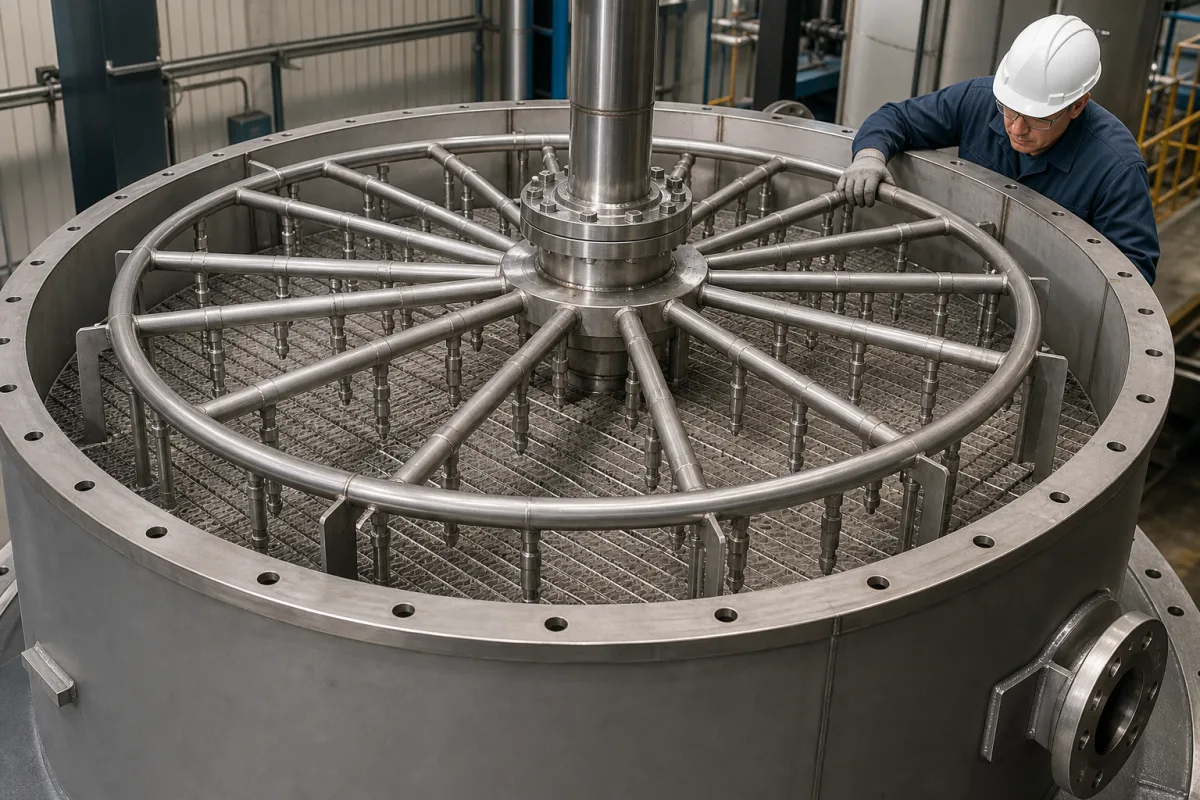
Packed column liquid distributors · Type by liquid rate, drip point density, distribution quality, turndown, fouling resistance
A liquid distributor sits above a packed bed in a distillation, absorption or stripping column and spreads the liquid evenly over the packing so the whole bed works, as with the ring-and-spoke pipe distributor with drip tubes pictured above the packing in a column section. Ask three things first: the liquid rate range per unit of column area, the drip point density the packing needs, and how the metering devices cope with fouling and turndown.
Liquid distributors and redistributors for packed columns: pan, deck, channel, trough, pipe, tubular and spray-nozzle types. Vapour distributors, liquid collectors, packing, support plates and trays are outside this page.
CNFX editorial research · Sources checked October 12, 2026 · 4 sources
Choose the distributor type by liquid rate and column size
Koch-Glitsch's packed tower internals brochure gives each distributor type a liquid-rate window and diameter range: its pan distributor 5–195 m³/h/m² for 150–900 mm towers; deck distributor 10–195 m³/h/m² for 450–6,100 mm; channel distributor 0.7–37 m³/h/m² above 900 mm; tubular distributor 0.7–20 m³/h/m² for clean services only; trough types from 0.25 to 60 m³/h/m²; packed-trough very low flow types down to 0.07 m³/h/m²; pipe distributor 3.7–24 m³/h/m² above 450 mm; and spray-nozzle distributor 0.5–122 m³/h/m² with no diameter restriction. [1]
The same brochure lists the attributes of an ideal distributor: uniform liquid distribution, operation through the required turndown, low vapour pressure drop, resistance to plugging or fouling, optimal use of vessel height, minimal liquid residence time and, for redistribution, mixing capability. It names liquid and vapour maldistribution as the leading causes of packed tower failures not due to operation. [1] Sulzer lists distributors for liquid loads from 0.02 to 400 m³/m²h, for high turndown, for highly loaded columns, for suspensions, emulsions and fouling liquids, and for moving conditions. [2]
Koch-Glitsch's pipe distributor meters liquid through orifices in pipe laterals, needs little tower elevation, has very high open area and flange connections with PTFE gaskets; its standard turndown is 2.5:1. [1]
Give the supplier the column diameter, packing type and size, design, minimum and maximum liquid rates, liquid properties and any solids or fouling tendency, the vapour rate and allowable pressure drop, available height, feed arrangement, and materials and gaskets.
02
Set drip point density, turndown and fouling resistance
Koch-Glitsch's minimum recommended drip point densities run from 60 points/m² for random packings of nominal 25 mm and larger, through 100, 130 and 160 points/m², to 215 points/m² for wire gauze and the finest structured packings. It says “With the most commonly used sizes of random and structured packings, the effect of the drip point density is relatively minor”, but has a considerable effect on high surface area, very high efficiency packings. It rates distribution uniformity on a percentage scale where 100% is ideal. [1]
On turndown, Koch-Glitsch explains that a distributor performs best around 100% of design flow; as flow falls and the liquid head drops, levelness and gradients become a larger share of the head until point-to-point variation is unacceptable. Its distributor models are rated 2:1 or 2.5:1 turndown as standard, with multi-level orifices or slotted weirs as options for higher turndown at the cost of higher flow variation. For fouling it ranks metering devices “starting at the left with the most resistant”: V-notch weir, spray nozzle, slotted weir, sidewall orifice, bottom orifice. [1]
Editorial calculation: a 2.0 m diameter column has an area of π × 1.0² ≈ 3.14 m²; at 100 drip points/m² it needs about 314 drip points, and at 215 points/m² about 675. A 2:1 turndown on a design rate of 20 m³/h/m² covers about 10–20 m³/h/m².
03
Compare a second maker's load windows and feed-system rules
RVT Process Equipment's column internals brochure (August 2022) gives recommended liquid loads and column diameters by distributor type: pan 0.3–200 m³/m²h for columns of 100–1,600 mm; deck 5–200 m³/m²h above 200 mm; trough 0.3–50 m³/m²h above 600 mm; ladder 4–100 m³/m²h and spray-nozzle 3–200 m³/m²h for all sizes. It gives 60–150 drip points per m² depending on the application, uses bottom orifices in troughs for clean systems with standard turndown, side orifices, weirs or distribution pipes for low loads and wide ranges, overflow weirs where fouling is a risk, and spray nozzles only for solids-free service. For feeding the distributor it recommends a ladder-type feed for low and medium loads below 80 m³/m²h with 1:3 turndown, a parting box with downcomers for high loads and turndown of 1:10 or more, and no separate feed system for loads up to 5 m³/m²h in small columns. [4]
Editorial calculation: RVT's 60–150 points/m² range overlaps Koch-Glitsch's 60 points/m² minimum for 25 mm random packing and its higher figures for finer packings above; for the 2.0 m column (3.14 m²) worked out above, 60–150 points/m² means about 190–470 drip points. Give both suppliers your liquid load range, fouling tendency and turndown, since those decide the distributor type and the feed system. [4][1]
The supplier linked to this page lists pan, trough, deck, ladder and spray-nozzle liquid distributors with other column internals; its card links to the page reviewed.
Saiptech states that equal distribution of liquid over the entire bed cross-section is needed for optimum mass transfer, together with low gas-side pressure drop, low fouling sensitivity and low overall height. [3] Ask any supplier for the drip point count and layout, distribution quality rating or test basis, rated liquid range and turndown, metering device and orifice size, open area for vapour, height, materials, gaskets and installation method.
05
Trace the distributor parts
This is a functional reference built from the sources cited; it is not one maker's specification.
Fill the specification fields with values for your column
A liquid distributor quotation needs values for your column and service. The table explains each field, gives published values where a reviewed source states them, and says what to obtain from the supplier.
Field
What it means and published values
Ask the supplier for
Nominal Diameter (mm)
Column ID, e.g. 150–900 mm pan; 450–6,100 mm deck. [1]
Explore company information and manufacturing capabilities, then discuss the scope of your project with a relevant supplier.
Share this page
Compiled and source-reviewed by the CNFX editorial team.
Published product pages show what a company offers, not tested performance. Confirm the legal seller, factory and scope for your order. How we source and review
· Page last updated 13 October 2026
Buyer questions
How many drip points does a packed column distributor need?
Koch-Glitsch recommends minimums from 60 points/m² for 25 mm and larger random packings up to 215 points/m² for wire gauze and the finest structured packings. [1]
What turndown can a liquid distributor handle?
Koch-Glitsch rates its distributor models at 2:1 or 2.5:1 as standard, with multi-level orifices or slotted weirs for higher turndown at higher flow variation. [1]
Which distributor resists fouling best?
Koch-Glitsch's fouling-resistance ranking runs from V-notch weirs to spray nozzles, slotted weirs, sidewall orifices and bottom orifices. [1]
How many drip points does a packed-column liquid distributor need?
One internals maker gives 60–150 drip points per m² depending on the application; another sets minimums from 60 points/m² for 25 mm random packing upward for finer packings. [4][1]
Sources and what still needs a direct check
Sources checked 2026-10-12. Koch-Glitsch and Sulzer make column internals and publish design guidance; Saiptech is the supplier linked to this page.