Industry-Verified Manufacturing Data (2026)

Demister

Based on aggregated insights from multiple verified factory profiles within the CNFX directory, the standard Demister used in the Chemical Manufacturing sector typically supports operational capacities ranging from standard industrial configurations to heavy-duty production requirements.

Technical Definition & Core Assembly

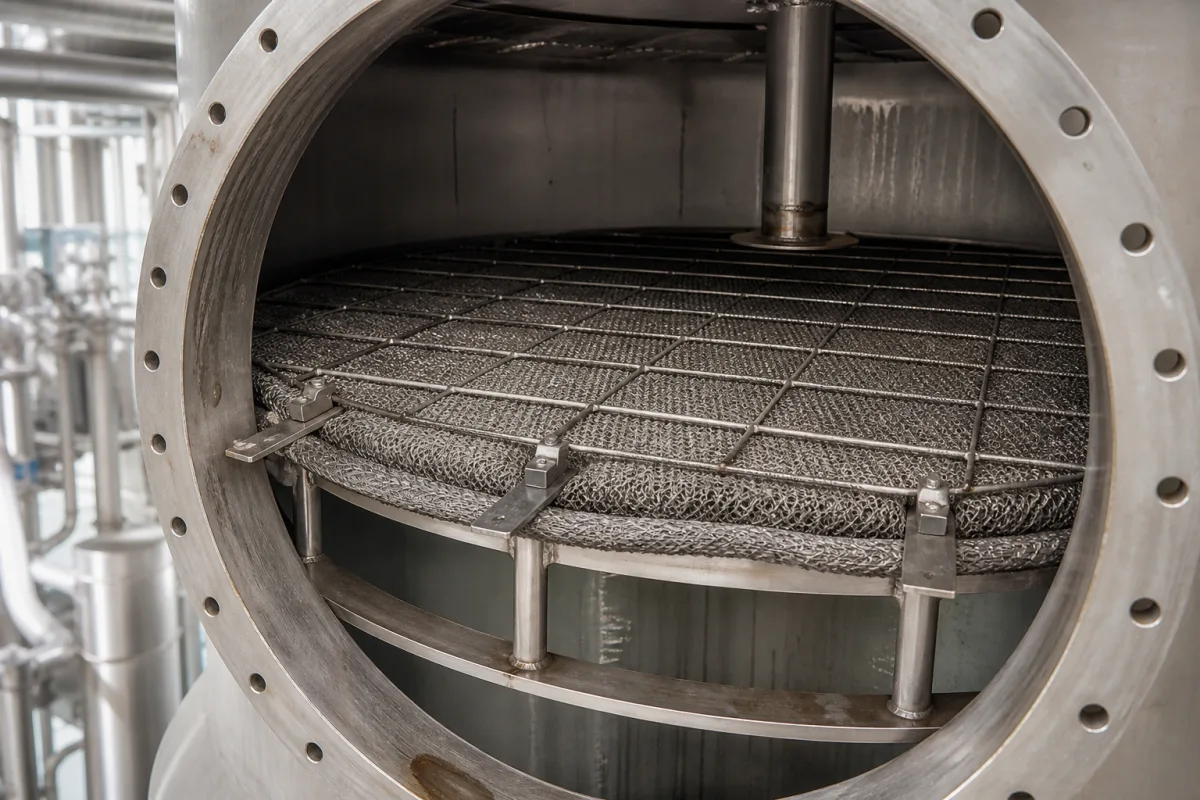
A canonical Demister is characterized by the integration of Mesh Pad / Packing and Support Grid / Frame. In industrial production environments, manufacturers listed on CNFX commonly emphasize Stainless Steel (e.g., 304, 316L) construction to support stable, high-cycle operation across diverse manufacturing scenarios.

A device used to remove entrained liquid droplets from a gas or vapor stream.

Product Specifications

Technical details and manufacturing context for Demister

Definition
A demister, also known as a mist eliminator or entrainment separator, is a critical component within an absorption column system. It is typically installed at the top of the column or in the vapor outlet line. Its primary function is to capture and coalesce fine liquid droplets (mist) that are carried upward by the gas/vapor stream, preventing liquid carryover into downstream equipment. This ensures product purity, protects compressors or other units, improves separation efficiency, and reduces solvent loss.
Working Principle
The demister operates based on inertial impaction, interception, and diffusion. As the gas/vapor stream laden with liquid droplets passes through the demister pad (usually made of knitted wire mesh, vane packs, or fiber beds), the droplets collide with the surfaces of the demister elements. These collisions cause the droplets to coalesce into larger droplets. Once the droplets become sufficiently large, gravity overcomes the drag force of the gas stream, causing the liquid to drain down the demister elements and back into the column or a collection sump, while the cleaned gas/vapor exits.
Common Materials
Stainless Steel (e.g., 304, 316L), Polypropylene (PP), Polytetrafluoroethylene (PTFE), Nickel Alloys
Technical Parameters
  • Standard thickness/depth of the demister pad or element. (mm) Per Request
Components / BOM
  • Mesh Pad / Packing
    The primary filtering element, typically a knitted wire mesh, vane pack, or fiber bed that captures and coalesces liquid droplets.
    Material: Stainless Steel, Plastic, or Specialty Alloy
  • Support Grid / Frame
    A structural frame that holds the demister pad in place within the column or housing, ensuring it maintains its shape and position under gas flow.
    Material: Carbon Steel or Stainless Steel
  • Liquid Drainage System
    Channels or gutters (if separate from the pad) that collect the coalesced liquid and direct it back into the column or to an outlet.
    Material: Stainless Steel
Engineering Reasoning
0.1-10 bar differential pressure, 0-150°C temperature, 0.5-15 m/s gas velocity
Droplet re-entrainment at 20 m/s gas velocity, mesh collapse at 2.5 bar differential pressure, corrosion failure at pH<4 or pH>10
Design Rationale: Droplet re-entrainment due to excessive gas momentum overcoming surface tension (Weber number >12), mesh structural failure from differential pressure exceeding yield strength (σ_y=250 MPa for 316SS), chemical attack on wire mesh from acidic/alkaline condensate
Risk Mitigation (FMEA)
Trigger Chloride stress corrosion cracking in 316SS mesh at >60°C with >50 ppm chlorides
Mode: Mesh wire fracture and disintegration
Strategy: Replace with duplex stainless steel (UNS S32205) or apply PTFE coating
Trigger Liquid overload exceeding 0.15 m³/m²·h drainage capacity
Mode: Flooding and carryover of liquid droplets
Strategy: Install pre-separator cyclone or increase demister pad thickness to 150 mm

Industry Taxonomies & Aliases

Commonly used trade names and technical identifiers for Demister.

Applied To / Applications

This component is essential for the following industrial systems and equipment:

Industrial Ecosystem & Supply Chain DNA

Complementary Systems
Downstream Applications
Specialized Tooling

Application Fit & Sizing Matrix

Operational Limits
pressure: Up to 100 bar (standard), higher with reinforced construction
flow rate: 0.1 to 100 m³/s (gas), velocity typically 1-5 m/s
temperature: -40°C to 400°C (typical), up to 600°C with special materials
slurry concentration: Up to 5% liquid by volume, droplet size >3-10 microns
Media Compatibility
✓ Steam systems (water droplets) ✓ Chemical process gases (acid mists) ✓ Compressed air systems (oil/water aerosols)
Unsuitable: High-viscosity liquids (>100 cP) or sticky/solidifying substances
Sizing Data Required
  • Gas flow rate (actual m³/h)
  • Operating pressure and temperature
  • Required separation efficiency (droplet size removal)

Reliability & Engineering Risk Analysis

Failure Mode & Root Cause
Mesh clogging/plugging
Cause: Accumulation of solids, salts, or viscous liquids in the mesh structure due to inadequate upstream filtration, process upsets, or chemical reactions forming deposits
Mesh degradation/structural failure
Cause: Corrosion from aggressive chemicals (acids, chlorides), mechanical damage from high velocity droplets or debris impact, or thermal stress from temperature cycling
Maintenance Indicators
  • Significant increase in pressure drop across the demister (typically >2x design differential pressure)
  • Visible liquid carryover in downstream equipment or audible 'sloshing' sounds indicating poor separation efficiency
Engineering Tips
  • Install proper upstream filtration (strainers, separators) and implement regular chemical cleaning/washing protocols to prevent fouling
  • Select corrosion-resistant mesh materials (e.g., 316L SS, alloys, or plastics) compatible with process chemistry and ensure proper installation to avoid stress concentrations

Compliance & Manufacturing Standards

Reference Standards
ISO 9001:2015 (Quality Management Systems) ASME BPE (Bioprocessing Equipment) PED 2014/68/EU (Pressure Equipment Directive)
Manufacturing Precision
  • Mesh Wire Diameter: +/-0.01mm
  • Support Grid Flatness: 0.5mm per meter
Quality Inspection
  • Pressure Drop Test (to verify design efficiency)
  • Material Composition Verification (via PMI or Spectrographic Analysis)

Factories Producing Demister

Verified manufacturers with capability to produce this product in China

✓ 95% Supplier Capability Match Found

S Sourcing Manager from Brazil Jan 04, 2026
★★★★★
"Standard OEM quality for Chemical Manufacturing applications. The Demister arrived with full certification."
Technical Specifications Verified
P Procurement Specialist from Canada Jan 01, 2026
★★★★☆
"Great transparency on the Demister components. Essential for our Chemical Manufacturing supply chain. (Delivery took slightly longer than expected, but technical support was excellent.)"
Technical Specifications Verified
T Technical Director from United States Dec 29, 2025
★★★★★
"The Demister we sourced perfectly fits our Chemical Manufacturing production line requirements."
Technical Specifications Verified
Verification Protocol

“Feedback is collected from verified sourcing managers during RFQ (Request for Quote) and factory evaluation processes on CNFX. These reports represent historical performance data and technical audit summaries from our B2B manufacturing network.”

7 sourcing managers are analyzing this specification now. Last inquiry for Demister from Vietnam (32m ago).

Supply Chain Compatible Machinery & Devices

Automated Batch Crystallization System

Automated system for controlled crystallization of chemical compounds in batch processes.

Explore Specs →
Automated pH Monitoring and Dosing System

Automated system for continuous pH monitoring and chemical dosing in process streams.

Explore Specs →
Automated Powder Dispensing and Blending System

Automated system for precise dispensing and homogeneous blending of powdered chemicals.

Explore Specs →
Automated Solvent Recovery and Purification System

Automated system for recovering and purifying industrial solvents.

Explore Specs →

Frequently Asked Questions

What materials are best for corrosive chemical applications?

For highly corrosive environments, PTFE (Teflon) or nickel alloys like Hastelloy offer superior resistance. 316L stainless steel is suitable for many common chemicals, while polypropylene (PP) provides cost-effective corrosion resistance for less aggressive streams.

How does the mesh pad design affect separation efficiency?

The mesh pad's density, material, and construction determine droplet removal efficiency. Denser pads with finer filaments capture smaller droplets but increase pressure drop. Proper selection balances efficiency with system energy requirements.

What maintenance does a demister require?

Minimal maintenance is needed with proper design. Periodic inspection of the mesh pad for fouling or damage, and ensuring the liquid drainage system remains unobstructed, maintains optimal performance. Materials like PTFE resist fouling in sticky applications.

Can I contact factories directly on CNFX?

CNFX is an open directory, not a transaction platform. Each factory profile provides direct contact information and production details to help you initiate direct inquiries with Chinese suppliers.

Get Quote for Demister

Request technical pricing, lead times, or customized specifications for Demister directly from verified manufacturing units.

Your business information is encrypted and only shared with verified Demister suppliers.

Thank you! Your message has been sent. We'll respond within 1–3 business days.

Need to Manufacture Demister?

Connect with verified factories specializing in this product category

Add Your Factory Contact Us
Previous Product
Decontamination System (Isolator)
Next Product
Demister/Mist Eliminator