Industry-Verified Manufacturing Data (2026)

Column Shell

Based on aggregated insights from multiple verified factory profiles within the CNFX directory, the standard Column Shell used in the Chemical Manufacturing sector typically supports operational capacities ranging from standard industrial configurations to heavy-duty production requirements.

Technical Definition & Core Assembly

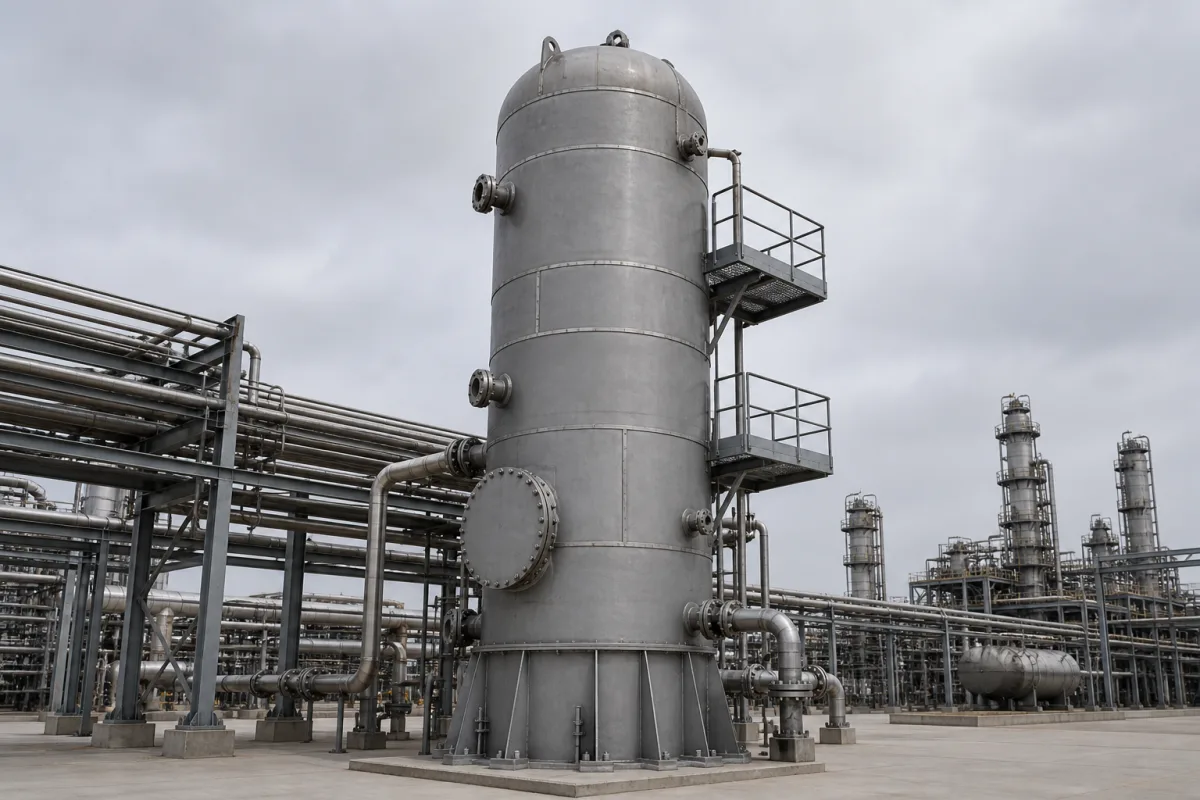
A canonical Column Shell is characterized by the integration of Shell Cylinder and Shell Heads. In industrial production environments, manufacturers listed on CNFX commonly emphasize Carbon Steel construction to support stable, high-cycle operation across diverse manufacturing scenarios.

The outer cylindrical structure of an absorption column that contains the internal components and process fluids.
Product Specifications

Technical details and manufacturing context for Column Shell

Definition
The column shell is the primary pressure-retaining vessel of an absorption column system, providing structural integrity to house internal components such as packing materials, trays, distributors, and mist eliminators. It maintains the process environment by containing gases and liquids under specified pressure and temperature conditions while withstanding corrosion from chemical processes.
Working Principle
The column shell functions as a containment vessel that maintains the internal pressure and temperature conditions required for the absorption process. It provides a sealed environment where gas and liquid phases interact, with the shell's design ensuring structural stability against internal pressure, external loads, and thermal expansion while facilitating proper fluid distribution and collection.
Common Materials
Carbon Steel, Stainless Steel, Alloy Steel, Fiberglass Reinforced Plastic
Technical Parameters
  • Diameter and height specifications for the cylindrical shell (mm) Standard Spec
Components / BOM
  • Shell Cylinder
    Main cylindrical body providing containment volume
    Material: steel
  • Shell Heads
    Top and bottom closures (typically elliptical or hemispherical)
    Material: steel
  • Nozzles
    Inlet and outlet connections for process fluids
    Material: steel
  • Manways
    Access openings for inspection and maintenance
    Material: steel
  • Support Skirt
    Structural support connecting column to foundation
    Material: steel
Engineering Reasoning
0.1-2.0 MPa (1-20 bar) at 20-200°C
Yield strength exceeded at 250 MPa stress or 0.2% permanent strain
Design Rationale: Stress corrosion cracking from chloride ion concentration exceeding 50 ppm in process fluids at temperatures above 60°C, following Nernst equation electrochemical potential principles
Risk Mitigation (FMEA)
Trigger Cyclic thermal stress from 50°C temperature differentials during startup/shutdown cycles
Mode: Thermal fatigue cracking initiating at weld heat-affected zones with crack propagation rates exceeding 10^-8 m/cycle
Strategy: Controlled heating/cooling ramp rates of 25°C/hour maximum with post-weld heat treatment at 625°C for 2 hours per ASME Section VIII requirements
Trigger External corrosion under insulation with moisture accumulation exceeding 5% by volume
Mode: Localized wall thinning below minimum required thickness of 6.35 mm for 1500 mm diameter shells
Strategy: Weather barrier jacketing with 100% seal welding and corrosion monitoring using ultrasonic thickness measurement at 100 mm grid intervals

Industry Taxonomies & Aliases

Commonly used trade names and technical identifiers for Column Shell.

Applied To / Applications

This component is essential for the following industrial systems and equipment:

Industrial Ecosystem & Supply Chain DNA

Complementary Systems
Downstream Applications
Specialized Tooling

Application Fit & Sizing Matrix

Operational Limits
pressure: Up to 100 bar (design dependent)
flow rate: Varies with diameter (typically 0.5-10 m/s superficial velocity)
temperature: -50°C to 400°C (dependent on material of construction)
slurry concentration: Up to 40% solids by weight (with proper internals design)
Media Compatibility
✓ Carbon steel for hydrocarbon processing ✓ Stainless steel 316L for corrosive chemical absorption ✓ FRP for acidic gas scrubbing
Unsuitable: Hydrofluoric acid environments (requires specialized materials like monel or hastelloy)
Sizing Data Required
  • Required process flow rate (m³/hr)
  • Operating pressure and temperature conditions
  • Column height based on theoretical stages/transfer units

Reliability & Engineering Risk Analysis

Failure Mode & Root Cause
Corrosion-induced thinning
Cause: Chemical attack from process fluids, moisture, or atmospheric exposure leading to wall thickness reduction and potential leaks.
Mechanical fatigue cracking
Cause: Cyclic thermal stresses, pressure fluctuations, or vibration from connected equipment causing crack initiation and propagation.
Maintenance Indicators
  • Visible external corrosion, pitting, or discoloration on the shell surface
  • Audible hissing or whistling sounds indicating gas leaks through compromised shell integrity
Engineering Tips
  • Implement regular ultrasonic thickness testing to monitor corrosion rates and schedule proactive repairs before failure occurs.
  • Install expansion joints or flexible connections to absorb thermal and mechanical stresses, reducing fatigue loading on the shell.

Compliance & Manufacturing Standards

Reference Standards
ISO 9001:2015 - Quality Management Systems ASME B31.3 - Process Piping DIN EN 13445 - Unfired Pressure Vessels
Manufacturing Precision
  • Wall Thickness: +/-5% of nominal
  • Circularity: 0.5% of diameter
Quality Inspection
  • Ultrasonic Thickness Testing
  • Hydrostatic Pressure Test

Factories Producing Column Shell

Verified manufacturers with capability to produce this product in China

✓ 94% Supplier Capability Match Found

P Project Engineer from United Arab Emirates Jan 05, 2026
★★★★★
"The technical documentation for this Column Shell is very thorough, especially regarding technical reliability."
Technical Specifications Verified
S Sourcing Manager from Australia Jan 02, 2026
★★★★★
"Reliable performance in harsh Chemical Manufacturing environments. No issues with the Column Shell so far."
Technical Specifications Verified
P Procurement Specialist from Singapore Dec 30, 2025
★★★★★
"Testing the Column Shell now; the technical reliability results are within 1% of the laboratory datasheet."
Technical Specifications Verified
Verification Protocol

“Feedback is collected from verified sourcing managers during RFQ (Request for Quote) and factory evaluation processes on CNFX. These reports represent historical performance data and technical audit summaries from our B2B manufacturing network.”

19 sourcing managers are analyzing this specification now. Last inquiry for Column Shell from Brazil (35m ago).

Supply Chain Compatible Machinery & Devices

Modular Distillation Column System

Pre-engineered modular system for continuous separation of chemical mixtures via distillation.

Explore Specs →
Automated Batch Crystallization System

Automated system for controlled crystallization of chemical compounds in batch processes.

Explore Specs →
Automated pH Monitoring and Dosing System

Automated system for continuous pH monitoring and chemical dosing in process streams.

Explore Specs →
Automated Powder Dispensing and Blending System

Automated system for precise dispensing and homogeneous blending of powdered chemicals.

Explore Specs →

Frequently Asked Questions

What materials are commonly used for column shells in chemical manufacturing?

Column shells are typically constructed from carbon steel, stainless steel, alloy steel, or fiberglass reinforced plastic (FRP), selected based on process fluid compatibility, corrosion resistance, and pressure requirements.

What are the key components included in a column shell BOM?

A standard column shell bill of materials includes the shell cylinder, shell heads, nozzles for fluid inlets/outlets, manways for maintenance access, and a support skirt for structural stability.

How does column shell design impact absorption column performance?

The column shell provides structural integrity, contains process fluids under pressure, and houses internal components like packing or trays. Proper material selection and fabrication ensure safety, durability, and efficient mass transfer operations.

Can I contact factories directly on CNFX?

CNFX is an open directory, not a transaction platform. Each factory profile provides direct contact information and production details to help you initiate direct inquiries with Chinese suppliers.

Get Quote for Column Shell

Request technical pricing, lead times, or customized specifications for Column Shell directly from verified manufacturing units.

Your business information is encrypted and only shared with verified Column Shell suppliers.

Thank you! Your message has been sent. We'll respond within 1–3 business days.

Need to Manufacture Column Shell?

Connect with verified factories specializing in this product category

Add Your Factory Contact Us
Previous Product
Collector Header
Next Product
Compression Fitting