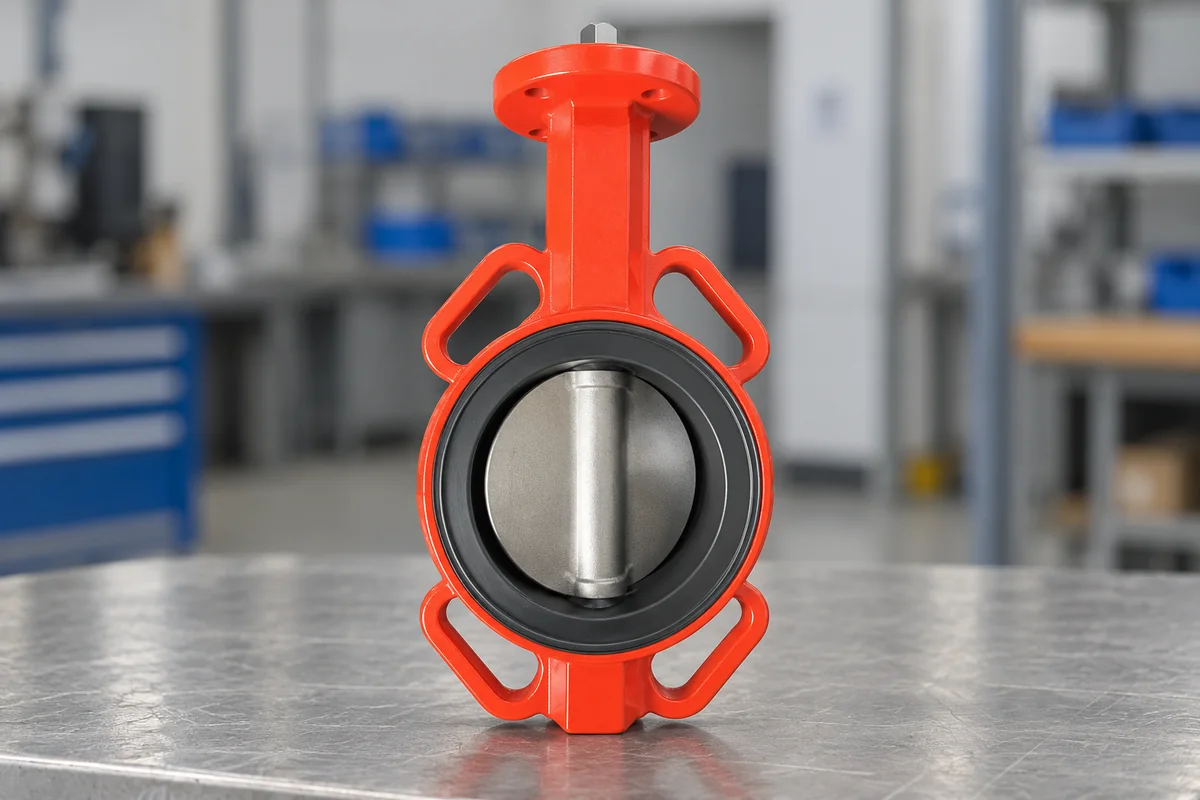
Butterfly valves · quarter-turn disc valves for isolation and regulation, wafer, lug, flanged and grooved ends, concentric, double- and triple-offset designs, soft and metal seats with their pressure and temperature limits, body and disc materials, API 609 and sanitary types
A butterfly valve is a quarter-turn valve whose disc rotates on a stem in the flow to open, close or throttle a pipeline. Ask three things first: what fluid, pressure class and temperature it must handle, which end connection and size fit your pipework, and whether a resilient (soft) seat or a metal seat with an offset design is needed.
Industrial, water and sanitary butterfly valves with manual, gear, pneumatic or electric operation. Ball, gate and check valves and loose valve parts are outside this page except where compared.
CNFX editorial research · Sources checked October 11, 2026 · 4 sources
ZFA, a butterfly valve maker, explains that the disc opens and closes when the stem is rotated. It classifies butterfly valves by connection (wafer, flanged, lug, welded and grooved), by seat (soft or hard seal), and by structure (concentric, double eccentric and triple eccentric). It names the body, disc, seat and actuator as the main parts. [1]
ZFA describes the double-offset (double-eccentric) butterfly valve as having two offsets, one in the stem and one in the disc, so that the disc moves completely out of the flow path when fully open, reducing friction and wear on the sealing surfaces. [2]
For bodies and discs ZFA lists ductile iron (with nickel, nylon, PFA or PTFE coatings or linings), WCB, LCB/LCC, stainless steels (CF8, CF3, CF3M), duplex (2205, 2507) and aluminium bronze. Seats are listed in EPDM, NBR, Viton, natural, silicone and other rubbers, PTFE, stainless steel with graphite, and stainless steel with Stellite. [1]
Give the supplier the fluid and solids content, the pressure class and test pressure, the temperature range, the size and end connection (wafer, lug, flanged, grooved), the flange standard, the body, disc, stem and seat materials, the offset design, the operator (lever, gear, pneumatic, electric) with fail position, any sanitary or drinking-water approvals, and the inspection and test certificates.
02
Match pressure class and temperature to the seat
ZFA states that soft seats are suitable for PN10, PN16 and PN25, Class 150 and JIS 5K/10K, while hard (metal) seats can be used at higher pressures. Soft seats are rated at −20 to +120 °C for rubber and −25 to +150 °C for PTFE. Metal-seated valves cover a wider range, for example −29 to +180 °C in LCB, up to 425 °C in WCB and up to 600 °C in stainless steel. For its standard range ZFA lists wafer and lug sizes from DN25 to DN600, single-flange DN700 to DN1000, and double-flange DN50 to DN2400. [1]
Its double-offset valve page relates EN 1092-1 PN ratings to ASME B16.34 classes, for example PN16 (1.6 MPa) to Class 150 and PN40 (4 MPa) to Class 300. [2]
Landee, a valve and pipe stockist, lists API 609 butterfly valves including ductile iron wafer valves at DN100 PN16 and 4 in CL150, a double-offset WCB valve at 6 in CL300 with raised-face ends, CF3M lug valves at 600 lb, and aluminium-bronze C95800 wafer valves. [3]
Editorial calculation: 1 MPa = 10 bar, so PN16 corresponds to 16 bar and PN40 to 40 bar nominal.
03
Consider sanitary butterfly valves for food and beverage lines
Donjoy, a sanitary valve maker, lists manual and pneumatic sanitary butterfly valves for food and beverage, wine and similar fluid systems, including regulating valves with positioners and wafer-type valves in sizes 1.5–12 in (DN40–DN300). Landee lists sanitary butterfly valves in 304 and 316L stainless steel from ½ to 12 in at 10 bar. [4][3]
Specify the clean-in-place conditions, surface finish and food-contact certificates with the supplier.
04
Fill the specification fields with values for your line
A butterfly valve quotation needs values for your service. The table explains each field, gives published values where a reviewed source states them, and says what to ask the supplier for.
Explore company information and manufacturing capabilities, then discuss the scope of your project with a relevant supplier.
Compiled and source-reviewed by the CNFX editorial team.
Published product pages show what a company offers, not tested performance. Confirm the legal seller, factory and scope for your order. How we source and review
· Page last updated 11 October 2026
What is the difference between soft-seated and metal-seated butterfly valves?
ZFA says soft (rubber or PTFE) seats suit PN10–PN25 and Class 150 up to about 120–150 °C, while metal seats can be used at higher pressures and temperatures. [1]
Why use a double-offset butterfly valve?
Its two offsets let the disc swing clear of the seat when open, reducing friction and wear on the sealing surfaces. [2]