Industry-Verified Manufacturing Data (2026)

Oxidant Dispenser

Based on aggregated insights from multiple verified factory profiles within the CNFX directory, the standard Oxidant Dispenser used in the Chemical Manufacturing sector typically supports operational capacities ranging from standard industrial configurations to heavy-duty production requirements.

Technical Definition & Core Assembly

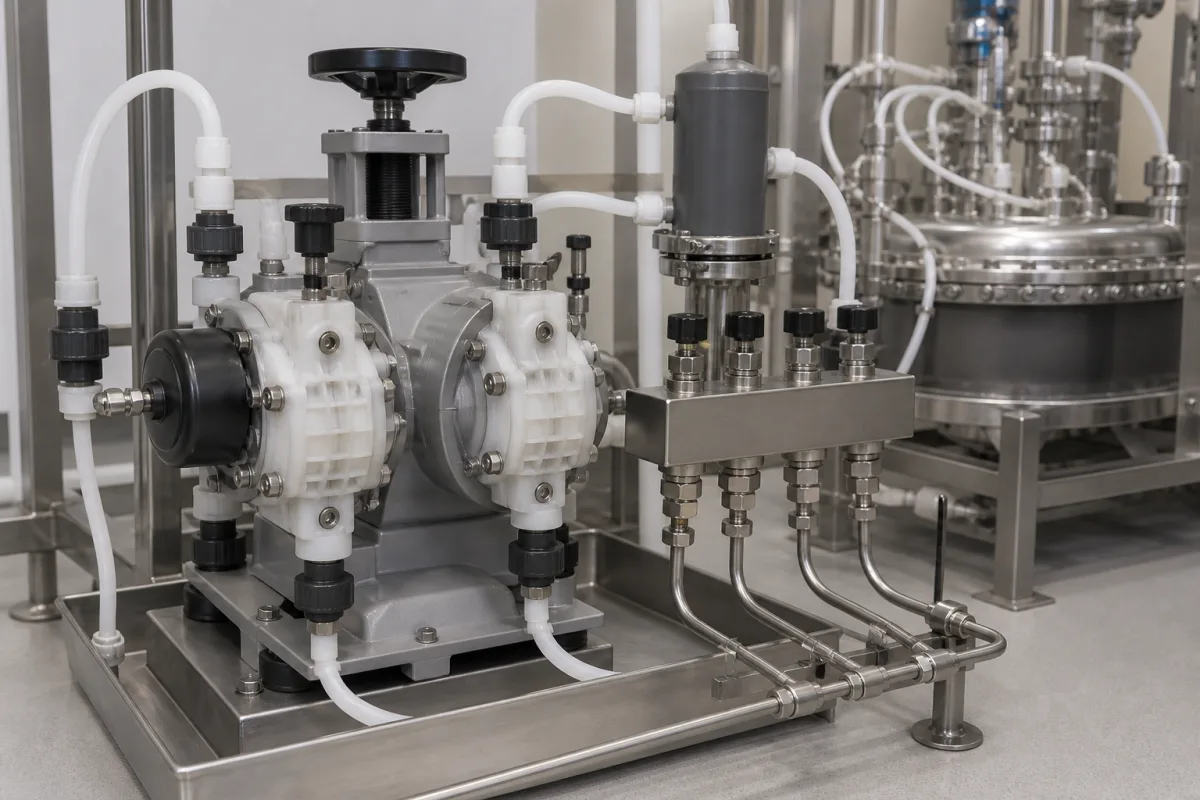
A canonical Oxidant Dispenser is characterized by the integration of Metering Valve and Distribution Manifold. In industrial production environments, manufacturers listed on CNFX commonly emphasize Stainless Steel (e.g., 316L) construction to support stable, high-cycle operation across diverse manufacturing scenarios.

A precision component within an Oxidation System that meters and distributes controlled amounts of oxidizing agents to reaction zones.
Product Specifications

Technical details and manufacturing context for Oxidant Dispenser

Definition
The Oxidant Dispenser is a critical subsystem component of an Oxidation System, responsible for the accurate measurement, controlled release, and uniform distribution of oxidizing agents (such as oxygen, ozone, or chemical oxidants) into process streams or reaction chambers. It ensures precise stoichiometric ratios and optimal contact between oxidants and target materials to facilitate efficient oxidation reactions while maintaining safety and process stability.
Working Principle
The dispenser typically operates via a combination of flow control mechanisms (such as valves, pumps, or injectors) and metering devices (like mass flow controllers or dosing pumps). It receives oxidant from a supply source, measures the required quantity based on system inputs or setpoints, and distributes it through nozzles, diffusers, or injection ports into the designated area of the Oxidation System. Control systems regulate the timing, rate, and distribution pattern to match process requirements.
Common Materials
Stainless Steel (e.g., 316L), PTFE (Polytetrafluoroethylene), Ceramic (for wear resistance)
Technical Parameters
  • Maximum oxidant flow rate capacity (L/min) Standard Spec
Components / BOM
  • Metering Valve
    Precisely controls the volume of oxidant released per cycle
    Material: Stainless Steel
  • Distribution Manifold
    Channels oxidant to multiple outlet ports for even dispersion
    Material: Stainless Steel or PTFE
  • Nozzle/Diffuser Array
    Creates optimal oxidant dispersion pattern in the reaction zone
    Material: Ceramic or Stainless Steel
Engineering Reasoning
0.5-15.0 bar at 20-80°C with flow rates of 0.1-5.0 L/min
18.7 bar internal pressure or 125°C fluid temperature
Design Rationale: Yield strength of 316L stainless steel (205 MPa) exceeded at 18.7 bar internal pressure in 25mm diameter tubing, or thermal expansion mismatch between ceramic metering valve (α=5.5×10⁻⁶/°C) and stainless steel housing (α=16.0×10⁻⁶/°C) causing stress cracking at ΔT>45°C
Risk Mitigation (FMEA)
Trigger Particulate contamination >25μm in oxidant stream
Mode: Metering valve seizure with 0.02mm clearance violation
Strategy: Install 10μm absolute filtration with differential pressure monitoring (ΔP>0.3 bar triggers bypass)
Trigger Electrochemical corrosion at pH<2.5 with chloride concentration >50ppm
Mode: Pitting corrosion penetration rate >0.5mm/year through passivation layer
Strategy: Apply 30μm thick PTFE lining with 100% coverage verification via holiday detection at 15kV

Industry Taxonomies & Aliases

Commonly used trade names and technical identifiers for Oxidant Dispenser.

Applied To / Applications

This component is essential for the following industrial systems and equipment:

Industrial Ecosystem & Supply Chain DNA

Complementary Systems
Downstream Applications
Specialized Tooling

Application Fit & Sizing Matrix

Operational Limits
pressure: 0 to 10 bar (g)
flow rate: 0.1 to 100 L/min
temperature: -20°C to 150°C
slurry concentration: Up to 30% solids by weight
Media Compatibility
✓ Hydrogen peroxide solutions ✓ Sodium hypochlorite solutions ✓ Ozone gas mixtures
Unsuitable: Hydrofluoric acid or HF-containing media
Sizing Data Required
  • Required oxidant mass flow rate (kg/h)
  • System operating pressure (bar)
  • Required dosing accuracy (% of setpoint)

Reliability & Engineering Risk Analysis

Failure Mode & Root Cause
Corrosion-induced leakage
Cause: Oxidant chemical attack on metallic components, especially at seals and joints, leading to material degradation and loss of containment integrity.
Dispersion nozzle clogging
Cause: Oxidant residue buildup or foreign particle ingress, obstructing flow paths and causing uneven or reduced dispersion performance.
Maintenance Indicators
  • Visible oxidant residue or discoloration around seals and joints indicating potential leakage
  • Audible hissing or irregular flow noise suggesting partial blockage or pressure fluctuation
Engineering Tips
  • Implement routine chemical compatibility checks and use corrosion-resistant materials (e.g., specialized alloys or coatings) for wetted parts
  • Establish a preventive cleaning schedule for dispersion nozzles and install fine filtration upstream to minimize particulate contamination

Compliance & Manufacturing Standards

Reference Standards
ISO 15848-1:2015 (Leakage testing of valve sealing performance) ANSI/ASME B16.34-2020 (Valves - Flanged, threaded, and welding end) DIN EN 10204:2004 (Metallic products - Types of inspection documents)
Manufacturing Precision
  • Flow rate accuracy: +/-2% of nominal value
  • Sealing surface flatness: 0.05mm maximum deviation
Quality Inspection
  • Pressure decay leak test (per ISO 15848-1)
  • Material composition verification via X-ray fluorescence (XRF) analysis

Factories Producing Oxidant Dispenser

Verified manufacturers with capability to produce this product in China

✓ 92% Supplier Capability Match Found

T Technical Director from United States Jan 14, 2026
★★★★★
"Great transparency on the Oxidant Dispenser components. Essential for our Chemical Manufacturing supply chain."
Technical Specifications Verified
P Project Engineer from United Arab Emirates Jan 11, 2026
★★★★☆
"The Oxidant Dispenser we sourced perfectly fits our Chemical Manufacturing production line requirements. (Delivery took slightly longer than expected, but technical support was excellent.)"
Technical Specifications Verified
S Sourcing Manager from Australia Jan 08, 2026
★★★★★
"Found 16+ suppliers for Oxidant Dispenser on CNFX, but this spec remains the most cost-effective."
Technical Specifications Verified
Verification Protocol

“Feedback is collected from verified sourcing managers during RFQ (Request for Quote) and factory evaluation processes on CNFX. These reports represent historical performance data and technical audit summaries from our B2B manufacturing network.”

11 sourcing managers are analyzing this specification now. Last inquiry for Oxidant Dispenser from Vietnam (1h ago).

Supply Chain Compatible Machinery & Devices

Modular Distillation Column System

Pre-engineered modular system for continuous separation of chemical mixtures via distillation.

Explore Specs →
Automated Batch Crystallization System

Automated system for controlled crystallization of chemical compounds in batch processes.

Explore Specs →
Automated pH Monitoring and Dosing System

Automated system for continuous pH monitoring and chemical dosing in process streams.

Explore Specs →
Automated Powder Dispensing and Blending System

Automated system for precise dispensing and homogeneous blending of powdered chemicals.

Explore Specs →

Frequently Asked Questions

What materials are used in the oxidant dispenser for corrosion resistance?

The dispenser uses 316L stainless steel for structural components, PTFE for sealing and chemical resistance, and ceramic for wear-resistant nozzle/diffuser elements.

How does the oxidant dispenser ensure precise distribution to reaction zones?

Through a combination of a precision metering valve and optimized nozzle/diffuser array, the dispenser delivers controlled, consistent oxidant amounts to specific reaction zones.

What maintenance is required for the oxidant dispenser in continuous operation?

Regular inspection of the metering valve and nozzle array, along with periodic replacement of PTFE seals, ensures optimal performance and prevents oxidant leakage.

Can I contact factories directly on CNFX?

CNFX is an open directory, not a transaction platform. Each factory profile provides direct contact information and production details to help you initiate direct inquiries with Chinese suppliers.

Get Quote for Oxidant Dispenser

Request technical pricing, lead times, or customized specifications for Oxidant Dispenser directly from verified manufacturing units.

Your business information is encrypted and only shared with verified Oxidant Dispenser suppliers.

Thank you! Your message has been sent. We'll respond within 1–3 business days.

Need to Manufacture Oxidant Dispenser?

Connect with verified factories specializing in this product category

Add Your Factory Contact Us
Previous Product
Outlet Port with Valve
Next Product
Oxygen Analyzer