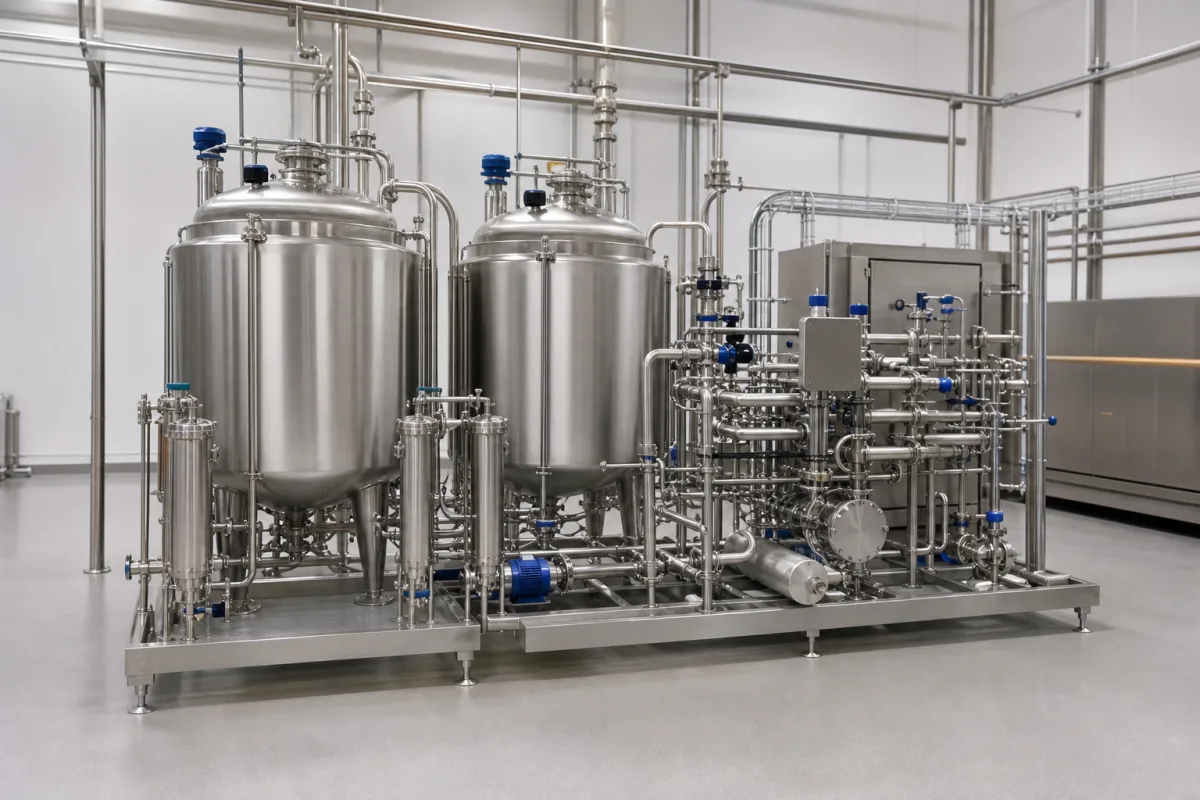
Ozone oxidation system for food-plant water and food-contact treatment
Food-plant ozone oxidation · Generator output and feed gas, contactor and contact time, off-gas destruction and the 0.1 ppm workplace limit
An ozone oxidation system makes ozone on site from dry air or oxygen, dissolves it into process water in a contactor, and destroys the unused ozone in the off-gas. In food plants it is specified as an antimicrobial treatment for water and for food-contact use. Ask three things first: how much ozone the generator makes at what concentration and power, how the gas is contacted with the water and for how long, and how off-gas and room air are kept within the workplace exposure limit.
Skid-built ozone oxidation systems for food and beverage plants: feed-gas preparation, ozone generator, contactor or injector, contact tanks, off-gas destruction and monitoring, supplied for water and food-contact antimicrobial treatment. Dough conditioners and bread improvers, including oxidising ingredients such as ascorbic acid, are covered on the Dough conditioners and bread improvers page. Thermal oxidisers for exhaust air, PCB brown-oxide lines and ozone used as a bleaching agent in flour are outside this page.
CNFX editorial research · Sources checked October 12, 2026 · 4 sources
EPA's Wastewater Technology Fact Sheet on ozone disinfection (EPA 832-F-99-063) explains that ozone is generated on site because it is unstable, by electrical discharge through extremely dry air or pure oxygen. The feed gas dew point must be −60 °C (−76 °F) or lower; gas generated from air contains about 0.5 to 3.0% ozone by weight, and pure oxygen forms about two to four times that concentration. [2]
Ozonia's OZAT CFS-14 2G data sheet gives a worked example of the trade-off. On oxygen it produces 730 g/h at a nominal 10 wt%; on air, 470 g/h at 3 wt%. Recommended regulation ranges are 6–12 wt% on oxygen and 3–5 wt% on air. It draws 8.55 kW at the mains, needs 1.09 m³/h of cooling water at 20 °C, and with oxygen feed all pipes and fittings must be suitable for oxygen service and free of oil and grease. [3]
Editorial calculation: 8.55 kW ÷ 0.730 kg/h ≈ 11.7 kWh per kg of ozone on oxygen feed, and 8.55 ÷ 0.470 ≈ 18.2 kWh/kg on air, assuming the same mains power on both feeds (the data sheet lists one power figure). [3]
Give the supplier the use (process water, wash water, CIP rinse, air or surface treatment), water flow and quality, target dissolved ozone or dose and contact time, feed gas (air or oxygen, with dew point), cooling water available, room ventilation, the off-gas route, the monitoring and interlocks required, and the food regulations the plant must meet.
02
Contact the ozone with the water and destroy the off-gas
EPA's fact sheet describes the contactor's job as transferring ozone from the gas bubble into the bulk liquid while giving enough contact time; it lists diffused-bubble (co-current and counter-current), positive-pressure injection, negative-pressure (Venturi), mechanically agitated and packed-tower contactors, and says ozone must be contacted uniformly in a near plug-flow contactor because it is consumed quickly. Contact time is approximately 10 to 30 minutes. [2]
The fact sheet adds that ozone is very reactive and corrosive, requiring corrosion-resistant material such as stainless steel, and that off-gases from the contactor must be destroyed to prevent worker exposure. [2] Ozonia lists 316 stainless steel, PTFE, PVDF and Viton as its ozone-wetted materials. [3]
OSHA's Table Z-1 in 29 CFR 1910.1000 sets the 8-hour time-weighted average permissible exposure limit for ozone at 0.1 ppm (0.2 mg/m³). [4] Editorial note: ask for ambient ozone monitors in the generator and contactor rooms with an interlock that stops generation on alarm, and for the off-gas destruct unit's rating at full generator output.
Editorial calculation: treating 20 m³/h of water at an applied dose of 2 g/m³ needs 40 g/h of ozone, about 5.5% of the CFS-14's 730 g/h oxygen-fed rating; a 20-minute contact time at that flow needs about 6.7 m³ of contactor volume. Flow and dose are assumed examples. [3][2]
03
Check the food-use authorisation
21 CFR 173.368 allows ozone to be used safely in the treatment, storage and processing of foods, including meat and poultry unless a standard of identity precludes it, as an antimicrobial agent, in the gaseous or aqueous phase in accordance with current industry good manufacturing practice. It describes ozone as produced commercially by passing electrical discharges or ionizing radiation through air or oxygen, and requires it to meet the Food Chemicals Codex specification. [1]
Editorial note: the rule authorises the substance, not a machine. Ask the supplier which food uses the system has been installed for and what records the controls keep (dose, dissolved ozone, contact time), so the plant can show good manufacturing practice.
04
From feed-gas dryer to off-gas destruct: the parts of an ozone skid
The parts below follow the gas path that EPA's fact sheet describes: feed-gas preparation, generation, contacting and destruction of the unused ozone.
Part
Role
Fix in the order
Feed-gas preparation
Dry air or oxygen at −60 °C dew point or lower. [2]
Ozone skid data to fix in the quotation: output, feed gas, power and footprint
Nearly every published value here comes from one generator, Ozonia's 730 g/h CFS-14; use them to check that a quotation states the same items for your duty, not as targets.
Explore company information and manufacturing capabilities, then discuss the scope of your project with a relevant supplier.
Share this page
Compiled and source-reviewed by the CNFX editorial team.
Each manufacturer above links to the page on that company's own website where the product is listed, with the date we checked it. How we source and review
· Page last updated 13 October 2026
Buyer questions
Is ozone allowed in food processing in the US?
21 CFR 173.368 allows ozone as an antimicrobial agent in the treatment, storage and processing of foods, in gas or aqueous phase under good manufacturing practice. [1]
Why feed oxygen instead of air?
EPA notes oxygen forms about two to four times the 0.5–3.0 wt% made from air; Ozonia's CFS-14 makes 730 g/h at 10 wt% on oxygen versus 470 g/h at 3 wt% on air. [2][3]
What is the workplace limit for ozone?
OSHA's Table Z-1 sets an 8-hour TWA of 0.1 ppm (0.2 mg/m³). [4]
Sources and what still needs a direct check
Sources checked 2026-10-12. 21 CFR 173.368 is an FDA regulation and Table Z-1 an OSHA regulation, both via eCFR; EPA's fact sheet is US government guidance; Ozonia's data sheet describes its own generator.