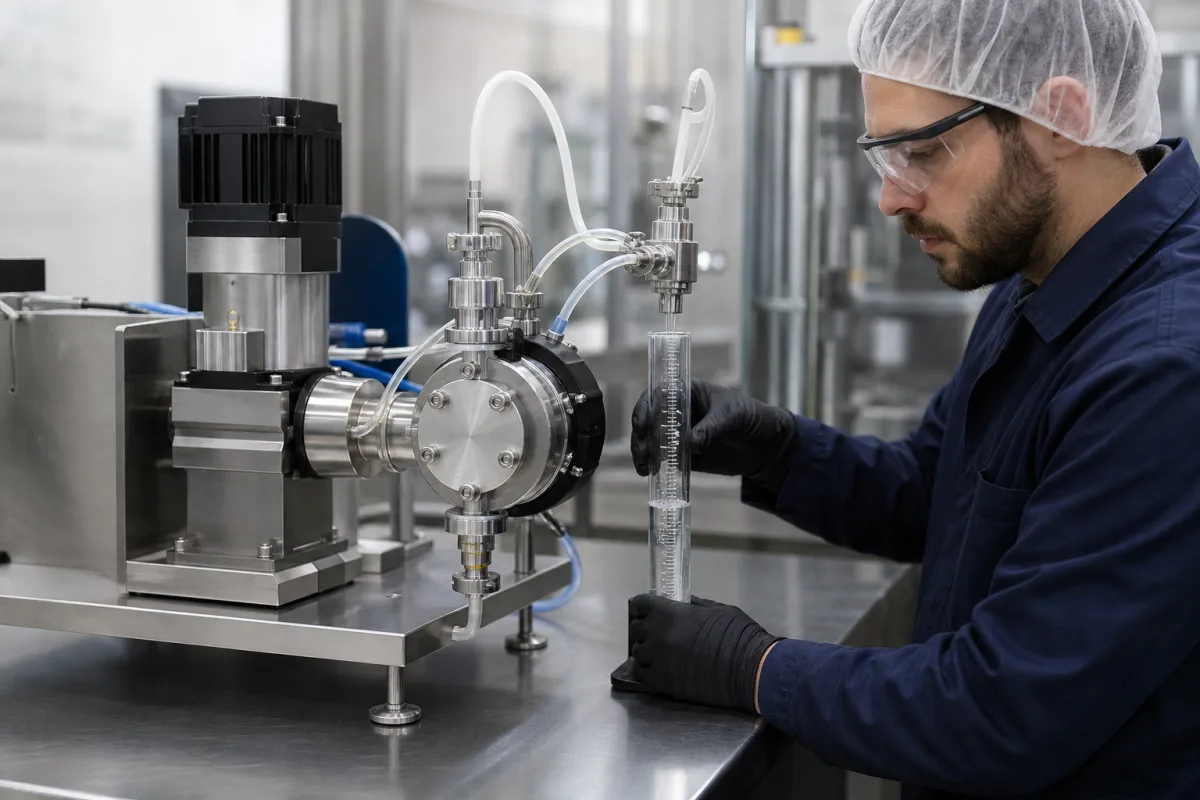
Precision metering pump for filling and dispensing (ceramic piston, per-shot volume)
Ceramic piston dispensing pumps · fixed volume per shot or revolution, stepper or servo drive, valveless or rotary-valve heads for filling and dispensing machines
A precision metering pump for filling and dispensing is a positive-displacement piston pump, on the reviewed designs with a ceramic piston and liner, driven by a stepper or servo motor so that each shot or revolution moves a fixed, programmable volume. It sits on filling machines, battery electrolyte injectors and analytical or medical instruments. Ask three things first: what volume per shot or revolution and what repeat precision the maker states, which valve arrangement (valveless rotating piston or rotary valve) and wetted materials the head uses, and what drive and pressure rating come with it.
Ceramic piston dispensing and filling pumps — valveless rotating-reciprocating piston pumps and rotary-valve plunger pumps — that deliver programmable volumes from below 1 µL to tens of millilitres per shot or revolution for filling machines, electrolyte injection and instruments. Diaphragm, plunger, peristaltic and gear metering pumps for continuous chemical dosing in water treatment and process plants are covered on the Metering pump page. Complete filling machines and syringe pumps are outside this page.
CNFX editorial research · Sources checked October 12, 2026 · 5 sources
Read volume per shot and repeat precision as the maker defines them
Takasago's CAP series is a valveless ceramic piston pump driven by a 2-phase bipolar stepper motor (5–300 rpm) with an optical sensor; standard volumes are 50, 100, 200 and 300 µL per shot, discharge pressure is 150 kPa, and repeat precision is stated as 0.5% or less, tested at 100 rpm, 10 shots, under no-load conditions. Takasago also states a life of 10 million cycles or more under its own test conditions. [1]
Fluid Metering's FENYX variable dispense pump lists three heads: FENYX-100 at 0.75–110 µL per revolution (0.00075–110 mL/min), FENYX-200 at 2–200 µL/rev and FENYX-400 at 4–400 µL/rev, with operating pressure 0–30 psig (0–2.1 bar) and non-contact dispensing down to 4 µL. [2] Its linearly driven TRYTON ceramic piston pump dispenses 0–150 µL with a resolution of 0.031 µL per full motor step and flows from 0.105 µL/s at 1 rpm to 125.6 µL/s at 1200 rpm, at 0–100 psig (0–6.89 bar). [3]
For filling lines, XUEFILL states a fill accuracy of ±0.25% to ±0.5% across its ceramic metering pump series, with maximum discharge per revolution from 100 µL/rev to 50 mL/rev; its perfume filling pump is adjustable from 0.5 mL to 20 mL at ≤±0.25%. [4]
Editorial calculation: a coefficient of variation of 0.5% on a 100 µL shot is a standard deviation of about 0.5 µL (100 × 0.005). A full 150 µL TRYTON stroke at 0.031 µL per step is about 4,800 full steps (150 ÷ 0.031 ≈ 4,839). [1][3] Editorial note: Takasago quotes repeatability under no load, and XUEFILL quotes fill accuracy; ask each supplier to state which they mean and to test with your liquid, viscosity and back-pressure.
Give the supplier the liquid (viscosity, solids, solvent, temperature), target volume per fill and range, required precision and how it is weighed, fills per minute, back-pressure at the nozzle, and the controller interface.
02
Choose the pump head, wetted materials and drive
XUEFILL describes its rotary ceramic plunger cycle: as the plunger rotates and moves backward with its flow channel facing the inlet, chamber volume grows and draws liquid in; the plunger then rotates so the channel faces the outlet and moves forward to expel it, so the plunger itself acts as the valve. [4]
XUEFILL lists 99.99% alumina or zirconia ceramic for the plunger and sleeve, with silicon carbide as an option, and 316L or 316 stainless steel for other liquid-contact parts; its XBTGS-30 pump is servo-driven with a ceramic rotary valve and set from a colour touchscreen. [4] UBA (Foshan Hi-Tech Machineries) describes its ER series as electrically driven rotary-valve plunger pumps with a high-purity ceramic rotary valve, a ground ceramic plunger and liner, and a precision lead-screw drive by stepper or servo motor, used for electrolyte injection in battery production. [5]
Takasago's CAP pump wets only PVDF or PTFE body material and Al₂O₃ ceramic, runs on 24 V DC, handles fluid at 0–60 °C in a 0–40 °C ambient, and weighs about 620 g in a 130 × 84 × 68 mm envelope. [1] Fluid Metering's FENYX uses a NEMA 17 rotational motor (up to 1000 rpm, 2.0 A) and a NEMA 11 linear motor (up to 1900 rpm, 1.0 A) and operates at 0–50 °C. [2]
03
Valveless or valved: published ceramic piston pumps
Ask each supplier for the stated precision with its test method, the volume range of the exact head, wetted materials and the drive and controller supplied.
One maker lists ceramic metering pumps by series (XBW, XBWI, XBWH, XBTG, XBDG-50, XBZG-50, XBS, XBTGS) for liquid filling; the other lists liquid injection pumps with ceramic rotary valves and plungers.
Explore company information and manufacturing capabilities, then discuss the scope of your project with a relevant supplier.
Share this page
Compiled and source-reviewed by the CNFX editorial team.
Each manufacturer above links to the page on that company's own website where the product is listed, with the date we checked it. How we source and review
· Page last updated 13 October 2026
Buyer questions
How is a precision metering pump different from a dosing metering pump?
A dosing metering pump feeds chemicals continuously into a process; a precision dispensing pump moves a fixed volume per shot or revolution, e.g. 50–300 µL per shot on Takasago's CAP or up to 50 mL per revolution on XUEFILL pumps. [1][4]
What does a valveless ceramic piston pump mean?
The ceramic piston both reciprocates and rotates, so its channel opens to the inlet on the suction stroke and to the outlet on the discharge stroke without check valves. [4][1]
How small a volume can these pumps dispense?
Fluid Metering states its TRYTON pump can dispense less than 1 µL, with 0.031 µL per full motor step. [3]
Sources and what still needs a direct check
Sources checked 2026-10-12. Takasago and Fluid Metering publish specifications for their own ceramic piston pumps; XUEFILL and UBA are Chinese makers describing their own filling pumps.