Industry-Verified Manufacturing Data (2026)

Cell Housing Assembly

Based on aggregated insights from multiple verified factory profiles within the CNFX directory, the standard Cell Housing Assembly used in the Computer, Electronic and Optical Product Manufacturing sector typically supports operational capacities ranging from standard industrial configurations to heavy-duty production requirements.

Technical Definition & Core Assembly

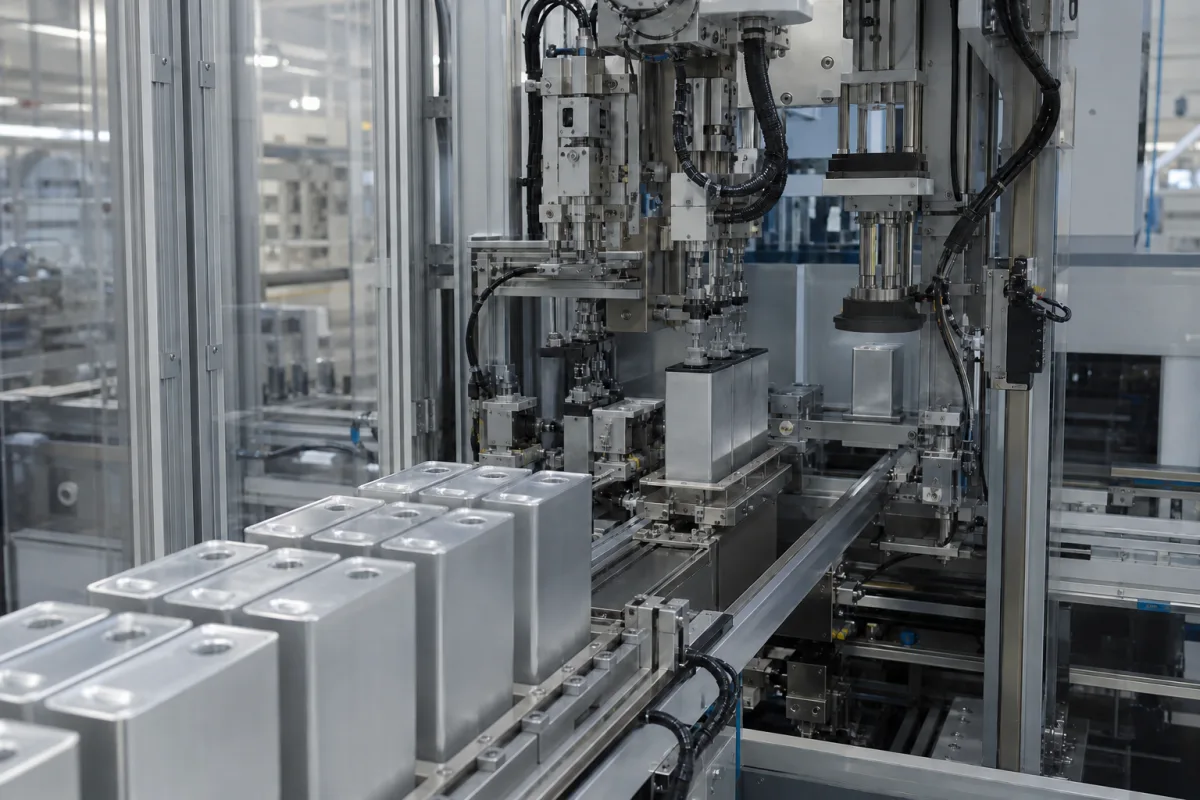
A canonical Cell Housing Assembly is characterized by the integration of Housing Can (or Pouch) and Cap/Lid Assembly. In industrial production environments, manufacturers listed on CNFX commonly emphasize Aluminum alloy construction to support stable, high-cycle operation across diverse manufacturing scenarios.

The structural enclosure that contains and protects the internal components of a lithium-ion battery cell.

Product Specifications

Technical details and manufacturing context for Cell Housing Assembly

Definition
A critical component within the Lithium-Ion Battery Cell Assembly System, the Cell Housing Assembly serves as the primary structural and protective enclosure for the cell's internal components, including the electrodes, separator, and electrolyte. It ensures mechanical integrity, provides electrical insulation where required, and often facilitates thermal management and safety features such as venting mechanisms.
Working Principle
The assembly functions as a sealed or semi-sealed container. It physically constrains the cell's internal components, maintains electrode alignment and pressure, and provides the necessary interface points (e.g., terminals, safety vents) for integration into battery modules or packs. Its design is critical for preventing internal short circuits, containing thermal runaway, and withstanding external mechanical stresses.
Common Materials
Aluminum alloy, Stainless steel, Nickel-plated steel
Technical Parameters
  • Overall external dimensions (length, width, height) and internal cavity dimensions to precisely fit the cell jellyroll or stack. (mm) Customizable
Components / BOM
  • Housing Can (or Pouch)
    Forms the main sealed body of the enclosure.
    Material: Aluminum alloy or laminated polymer film
  • Cap/Lid Assembly
    Seals the open end of the can, often incorporating terminals and safety vents.
    Material: Aluminum alloy or steel
  • Positive Terminal
    Electrical connection point for the cell's cathode.
    Material: Aluminum or aluminum alloy
  • Negative Terminal
    Electrical connection point for the cell's anode.
    Material: Copper or nickel-plated steel
  • Safety Vent (CID)
    Pressure relief device that opens at a specified pressure to prevent rupture.
    Material: Stainless steel or aluminum
  • Insulating Gasket/Seal
    Provides electrical insulation and hermetic seal between the can and cap.
    Material: Polypropylene (PP), Polyphenylene Sulfide (PPS), or other high-temperature polymers
Engineering Reasoning
0-150°C, 0-3.5 MPa internal pressure, 0.1-1.0 mm wall thickness
Yield strength exceedance at 250 MPa stress, 200°C thermal softening threshold, 4.2 MPa burst pressure
Design Rationale: Von Mises yield criterion violation due to internal gas pressure from electrolyte decomposition (C6Li + LiPF6 → LiF + PF5 + C2H4), thermal creep deformation above 0.4Tm (Tm=933K for Al-3003)
Risk Mitigation (FMEA)
Trigger Internal short circuit generating 1000A current through 0.1Ω resistance
Mode: Joule heating reaching 1000°C causing aluminum melting point (660°C) exceedance
Strategy: Ceramic-coated separator with 2000V/μm dielectric strength, PTC current limiter with 80°C trip temperature
Trigger Electrolyte oxidation at cathode producing O2 gas via 4.6V vs Li/Li+ potential
Mode: Internal pressure exceeding 4.2 MPa causing tensile failure at 0.5mm wall thickness
Strategy: Pressure relief valve with 3.8 MPa burst disk, vent channel design with 2.0 mm² flow area

Industry Taxonomies & Aliases

Commonly used trade names and technical identifiers for Cell Housing Assembly.

Industrial Ecosystem & Supply Chain DNA

Complementary Systems
Downstream Applications
Specialized Tooling

Application Fit & Sizing Matrix

Operational Limits
pressure: 0 to 5 bar internal pressure, 0 to 2 bar external pressure differential
other spec: Electrolyte compatibility: organic carbonate-based lithium salts, Slurry concentration: N/A (solid assembly), Flow rate: N/A (static enclosure)
temperature: -40°C to 85°C (operational), -60°C to 150°C (storage)
Media Compatibility
✓ Lithium hexafluorophosphate (LiPF6) electrolyte ✓ N-Methyl-2-pyrrolidone (NMP) solvent systems ✓ Aluminum and copper current collectors
Unsuitable: Aqueous electrolytes or high-moisture environments (>1000 ppm H2O)
Sizing Data Required
  • Cell dimensions (length × width × height)
  • Electrode stack thickness and number of layers
  • Required internal volume for electrolyte and gas expansion

Reliability & Engineering Risk Analysis

Failure Mode & Root Cause
Fatigue cracking at weld joints
Cause: Cyclic thermal and mechanical stresses from assembly/disassembly cycles, combined with vibration from adjacent equipment, leading to crack initiation and propagation at stress concentration points.
Corrosion and material degradation
Cause: Exposure to process fluids, atmospheric moisture, or chemical residues, exacerbated by improper material selection, inadequate surface protection, or contamination from adjacent components.
Maintenance Indicators
  • Visible cracks, discoloration, or material loss at weld seams or mounting points
  • Unusual vibration, rattling noises, or misalignment during operation indicating structural compromise
Engineering Tips
  • Implement regular non-destructive testing (e.g., ultrasonic or dye penetrant inspection) of critical welds and stress points to detect early-stage defects before catastrophic failure.
  • Apply protective coatings or cathodic protection where applicable, and ensure proper material compatibility with process environment through corrosion resistance analysis during design phase.

Compliance & Manufacturing Standards

Reference Standards
ISO 9001:2015 - Quality Management Systems ASTM E8/E8M - Standard Test Methods for Tension Testing of Metallic Materials CE Marking - Conformity with EU Directives (e.g., Machinery Directive 2006/42/EC)
Manufacturing Precision
  • Bore Diameter: +/-0.025 mm
  • Surface Flatness: 0.05 mm per 100 mm
Quality Inspection
  • Dimensional Verification with CMM (Coordinate Measuring Machine)
  • Leak Test (Helium or Pressure Decay Method)

Factories Producing Cell Housing Assembly

Verified manufacturers with capability to produce this product in China

✓ 92% Supplier Capability Match Found

S Sourcing Manager from United States Feb 17, 2026
★★★★★
"As a professional in the Computer, Electronic and Optical Product Manufacturing sector, I confirm this Cell Housing Assembly meets all ISO standards."
Technical Specifications Verified
P Procurement Specialist from United Arab Emirates Feb 14, 2026
★★★★☆
"Standard OEM quality for Computer, Electronic and Optical Product Manufacturing applications. The Cell Housing Assembly arrived with full certification. (Delivery took slightly longer than expected, but technical support was excellent.)"
Technical Specifications Verified
T Technical Director from Australia Feb 11, 2026
★★★★★
"Great transparency on the Cell Housing Assembly components. Essential for our Computer, Electronic and Optical Product Manufacturing supply chain."
Technical Specifications Verified
Verification Protocol

“Feedback is collected from verified sourcing managers during RFQ (Request for Quote) and factory evaluation processes on CNFX. These reports represent historical performance data and technical audit summaries from our B2B manufacturing network.”

10 sourcing managers are analyzing this specification now. Last inquiry for Cell Housing Assembly from Germany (27m ago).

Supply Chain Compatible Machinery & Devices

Industrial IoT Gateway

Edge computing device connecting industrial equipment to cloud platforms.

Explore Specs →
Modular Industrial Edge Computing Device

Rugged computing platform for industrial data processing at the network edge

Explore Specs →
Industrial Smart Camera Module

Embedded vision system for industrial automation and quality inspection.

Explore Specs →
Industrial Wireless Power Transfer Module

Wireless power transfer module for industrial equipment applications

Explore Specs →

Frequently Asked Questions

What materials are commonly used in cell housing assemblies for lithium-ion batteries?

Cell housing assemblies are typically manufactured from aluminum alloy, stainless steel, or nickel-plated steel to provide structural integrity, corrosion resistance, and electrical conductivity while protecting internal battery components.

What is the purpose of the safety vent (CID) in a battery cell housing?

The safety vent, or Current Interrupt Device (CID), is a critical safety feature that activates under excessive internal pressure or temperature, disconnecting the circuit to prevent thermal runaway and potential battery failure.

How does the cell housing assembly impact battery performance and safety?

The housing provides mechanical protection for electrodes and electrolytes, maintains structural stability during charge cycles, enables proper thermal management, and incorporates safety mechanisms like terminals and vents to ensure reliable operation in electronic devices.

Can I contact factories directly on CNFX?

CNFX is an open directory, not a transaction platform. Each factory profile provides direct contact information and production details to help you initiate direct inquiries with Chinese suppliers.

Get Quote for Cell Housing Assembly

Request technical pricing, lead times, or customized specifications for Cell Housing Assembly directly from verified manufacturing units.

Your business information is encrypted and only shared with verified Cell Housing Assembly suppliers.

Thank you! Your message has been sent. We'll respond within 1–3 business days.

Need to Manufacture Cell Housing Assembly?

Connect with verified factories specializing in this product category

Add Your Factory Contact Us
Previous Product
Cell Balancing Circuit
Next Product
Cell Monitoring Circuit