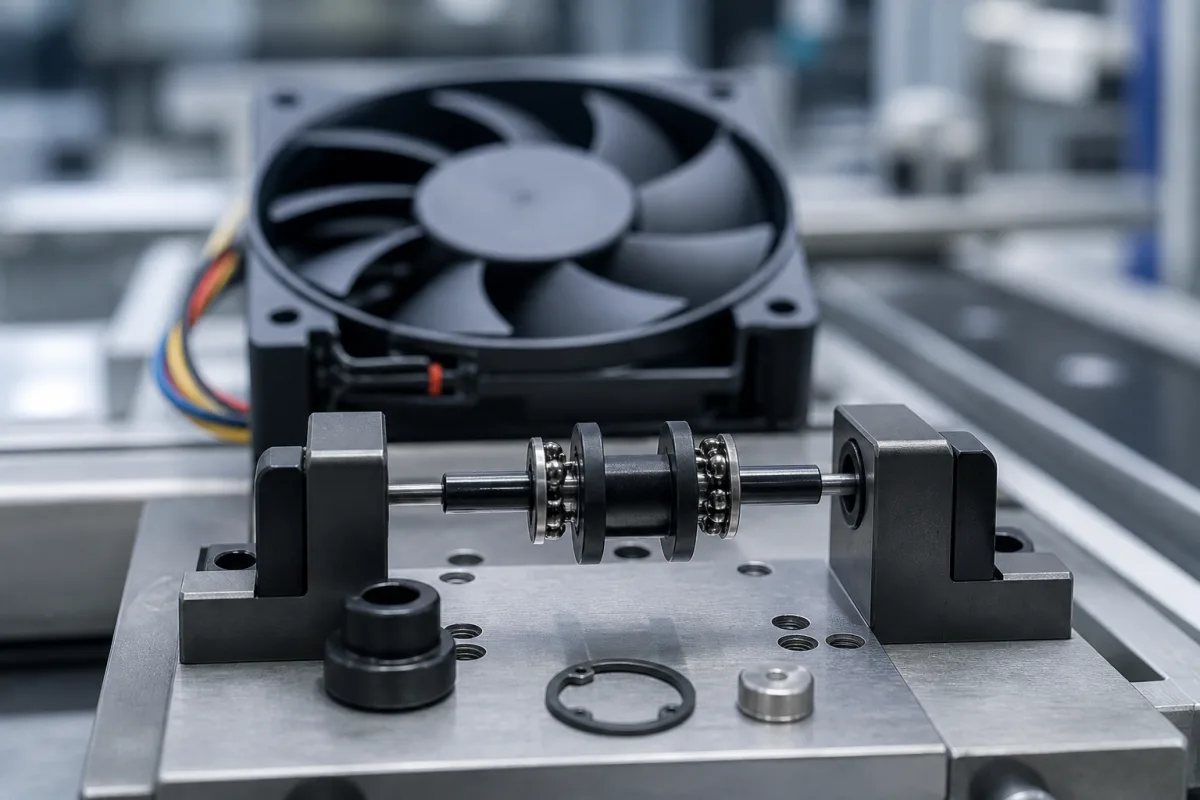
Cooling fan bearing assembly: a spring-preloaded pair of miniature ball bearings on the fan shaft
The shaft, two miniature ball bearings, spacer, preload spring and retaining ring inside a DC cooling fan · how the pair is preloaded, and why grease life at the bearing's temperature sets the fan's life
In a ball-bearing DC fan the impeller shaft runs in two small ball bearings; in an assembly like the one pictured they are separated by a spacer, preloaded by a spring and held by a retaining ring. That bearing assembly decides how long and how quietly the fan runs. Its design questions are the preload method and spring, the bearing size against speed, and above all the grease and the temperature the bearings run at.
The bearing system of small DC and EC cooling fans: shaft, paired miniature ball bearings, spacer, preload spring and retaining ring, their preload method, grease and the life that results. Choosing a whole cooling fan by airflow, static pressure, frame, voltage and rated life is covered on the Cooling fan (DC axial cooling fan for enclosures) page. Sleeve and fluid-dynamic bearings and industrial fan bearings in pillow blocks are outside this page except where compared.
CNFX editorial research · Sources checked October 12, 2026 · 3 sources
Spring preload across two shaft bearings, against deadweight bonding or solid clamping
Two bearings on one shaft need a small axial preload to take out play; Dynaroll, a miniature bearing maker, compares the three ways of applying it.
Dynaroll warns that with Belleville or wavy-washer springs the tolerance stack-up of mating parts can vary the spring compression by a large percentage of its maximum, so preload can vary by a large amount unless a spring with a low spring rate is used. [1]
Editorial note: where a fan uses a coil or wave spring against one bearing ring, ask the fan maker which ring is loaded, the spring type and the preload range, because preload variation shows up as noise and as changes in bearing temperature.
Preload method
How it works
Stated advantages and drawbacks
Deadweight
A fixed weight is set against a bearing ring while adhesive cures to retain the bearings [1]
Well-controlled torque and maximum stiffness; cure time and adhesive handling in mass production; relative thermal expansion must be allowed for with different materials [1]
Spring
A spring presses the inner rings together or the outer rings apart [1]
Easy to assemble and minimises thermal effects from relative expansion; stiffness is set by the spring rate rather than ball-raceway elasticity; used in high-speed applications [1]
Solid clamping
Parts machined so that clamping the rings removes axial play [1]
Few parts and good stiffness in theory, but hard to achieve because bearing axial play varies; risk of raceway brinelling or too little preload unless parts are matched [1]
For a bearing assembly drawing or quotation, state bearing size and series, shield or seal type, radial clearance, spring type and preload force, spacer length, shaft and bore fits, retaining ring type, and the grease and fill.
02
Grease life by bearing temperature: about 40,000 h at 40–70 °C, falling 1.5× per 10 °C above and sharply in the cold
A fan maker and a tribology study both point to the grease, not fatigue, as the life limit at fan loads.
ebm-papst distinguishes the mechanical L10 life to DIN ISO 281, the time until 10% of a large population of bearings fail by material fatigue, from grease service life. It states that with the low forces in a fan mechanical life need not be critical, and that grease life can be the limit for the bearing and so for the fan; ebm-papst calculates grease life from its own data using speed-dependent relubrication intervals and temperature factors, under worst-case full-load, high-temperature assumptions. [2]
Booser and Khonsari, writing in STLE's magazine, describe grease life (to 10% failures) in four temperature zones for premium mineral-oil grease in single-row ball bearings. [3]
Bearing temperature zone
Limiting mechanism
Life relation or value
Above about 160 °C
Oxidation hardens and dries the grease
Life halves for each 10 °C rise; about 300 h at 180 °C in ASTM D3527 tests [3]
70–160 °C
Oil loss by evaporation, bleeding and creep
Life falls by 1.5 for each 10 °C rise: log L = −2.60 + 2450/(273 + °C) for premium greases [3]
40–70 °C
Supplier experience
About 40,000 h relubrication life quoted by SKF and FAG for mild conditions [3]
Below 40 °C
Stiffer grease and less mobile oil
Life scales with the square of oil viscosity; for a lithium mineral-oil grease 40,000 h at 40 °C, 3,900 h at 20 °C, 40 h at 0 °C [3]
Ask for the fan's rated life with its temperature and speed basis, the bearing grease type and its temperature range, and whether the life figure is L10 or a mean; compare fans at the same bearing temperature.
03
Speed limits for grease-lubricated ball bearings and what they mean for a 5 mm fan shaft
Grease life also falls with surface speed, measured as DN (bore in mm times rpm).
Booser and Khonsari give approximate DN limits for grease lubrication of 270,000 for ABEC 1 ball bearings with steel cages, 330,000 with phenolic cages and 400,000 for ABEC 5 and 7 bearings with phenolic cages; silicone greases showed limits about 35% lower. They report that outer-ring rotation reduced grease life to 42% of that with inner-ring rotation, and that loads affect grease life only to a minor extent for C/P above 4. [3]
Editorial calculation: with the warm-zone equation, premium grease life is about 34,900 h at 70 °C, 21,900 h at 80 °C and 14,100 h at 90 °C. A 5 mm bore bearing at 3,000 rpm runs at DN 15,000, and at 10,000 rpm at DN 50,000, both well under the 270,000 limit, so in small fans temperature rather than speed sets grease life. For the lithium grease in the cold-zone table, life at 20 °C works out to 40,000 × (125/400)² ≈ 3,900 h, as listed.
State the fan's maximum speed and the bearing bore so DN can be checked, and the lowest storage and start-up temperatures if the fan must start cold.
04
Data for a fan bearing assembly
Paste it into your enquiry below or into an email to a maker, then replace every bracket.
Fan: [frame size; speed; voltage; orientation]
Bearings: [size and series; shields or seals; radial clearance; precision class]
Preload: [spring type; force; which ring loaded; spacer]
Shaft and fits: [shaft diameter; bore fits; retaining ring]
Grease: [type; fill; temperature range]
Life: [required life; bearing or ambient temperature basis; L10 or mean]
Noise: [acoustic limit; vibration grade]
Explore company information and manufacturing capabilities, then discuss the scope of your project with a relevant supplier.
Share this page
Compiled and source-reviewed by the CNFX editorial team.
Each manufacturer above links to the page on that company's own website where the product is listed, with the date we checked it. How we source and review
· Page last updated 13 October 2026
Buyer questions
What limits the life of a ball-bearing cooling fan?
ebm-papst states that with the low loads in a fan, grease service life rather than mechanical L10 fatigue life can be the limit. [2]
How does temperature affect fan bearing grease life?
Booser and Khonsari give about 40,000 h at 40–70 °C, a 1.5-fold drop per 10 °C from 70 to 160 °C, halving per 10 °C above about 160 °C, and steep losses below 40 °C. [3]
Why are fan bearings preloaded with a spring?
Dynaroll notes that spring preload is easy to assemble, minimises thermal expansion effects and is used at high speed, though stiffness is then set by the spring rate. [1]
Sources and what still needs a direct check
Sources checked 2026-10-12. Dynaroll is a miniature bearing maker describing preload methods; ebm-papst is a fan maker describing its life calculation; Booser and Khonsari's STLE article gives grease life relations for ball bearings as a class.