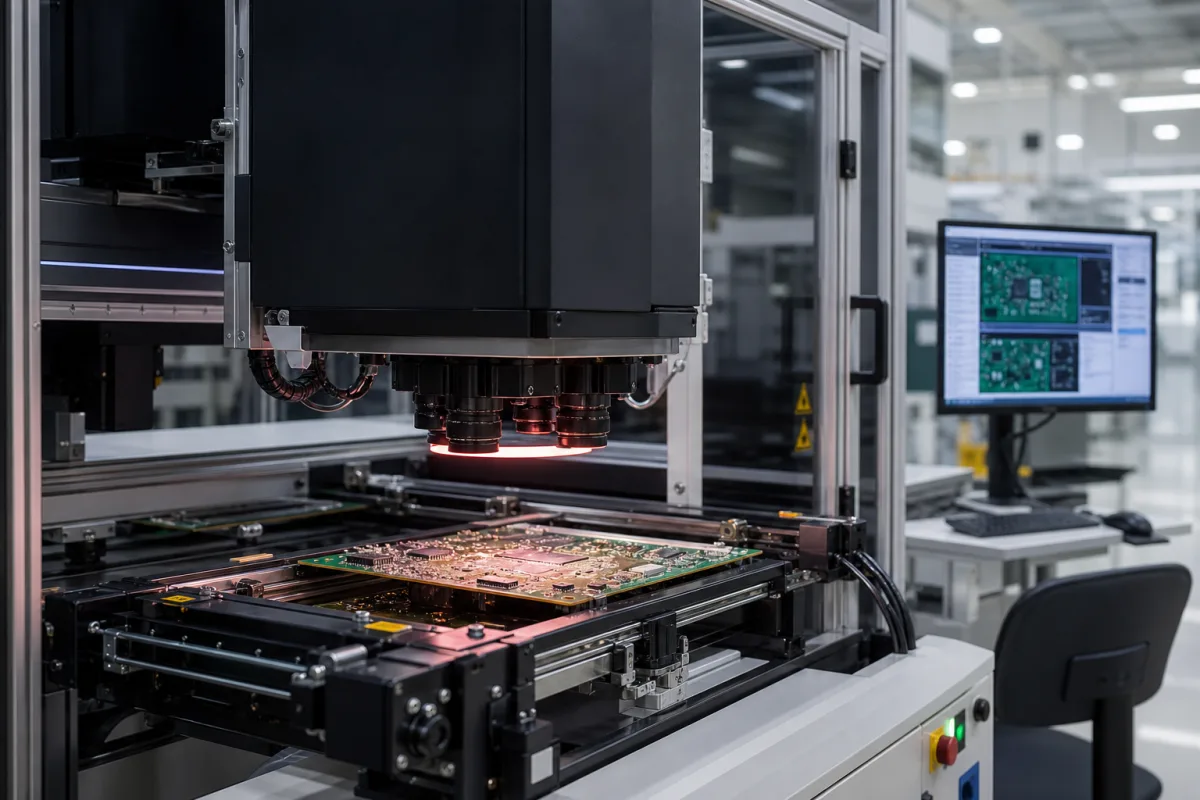
Automated optical inspection (AOI) system for PCB assembly
AOI for assembled PCBs · 2D versus 3D measurement, pixel resolution and height range, imaging speed and the defects covered
An automated optical inspection (AOI) system for PCB assembly is an in-line machine that photographs printed circuit boards after component placement or soldering and compares the images with the expected result to find missing, misplaced or wrongly soldered parts. Ask three things first: whether it inspects in 2D only or also measures height in 3D, what pixel resolution and height range it offers for your smallest and tallest parts, and how fast it images your largest board.
In-line and desktop AOI machines for assembled printed circuit boards, before or after reflow, in 2D or 3D. Bare-board AOI used in PCB fabrication, solder paste inspection (SPI) machines and X-ray inspection are outside this page.
CNFX editorial research · Sources checked October 11, 2026 · 4 sources
NeoDen's ND800 in-line AOI is a 2D system with a 5-megapixel full-colour camera (16 or 20 megapixels optional) and an optional telecentric lens so that tilted and tall components show clearly. It lists component defects — missing or extra parts, misalignment, reversed or wrong parts — and solder defects — excess or missing solder, bridging, solder balls and copper stain — for boards from 50 × 50 to 400 × 360 mm and 0.3–5 mm thick, with ≤8 µm XY positioning accuracy and SMEMA line communication. [1]
Omron's VT-S730 3D AOI family, in a distributor's brochure, combines RGB lighting, DLP projection and a phase-shift method so that it measures height as well as colour images, with telecentric optics giving 15 µm planar, 10 µm oblique and 1 µm height resolution, height measurement up to 25 mm, and component clearance of 40 mm above and below a board of 50 × 50 to 510 × 460 mm, 0.4–4 mm thick and up to 4 kg. [2]
Editorial note: 2D inspection judges from colour and shading, whereas 3D measurement reports actual heights of components, leads and solder fillets; ask suppliers which defects each mode detects on your sample boards, and what the false-call rate is.
Give the supplier sample boards with known defects, the smallest and tallest components, board size, thickness and weight, line speed and takt time, position in the line (pre- or post-reflow), 2D or 3D requirement, defect list, traceability and MES needs, and line communication standard.
02
Check pixel resolution, height range and imaging speed
Saki announced its 3Di series of in-line 3D AOI systems for high-density boards mixing very small and tall parts, including 008004 (0201 metric) components, with a camera resolution of 8 µm, a height measurement range of 25 mm and an imaging speed of 4,500 mm²/s. [3]
Omron notes that other resolutions are available on request and that its programming is wizard-guided, with image capture taking about five minutes after which the machine is no longer needed for programming and debugging. [2] NeoDen lists a maximum transfer speed of 830 mm/s. [1]
Editorial calculation: the metric 0201 code denotes a 0.2 × 0.1 mm part, so at 8 µm per pixel its 0.1 mm width spans about 12 pixels, and at 15 µm about 7. Imaging a 400 × 360 mm board (144,000 mm²) at 4,500 mm²/s takes about 32 s before handling time. Board size is an assumed example. [3][2]
03
Turn field of view and imaging speed into board time
Viscom's specification for its iS6059 PCB Inspection Plus in-line 3D AOI gives the figures needed to estimate inspection time: XMplus-II 3D camera technology with 0.5 µm z-resolution, a 50 × 50 mm field of view, inspection speed of up to 80 cm²/s, and PCB dimensions of 508 × 508 mm, with a longboard option for boards up to 720 mm long. It lists components down to 03015 and fine-pitch parts, and defect features including tombstoning, billboarding, lifted leads, bent pins, polarity errors and solder bridging. [4]
Editorial calculation: a 508 × 508 mm board is 258,064 mm²; at 80 cm²/s (8,000 mm²/s) imaging takes about 32 s, and at Saki's stated 4,500 mm²/s about 57 s, before board transfer and any re-imaging. With a 50 × 50 mm (2,500 mm²) field of view the board needs at least 104 image positions (258,064 / 2,500 = 103.2, rounded up), more with tile overlap. Run the same estimate on your own panel size and ask each supplier for the measured cycle time on your board. [4][3]
Suppliers linked to this page list AOI machines for assembled PCBs; each card links to the page reviewed.
The listing reviewed is a 2D in-line AOI with a colour camera sold alongside pick-and-place machines; ask for detection and false-call results on your own boards.
05
Trace the system components
This is a functional reference built from the sources cited; it is not one maker's specification.
Fill the specification fields with values for your parts
An AOI quotation needs values for your boards and line. The table explains each field, gives published values where a reviewed source states them, and says what to obtain from the supplier.
Explore company information and manufacturing capabilities, then discuss the scope of your project with a relevant supplier.
Share this page
Compiled and source-reviewed by the CNFX editorial team.
Published product pages show what a company offers, not tested performance. Confirm the legal seller, factory and scope for your order. How we source and review
· Page last updated 13 October 2026
Buyer questions
What is the difference between 2D and 3D AOI?
2D systems such as NeoDen's ND800 use colour images; 3D systems such as Omron's VT-S730 add phase-shift height measurement up to 25 mm. [1][2]
Saki states an imaging speed of 4,500 mm²/s for its 3Di series. [3]
What defects does AOI find?
NeoDen lists missing, misaligned, reversed or wrong parts and solder bridging, excess or missing solder and solder balls. [1]
How long does a 3D AOI take to image a large board?
Editorial calculation from Viscom's iS6059 data: a 508 × 508 mm board at up to 80 cm²/s takes about 32 s of imaging, using at least 104 positions of its 50 × 50 mm field of view. [4]
Sources and what still needs a direct check
Sources checked 2026-10-11. NeoDen, Viscom and Omron (via a distributor brochure) publish their own machine data; the Saki figures come from its announcement in trade press. Values are those makers' specifications.