Industry-Verified Manufacturing Data (2026)

Counting Circuitry

Based on aggregated insights from multiple verified factory profiles within the CNFX directory, the standard Counting Circuitry used in the Computer, Electronic and Optical Product Manufacturing sector typically supports operational capacities ranging from standard industrial configurations to heavy-duty production requirements.

Technical Definition & Core Assembly

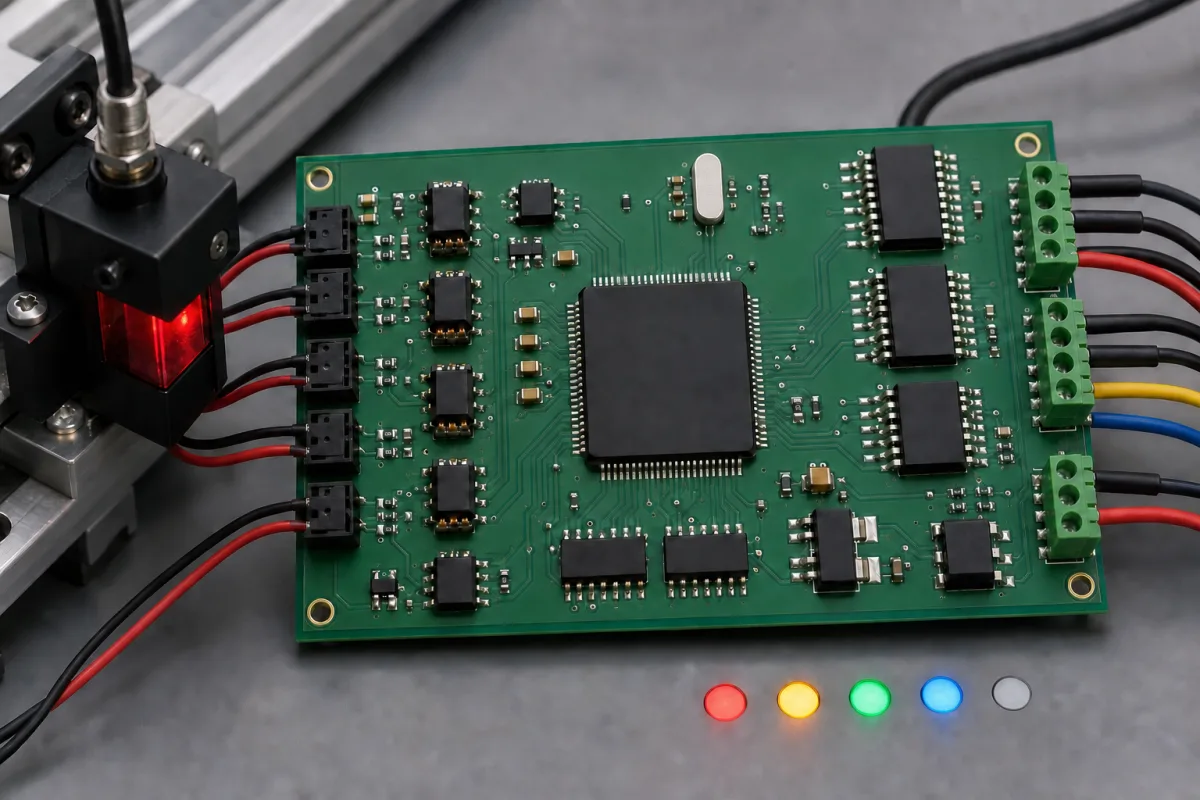
A canonical Counting Circuitry is characterized by the integration of Flip-Flop / Counter Register and Clock Oscillator. In industrial production environments, manufacturers listed on CNFX commonly emphasize Semiconductor (Silicon) construction to support stable, high-cycle operation across diverse manufacturing scenarios.

Electronic circuit designed to count discrete events or pulses within a counter system.
Product Specifications

Technical details and manufacturing context for Counting Circuitry

Definition
A specialized electronic circuit that forms the core functional unit of a counter system, responsible for detecting, processing, and tallying input signals (typically electrical pulses) to produce a numerical output representing the count. It interfaces with sensors, displays, and control systems.
Working Principle
Operates by receiving input pulses from a sensor or signal source. Each pulse triggers a state change in digital logic components (like flip-flops in a ripple counter or registers in a synchronous counter), incrementing a binary or BCD (Binary-Coded Decimal) count. The accumulated count is stored and can be output to a display, controller, or data logger.
Common Materials
Semiconductor (Silicon), Copper, Fiberglass (PCB substrate), Solder
Technical Parameters
  • Maximum counting frequency or pulse rate the circuitry can accurately process. (Hz) Customizable
Components / BOM
  • Flip-Flop / Counter Register
    Stores the current count value in binary form; toggles state with each input pulse.
    Material: Semiconductor (Silicon)
  • Clock Oscillator
    Provides a timing reference for synchronous counting operations.
    Material: Quartz crystal, Semiconductor
  • Input Conditioning Circuit
    Filters, amplifies, or shapes raw input pulses to ensure clean, detectable signals for the counter.
    Material: Semiconductor, Resistors, Capacitors
  • Output Buffer/Driver
    Amplifies the count signal to drive displays, LEDs, or interface with other systems.
    Material: Semiconductor
Engineering Reasoning
0-100 MHz pulse frequency, 3.3-5.0 VDC supply voltage, -40°C to +85°C ambient temperature
Clock frequency exceeding 110 MHz causes metastability in flip-flops, supply voltage below 2.7 VDC disrupts CMOS transistor switching thresholds, ambient temperature above 125°C induces thermal runaway in semiconductor junctions
Design Rationale: Metastability occurs when setup/hold time violations exceed 0.5 ns at clock edges, causing indeterminate logic states; CMOS subthreshold leakage current increases exponentially with temperature following Boltzmann distribution (kT/q ≈ 26 mV at 300K)
Risk Mitigation (FMEA)
Trigger Electrostatic discharge exceeding 8 kV HBM (Human Body Model) at input pins
Mode: Gate oxide breakdown in CMOS transistors, creating permanent short circuits between gate and substrate
Strategy: Integrated ESD protection diodes with 0.7 V forward voltage clamping, series 100 Ω resistors on all input lines
Trigger Alpha particle radiation from packaging materials exceeding 0.001 α/cm²-hr flux
Mode: Single-event upset causing bit flips in counter registers, introducing ±1 counting errors
Strategy: Triple modular redundancy with 2-out-of-3 voting logic, error-correcting codes with Hamming distance 3

Industry Taxonomies & Aliases

Commonly used trade names and technical identifiers for Counting Circuitry.

Applied To / Applications

This component is essential for the following industrial systems and equipment:

Industrial Ecosystem & Supply Chain DNA

Complementary Systems
Downstream Applications
Specialized Tooling

Application Fit & Sizing Matrix

Operational Limits
voltage: 3.3V to 5V DC
frequency: Up to 100 MHz
other spec: IP20 rating (indoor use only)
temperature: -40°C to +85°C
Media Compatibility
✓ Clean air environments ✓ Dry electrical cabinets ✓ Laboratory equipment
Unsuitable: High-vibration industrial machinery with particulate contamination
Sizing Data Required
  • Maximum pulse frequency (Hz)
  • Required counting resolution (bits)
  • Power supply voltage (V DC)

Reliability & Engineering Risk Analysis

Failure Mode & Root Cause
Signal Degradation
Cause: Electromagnetic interference (EMI) from nearby equipment or power surges, leading to inaccurate counts or signal loss.
Sensor Contamination
Cause: Dust, debris, or moisture accumulation on optical or inductive sensors, causing false triggers or missed counts.
Maintenance Indicators
  • Erratic or inconsistent count readings on the display or output interface
  • Unusual audible clicks, buzzing, or silence from the sensor or relay components during operation
Engineering Tips
  • Implement proper shielding and grounding for all wiring and components to minimize EMI, and use surge protectors on power inputs.
  • Regularly clean sensor surfaces with appropriate non-abrasive methods and ensure environmental seals are intact to prevent contamination.

Compliance & Manufacturing Standards

Reference Standards
ISO 9001:2015 - Quality Management Systems IEC 61000-6-2:2019 - Electromagnetic Compatibility (EMC) UL 508A - Industrial Control Panels
Manufacturing Precision
  • Component Placement: +/-0.1mm
  • Signal Timing: +/-5ns
Quality Inspection
  • In-Circuit Test (ICT)
  • Functional Test with Load Simulation

Factories Producing Counting Circuitry

Verified manufacturers with capability to produce this product in China

✓ 95% Supplier Capability Match Found

P Procurement Specialist from Brazil Jan 03, 2026
★★★★★
"The Counting Circuitry we sourced perfectly fits our Computer, Electronic and Optical Product Manufacturing production line requirements."
Technical Specifications Verified
T Technical Director from Canada Dec 31, 2025
★★★★★
"Found 37+ suppliers for Counting Circuitry on CNFX, but this spec remains the most cost-effective."
Technical Specifications Verified
P Project Engineer from United States Dec 28, 2025
★★★★★
"The technical documentation for this Counting Circuitry is very thorough, especially regarding technical reliability."
Technical Specifications Verified
Verification Protocol

“Feedback is collected from verified sourcing managers during RFQ (Request for Quote) and factory evaluation processes on CNFX. These reports represent historical performance data and technical audit summaries from our B2B manufacturing network.”

6 sourcing managers are analyzing this specification now. Last inquiry for Counting Circuitry from Turkey (1h ago).

Supply Chain Compatible Machinery & Devices

Industrial IoT Gateway

Edge computing device connecting industrial equipment to cloud platforms.

Explore Specs →
Modular Industrial Edge Computing Device

Rugged computing platform for industrial data processing at the network edge

Explore Specs →
Industrial Smart Camera Module

Embedded vision system for industrial automation and quality inspection.

Explore Specs →
Industrial Wireless Power Transfer Module

Wireless power transfer module for industrial equipment applications

Explore Specs →

Frequently Asked Questions

What are the primary applications for this counting circuitry?

This counting circuitry is designed for industrial automation, production line monitoring, electronic test equipment, and any system requiring precise counting of discrete events or pulses in computer, electronic, and optical manufacturing environments.

What materials ensure the durability of this counting circuit?

The circuit utilizes semiconductor-grade silicon for active components, copper for conductive traces, fiberglass PCB substrate for structural stability, and high-quality solder for reliable connections, ensuring long-term performance in industrial settings.

How does the BOM configuration affect counting accuracy?

The clock oscillator provides precise timing reference, flip-flop/counter registers maintain accurate counts, input conditioning circuits filter and shape signals, and output buffers ensure clean signal transmission - all working together to maintain counting accuracy in demanding environments.

Can I contact factories directly on CNFX?

CNFX is an open directory, not a transaction platform. Each factory profile provides direct contact information and production details to help you initiate direct inquiries with Chinese suppliers.

Get Quote for Counting Circuitry

Request technical pricing, lead times, or customized specifications for Counting Circuitry directly from verified manufacturing units.

Your business information is encrypted and only shared with verified Counting Circuitry suppliers.

Thank you! Your message has been sent. We'll respond within 1–3 business days.

Need to Manufacture Counting Circuitry?

Connect with verified factories specializing in this product category

Add Your Factory Contact Us
Previous Product
Counter Register
Next Product
Coupling Iris