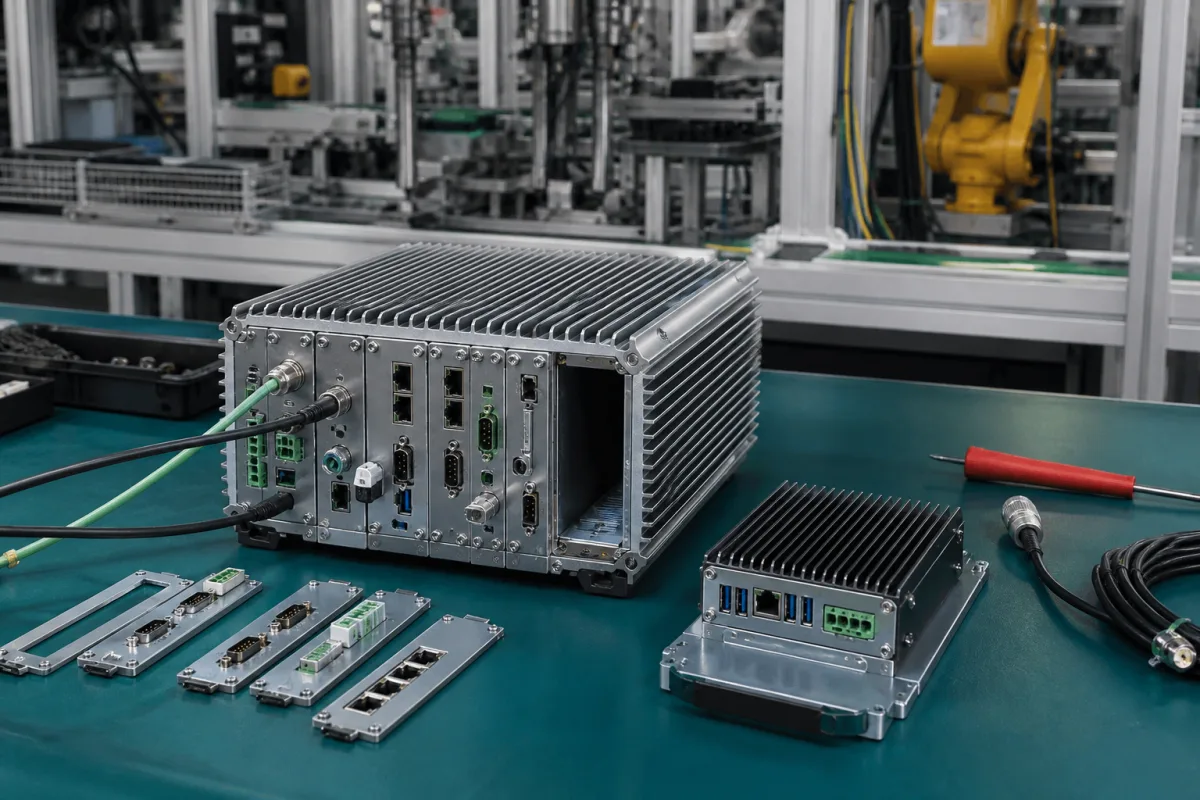
Modular industrial edge computer (fanless, with expansion cassettes and I/O modules)
Fanless edge computer built from modules · expansion cassettes and I/O modules, temperature limits per configuration, chassis height per slot
A modular industrial edge computer is a sealed fanless compute unit that is configured for each job from plug-in parts: I/O modules for serial, Ethernet, digital I/O or CAN, a cassette or rear slot that takes a PCIe or PCI card, and in some ranges a bolt-on node for storage or GPU acceleration. Ask three things first: which modules and cards the quoted configuration contains, what operating temperature the maker states for that exact configuration, and how the chassis size and weight change with each added slot.
Modular fanless edge computers whose I/O, expansion slots or accelerator nodes are added as modules, cassettes or stacked nodes on one compute unit. General box, panel, embedded and ARM industrial computers are covered on the Industrial computer page, and DIN-rail protocol gateways on the Industrial IoT gateway page; PLCs, standalone add-in cards and rack servers are outside this page.
CNFX editorial research · Sources checked October 12, 2026 · 5 sources
Check the operating temperature for the exact configuration
Neousys's data sheet for its Nuvo-3000E/3000P fanless controller shows why a temperature range belongs to a configuration, not to a model name. The system holds a PCIe x16 slot (wired with 8 lanes) or a PCI slot in an expansion cassette, an isolated chamber that Neousys says minimises thermal interference between the add-on card and the system. Its operating range is -25 °C to 70 °C with the Core i5-3610ME or Celeron 1020E but -25 °C to 60 °C with the Core i7-3610QE, both at 100% CPU loading applied with Intel's Thermal Analysis Tool, and below zero it needs a wide-temperature hard disk or an SSD. [1]
Neousys's announcement of its smaller Nuvo-2500, which carries one PCIe x4 slot (or one PCI slot on the Nuvo-2500P) in the same kind of cassette, states operation from -25 °C to 70 °C with 100% CPU loading and a DC input of 8 to 35 V. [2] Premio lists -25 °C to 70 °C for its RCO-6000-KBL family with up to two rear PCI or PCIe slots. [4]
Premio's EDGEBoost Nodes take a different route: a node that attaches to the lower part of its RCO-6000-CFL computer carries NVMe SSDs and GPUs, and Premio states that each node uses high-RPM active cooling, while the upper module holding the CPU, motherboard and sensitive electronics keeps its rugged design. [5] Editorial note: once a fan-cooled node, a GPU or a hot card is added, ask for the temperature range, CPU power mode and load test that apply to that configuration, and for the test tool used, since Neousys names Intel's Thermal Analysis Tool for its figure. [1][5]
Give the supplier the CPU and memory, every I/O module and card to be fitted with its power draw, storage type, operating and storage temperature at your enclosure, DC input range and ignition behaviour, mounting, vibration and shock levels with test standards, EMC requirements, and quantity.
02
Count the expansion modules and what each adds
Premio describes the modular approach to fanless PC design as starting from a family of processors with similar thermal requirements, a motherboard and heat sink designed around them, and then I/O options such as COM ports, Ethernet, digital or analog I/O and CAN bus made as standard modules that can be mixed and matched. It adds that some makers define a connector so modules stack without cables, and that chassis of the same footprint in different heights take different numbers of I/O modules. [3]
Premio's RCO-6000-KBL specification gives the numbers for one range: the base unit measures 240 × 261 × 79 mm with no rear expansion slot, the -1 version 240 × 261 × 107 mm with one, and the -2 version 240 × 261 × 127 mm with two, each with two front universal expansion slots; the rear slot options are one PCIe x16, one PCI, two PCIe x8, two PCI, or one PCIe x16 with one PCI, and a 4-port GbE module with RJ45 or M12 PoE can go in the front slots. Listed weights are 4.37 to 5.41 kg for the base unit and 5.54 to 6.64 kg for the -2 version, with the -1 version shown as TBC; input is 9 to 48 V DC. [4]
Editorial calculation: in that range the first rear slot adds 107 - 79 = 28 mm of height and the second a further 127 - 107 = 20 mm, so the cabinet space and mounting for a modular unit should be planned for the final module count, not the base model. For comparison, Neousys lists its Nuvo-3000E/3000P with one cassette slot at 240 × 225 × 88 mm and 4.4 kg including a 2.5-inch drive and memory. [4][1]
03
EDGE BOX and InBOX732: two listed edge devices to check against the module approach
DS Technology lists an EDGE BOX edge computing device for collecting equipment data through PLC, Modbus, OPC-UA and MQTT; InHand Networks lists its InBOX732 ARM-based industrial edge computer in a fanless metal enclosure. Ask each which I/O or expansion modules can be added to the quoted unit and what temperature range applies with them fitted.
04
Compute unit, I/O modules, cassettes and accelerator nodes
Each module changes the thermal or power budget: the cassette keeps a PCIe card away from the CPU heat, while an accelerator node brings its own active cooling.
Module
Role
Fix in the order
Compute unit
CPU, memory and heat sink in a fanless chassis. [3]
CPU, memory, power mode.
I/O modules
COM, Ethernet, DIO or CAN as mix-and-match modules. [3]
Module list and slot positions.
Expansion cassette or rear slot
Holds a PCIe or PCI card apart from the system's heat. [1]
Wide DC input; on/off with vehicle ignition. [1][2]
Voltage range, delays.
05
Temperature, DC input, size and weight change as modules are added
Read the processor and slot rows together: the temperature ceiling, height and weight in this table all move when a hotter CPU or another rear slot is chosen.
Field
What it means and published values
Ask the supplier for
Processor type
Sets the temperature ceiling; one system is 70 °C with i5/Celeron but 60 °C with i7. [1]
CPU and power mode.
Memory capacity (GB)
Example: two SO-DIMM sockets, up to 16 GB DDR3 on one cassette system. [1]
Capacity and type.
Storage capacity (GB)
Below 0 °C one maker requires a wide-temperature HDD or an SSD. [1]
Drive type and capacity.
Ethernet ports
Example: up to 5 GbE on one system; 4-port GbE front module on another. [1][4]
Ports, PoE, connectors.
IP rating
Protection of the chassis with modules fitted.
Rating and test.
Operating temperature (°C)
Examples: -25 to 70 °C; -25 to 60 °C with an i7 option. [1][4]
Explore company information and manufacturing capabilities, then discuss the scope of your project with a relevant supplier.
Share this page
Compiled and source-reviewed by the CNFX editorial team.
Each manufacturer above links to the page on that company's own website where the product is listed, with the date we checked it. How we source and review
· Page last updated 13 October 2026
Buyer questions
Does adding modules change the operating temperature?
It can: Neousys rates one cassette system at -25 to 70 °C with i5 or Celeron CPUs but -25 to 60 °C with its i7, at 100% CPU loading. [1]
What is an expansion cassette?
Neousys describes it as an isolated chamber in a fanless system that holds a PCIe or PCI card to minimise thermal interference with the system. [1][2]
How much bigger does a modular unit get with more slots?
In Premio's RCO-6000-KBL range the height rises from 79 mm to 107 mm with one rear slot and 127 mm with two. [4]
Are accelerator add-ons also fanless?
Not always: Premio states that each EDGEBoost Node uses high-RPM active cooling for its GPUs and NVMe SSDs. [5]
Sources and what still needs a direct check
Sources checked 2026-10-12. Neousys and Premio are industrial computer makers describing their own expansion designs and data sheets; one Neousys data sheet was reviewed from a distributor's copy and its press release from an archived copy.