Industry-Verified Manufacturing Data (2026)

Coupling Mechanism

Based on aggregated insights from multiple verified factory profiles within the CNFX directory, the standard Coupling Mechanism used in the Computer, Electronic and Optical Product Manufacturing sector typically supports operational capacities ranging from standard industrial configurations to heavy-duty production requirements.

Technical Definition & Core Assembly

A canonical Coupling Mechanism is characterized by the integration of Coupling Nut and Coupling Ring. In industrial production environments, manufacturers listed on CNFX commonly emphasize Beryllium Copper construction to support stable, high-cycle operation across diverse manufacturing scenarios.

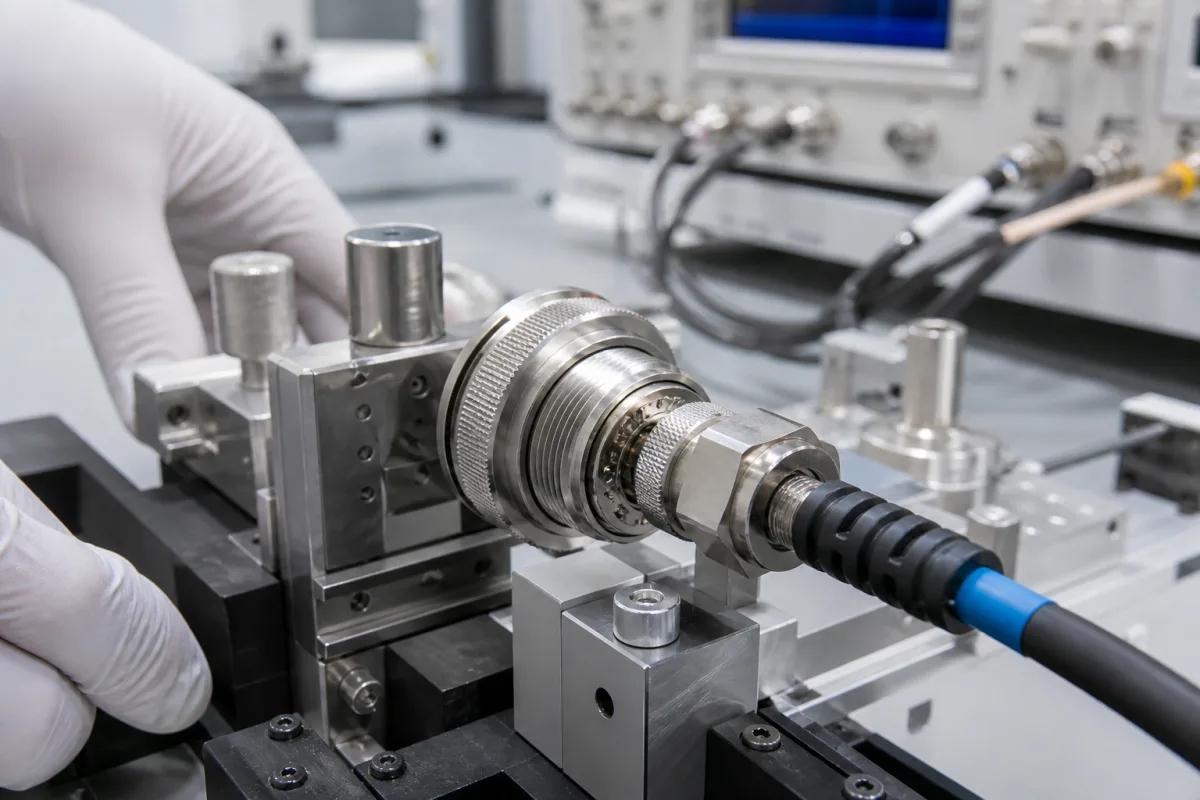
A mechanical interface within a high-frequency RF connector that ensures secure, repeatable, and low-loss electrical connection between mating components.
Product Specifications

Technical details and manufacturing context for Coupling Mechanism

Definition
The coupling mechanism is a critical sub-assembly of a high-frequency RF connector responsible for physically joining and aligning the connector halves while maintaining precise electrical contact. It ensures consistent impedance matching, minimizes signal reflection and insertion loss, and provides mechanical stability in demanding RF applications such as telecommunications, aerospace, and test equipment.
Working Principle
The mechanism typically employs a threaded, bayonet, push-pull, or snap-lock design to mechanically secure the connector interface. As the coupling is engaged, it forces the center conductors and outer shields into precise alignment, creating a continuous transmission path with controlled impedance. Proper coupling maintains contact pressure to ensure low electrical resistance and prevent signal leakage at high frequencies.
Common Materials
Beryllium Copper, Stainless Steel, Phosphor Bronze, PTFE (Polytetrafluoroethylene)
Technical Parameters
  • Coupling thread pitch or engagement length critical for mechanical stability and electrical performance (mm) Customizable
Components / BOM
  • Coupling Nut
    External threaded component that provides rotational force to secure connector halves
    Material: Stainless Steel
  • Coupling Ring
    Retains internal components and provides alignment during mating
    Material: Beryllium Copper
  • Spring Washer
    Maintains constant contact pressure and compensates for thermal expansion
    Material: Phosphor Bronze
  • Dielectric Spacer
    Insulates and positions center conductor within the coupling assembly
    Material: PTFE
Engineering Reasoning
0-18 GHz with VSWR <1.3, insertion loss <0.1 dB at 6 GHz, 5000 mating cycles minimum
Contact resistance >5 mΩ, VSWR >2.0 at 18 GHz, axial misalignment >0.05 mm, radial misalignment >0.02 mm
Design Rationale: Skin effect current crowding at RF frequencies (δ=1.3 μm at 18 GHz for gold), Peltier heating at dissimilar metal interfaces (Au-Ni thermoelectric coefficient 6.5 μV/K), plastic deformation exceeding yield strength of beryllium copper (σ_y=1.1 GPa)
Risk Mitigation (FMEA)
Trigger Dielectric contamination (particles >10 μm) at mating interface
Mode: Intermodulation distortion increase >20 dBc, localized arcing at >100 V/m field strength
Strategy: Integral wiper spring design with 15 N contact force, helium leak testing at 1×10⁻⁹ atm·cc/s
Trigger Galvanic corrosion at Au-Ni-Cu interfaces in chloride environments (>50 ppm Cl⁻)
Mode: Contact resistance drift >2 mΩ/year, third-order intercept degradation >3 dB
Strategy: Multi-layer Ni-Pd-Au plating (1.27 μm Au/0.76 μm Pd/2.54 μm Ni), environmental sealing to IP67

Industry Taxonomies & Aliases

Commonly used trade names and technical identifiers for Coupling Mechanism.

Applied To / Applications

This component is essential for the following industrial systems and equipment:

Industrial Ecosystem & Supply Chain DNA

Complementary Systems
Downstream Applications
Specialized Tooling

Application Fit & Sizing Matrix

Operational Limits
pressure: Up to 30 psi (sealed), 0-15 psi (operational)
other spec: Frequency range: DC to 18 GHz, VSWR: ≤1.3, Insertion loss: ≤0.1 dB
temperature: -65°C to +165°C
Media Compatibility
✓ Coaxial cable assemblies ✓ Printed circuit boards with RF traces ✓ Waveguide interfaces
Unsuitable: High-vibration environments without anti-vibration locking
Sizing Data Required
  • Operating frequency (GHz)
  • Connector interface type (e.g., SMA, N, TNC)
  • Required mating cycles (durability specification)

Reliability & Engineering Risk Analysis

Failure Mode & Root Cause
Misalignment-induced fatigue
Cause: Incorrect installation or foundation settling causing angular, parallel, or axial misalignment, leading to excessive vibration and cyclic stress on coupling components.
Lubrication failure in gear-type couplings
Cause: Contamination, degradation, or insufficient lubrication leading to increased friction, wear, and eventual seizure or tooth breakage.
Maintenance Indicators
  • Excessive vibration or audible knocking during operation
  • Visible oil leakage or grease purge from coupling seals
Engineering Tips
  • Implement laser alignment during installation and periodic realignment checks to maintain tolerances within manufacturer specifications.
  • Establish a rigorous lubrication schedule using the correct lubricant type and quantity, with contamination control measures.

Compliance & Manufacturing Standards

Reference Standards
ISO 9001:2015 - Quality management systems ANSI/AGMA 9000-D04 - Flexible couplings DIN 740 - Shaft couplings
Manufacturing Precision
  • Bore diameter: +/-0.02mm
  • Parallelism of flange faces: 0.05mm
Quality Inspection
  • Dye Penetrant Test for surface defects
  • Hardness Test (Rockwell C scale)

Factories Producing Coupling Mechanism

Verified manufacturers with capability to produce this product in China

✓ 92% Supplier Capability Match Found

T Technical Director from United States Feb 23, 2026
★★★★★
"As a professional in the Computer, Electronic and Optical Product Manufacturing sector, I confirm this Coupling Mechanism meets all ISO standards."
Technical Specifications Verified
P Project Engineer from United Arab Emirates Feb 20, 2026
★★★★☆
"Standard OEM quality for Computer, Electronic and Optical Product Manufacturing applications. The Coupling Mechanism arrived with full certification. (Delivery took slightly longer than expected, but technical support was excellent.)"
Technical Specifications Verified
S Sourcing Manager from Australia Feb 17, 2026
★★★★★
"Great transparency on the Coupling Mechanism components. Essential for our Computer, Electronic and Optical Product Manufacturing supply chain."
Technical Specifications Verified
Verification Protocol

“Feedback is collected from verified sourcing managers during RFQ (Request for Quote) and factory evaluation processes on CNFX. These reports represent historical performance data and technical audit summaries from our B2B manufacturing network.”

14 sourcing managers are analyzing this specification now. Last inquiry for Coupling Mechanism from Vietnam (1h ago).

Supply Chain Compatible Machinery & Devices

Industrial IoT Gateway

Edge computing device connecting industrial equipment to cloud platforms.

Explore Specs →
Modular Industrial Edge Computing Device

Rugged computing platform for industrial data processing at the network edge

Explore Specs →
Industrial Smart Camera Module

Embedded vision system for industrial automation and quality inspection.

Explore Specs →
Industrial Wireless Power Transfer Module

Wireless power transfer module for industrial equipment applications

Explore Specs →

Frequently Asked Questions

What materials make this coupling mechanism suitable for high-frequency applications?

Beryllium Copper provides excellent conductivity and spring properties, while PTFE (Polytetrafluoroethylene) dielectric spacers ensure minimal signal loss at high frequencies, making it ideal for RF applications in computer and optical manufacturing.

How does the coupling mechanism ensure repeatable connections?

The precision-engineered coupling nut and ring system, combined with spring washers, maintains consistent mating force and alignment for reliable, repeatable electrical connections every time components are coupled.

What industries benefit most from this specific coupling mechanism design?

Computer, Electronic and Optical Product Manufacturing industries benefit significantly, particularly for high-frequency applications requiring secure, low-loss connections in RF systems, test equipment, and precision optical devices.

Can I contact factories directly on CNFX?

CNFX is an open directory, not a transaction platform. Each factory profile provides direct contact information and production details to help you initiate direct inquiries with Chinese suppliers.

Get Quote for Coupling Mechanism

Request technical pricing, lead times, or customized specifications for Coupling Mechanism directly from verified manufacturing units.

Your business information is encrypted and only shared with verified Coupling Mechanism suppliers.

Thank you! Your message has been sent. We'll respond within 1–3 business days.

Need to Manufacture Coupling Mechanism?

Connect with verified factories specializing in this product category

Add Your Factory Contact Us
Previous Product
Coupling Iris
Next Product
Cover Tape Peeler