Industry-Verified Manufacturing Data (2026)

Filter Circuit

Based on aggregated insights from multiple verified factory profiles within the CNFX directory, the standard Filter Circuit used in the Computer, Electronic and Optical Product Manufacturing sector typically supports operational capacities ranging from standard industrial configurations to heavy-duty production requirements.

Technical Definition & Core Assembly

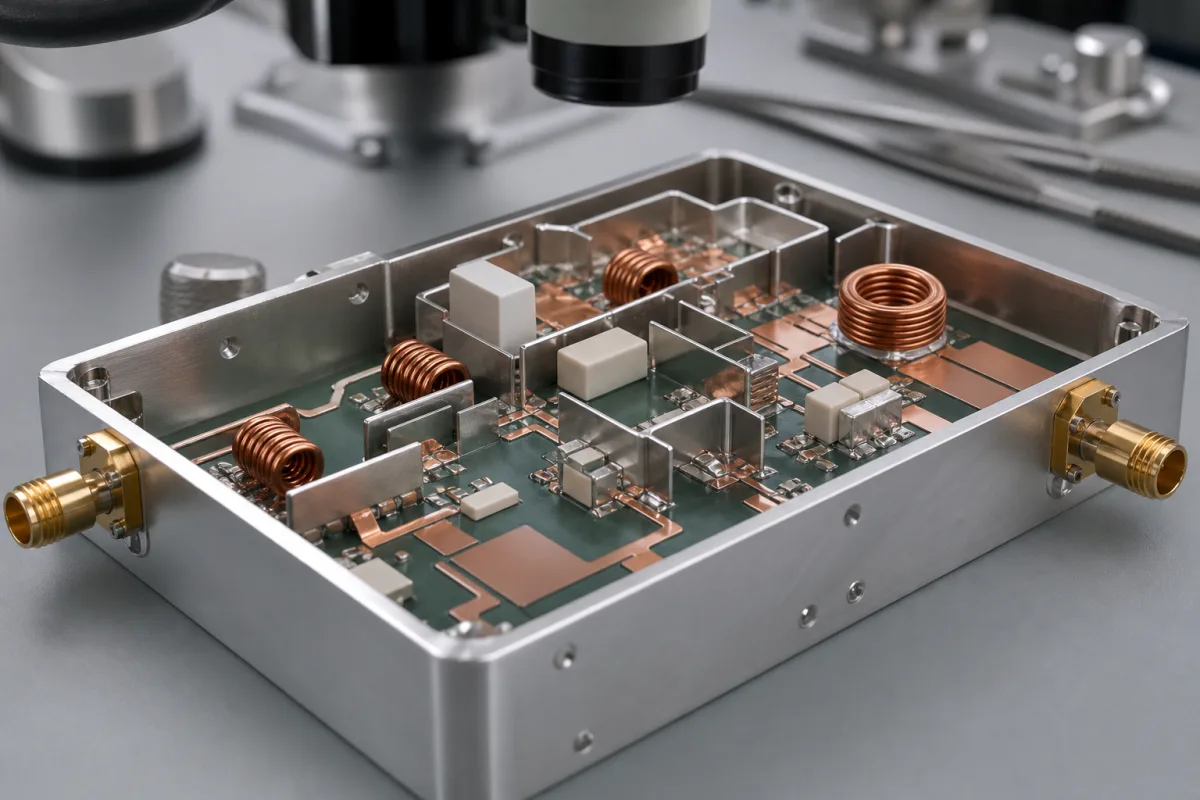
A canonical Filter Circuit is characterized by the integration of Capacitor and Inductor. In industrial production environments, manufacturers listed on CNFX commonly emphasize Semiconductor components construction to support stable, high-cycle operation across diverse manufacturing scenarios.

An electronic circuit designed to selectively pass or reject specific frequency components from a signal.
Product Specifications

Technical details and manufacturing context for Filter Circuit

Definition
A filter circuit is a critical component within a transceiver circuit that processes signals by allowing desired frequencies to pass while attenuating unwanted frequencies. It ensures signal integrity, reduces noise, and prevents interference in both transmission and reception paths of the transceiver.
Working Principle
Filter circuits operate based on the frequency-dependent impedance of components like resistors, capacitors, and inductors. They create frequency-selective networks that either pass (bandpass, low-pass, high-pass) or block (band-stop) specific frequency ranges through impedance matching and resonance effects.
Common Materials
Semiconductor components, Ceramic substrates, Copper traces
Technical Parameters
  • Center frequency or cutoff frequency range (MHz) Per Request
Components / BOM
  • Capacitor
    Stores and releases electrical energy, creating frequency-dependent impedance
    Material: Ceramic or tantalum
  • Inductor
    Stores energy in a magnetic field, creating inductive reactance
    Material: Copper wire with ferrite core
  • Resistor
    Limits current flow and provides impedance matching
    Material: Carbon film or metal film
Engineering Reasoning
1 Hz - 100 MHz frequency range, -40°C to +85°C temperature range, 3.3V - 15V DC supply voltage
Capacitor dielectric breakdown at 50V/mm electric field strength, inductor core saturation at 0.3T magnetic flux density, semiconductor junction failure at 150°C junction temperature
Design Rationale: Dielectric polarization breakdown in capacitors exceeding 50V/mm field strength, magnetic domain alignment saturation in ferrite cores at 0.3T flux density, carrier mobility degradation in semiconductors above 150°C junction temperature
Risk Mitigation (FMEA)
Trigger Electrolytic capacitor electrolyte evaporation at 105°C ambient temperature
Mode: Capacitance reduction below 80% of nominal value causing cutoff frequency shift beyond ±5% tolerance
Strategy: Polymer aluminum solid capacitor implementation with 125°C maximum operating temperature
Trigger Inductor winding insulation breakdown at 500V RMS voltage stress
Mode: Inter-turn short circuit reducing inductance by 30% and increasing DC resistance by 200%
Strategy: Triple-layer polyimide insulation with 3000V dielectric strength rating

Industry Taxonomies & Aliases

Commonly used trade names and technical identifiers for Filter Circuit.

Applied To / Applications

This component is essential for the following industrial systems and equipment:

Industrial Ecosystem & Supply Chain DNA

Complementary Systems
Downstream Applications
Specialized Tooling

Application Fit & Sizing Matrix

Operational Limits
pressure: Not applicable (electronic circuit)
other spec: Frequency range: 1 Hz to 100 MHz, Power supply: 5-24 VDC
temperature: -40°C to +85°C
Media Compatibility
✓ Audio signal processing ✓ RF communication systems ✓ Power supply noise filtering
Unsuitable: High-voltage power transmission lines
Sizing Data Required
  • Required frequency cutoff/bandwidth
  • Input signal amplitude range
  • Load impedance characteristics

Reliability & Engineering Risk Analysis

Failure Mode & Root Cause
Filter Media Clogging
Cause: Accumulation of particulate matter exceeding design capacity, often due to inadequate upstream filtration, excessive contaminant ingress, or extended service intervals beyond recommended limits.
Seal/Bypass Valve Failure
Cause: Degradation of elastomeric seals or mechanical failure of bypass mechanisms, typically resulting from chemical incompatibility with the fluid, thermal cycling, fatigue, or pressure surges exceeding the valve's rating.
Maintenance Indicators
  • Sustained high differential pressure across the filter (indicated by gauges or system alarms) despite normal operating flow rates.
  • Visible fluid leakage around the filter housing or bypass valve, or audible hissing/whistling indicating internal bypass activation under normal conditions.
Engineering Tips
  • Implement condition-based monitoring using permanent differential pressure transducers with trend logging to optimize filter change-outs based on actual loading rather than fixed time intervals.
  • Specify and validate filter media compatibility with the full range of operating temperatures and fluid chemistries encountered, including any additives or contaminants, to prevent premature seal degradation or media collapse.

Compliance & Manufacturing Standards

Reference Standards
ISO 16889:2022 (Hydraulic fluid power - Filters - Multi-pass method for evaluating filtration performance) ANSI/ASHRAE 52.2-2017 (Method of Testing General Ventilation Air-Cleaning Devices for Removal Efficiency by Particle Size) DIN EN 1822-1:2019 (High efficiency air filters (EPA, HEPA and ULPA) - Part 1: Classification, performance testing, marking)
Manufacturing Precision
  • Filter Media Thickness: +/-0.05mm
  • Sealing Surface Flatness: 0.1mm
Quality Inspection
  • Pressure Drop Test (to verify flow resistance within specified limits)
  • Particle Counting Efficiency Test (to validate filtration performance per rated efficiency)

Factories Producing Filter Circuit

Verified manufacturers with capability to produce this product in China

✓ 92% Supplier Capability Match Found

P Procurement Specialist from United States Jan 31, 2026
★★★★★
"Standard OEM quality for Computer, Electronic and Optical Product Manufacturing applications. The Filter Circuit arrived with full certification."
Technical Specifications Verified
T Technical Director from United Arab Emirates Jan 28, 2026
★★★★★
"Great transparency on the Filter Circuit components. Essential for our Computer, Electronic and Optical Product Manufacturing supply chain."
Technical Specifications Verified
P Project Engineer from Australia Jan 25, 2026
★★★★★
"The Filter Circuit we sourced perfectly fits our Computer, Electronic and Optical Product Manufacturing production line requirements."
Technical Specifications Verified
Verification Protocol

“Feedback is collected from verified sourcing managers during RFQ (Request for Quote) and factory evaluation processes on CNFX. These reports represent historical performance data and technical audit summaries from our B2B manufacturing network.”

7 sourcing managers are analyzing this specification now. Last inquiry for Filter Circuit from Thailand (1h ago).

Supply Chain Compatible Machinery & Devices

Industrial Smart Camera Module

Embedded vision system for industrial automation and quality inspection.

Explore Specs →
Industrial Wireless Power Transfer Module

Wireless power transfer module for industrial equipment applications

Explore Specs →
Industrial Smart Sensor Module

Modular industrial sensor with embedded processing and wireless connectivity

Explore Specs →
Surface Mount Resistor

Passive electronic component for current limiting and voltage division in circuits

Explore Specs →

Frequently Asked Questions

What are the main applications of filter circuits in computer and optical product manufacturing?

Filter circuits are essential for signal conditioning, noise reduction, and frequency selection in applications like data transmission systems, audio processing, power supply regulation, and EMI/RFI suppression in computers and optical devices.

How do capacitor, inductor, and resistor components work together in a filter circuit?

Capacitors block DC while passing AC signals, inductors resist changes in current, and resistors control signal amplitude. Their combined impedance characteristics create frequency-dependent behavior that allows specific frequencies to pass while attenuating others.

What advantages do ceramic substrates offer for filter circuit manufacturing?

Ceramic substrates provide excellent thermal stability, low dielectric loss, high frequency performance, and reliable mechanical properties, making them ideal for precision filter circuits in demanding electronic applications.

Can I contact factories directly on CNFX?

CNFX is an open directory, not a transaction platform. Each factory profile provides direct contact information and production details to help you initiate direct inquiries with Chinese suppliers.

Get Quote for Filter Circuit

Request technical pricing, lead times, or customized specifications for Filter Circuit directly from verified manufacturing units.

Your business information is encrypted and only shared with verified Filter Circuit suppliers.

Thank you! Your message has been sent. We'll respond within 1–3 business days.

Need to Manufacture Filter Circuit?

Connect with verified factories specializing in this product category

Add Your Factory Contact Us
Previous Product
Filter (Bandpass/SAW)
Next Product
Filter Circuit Board