Industry-Verified Manufacturing Data (2026)

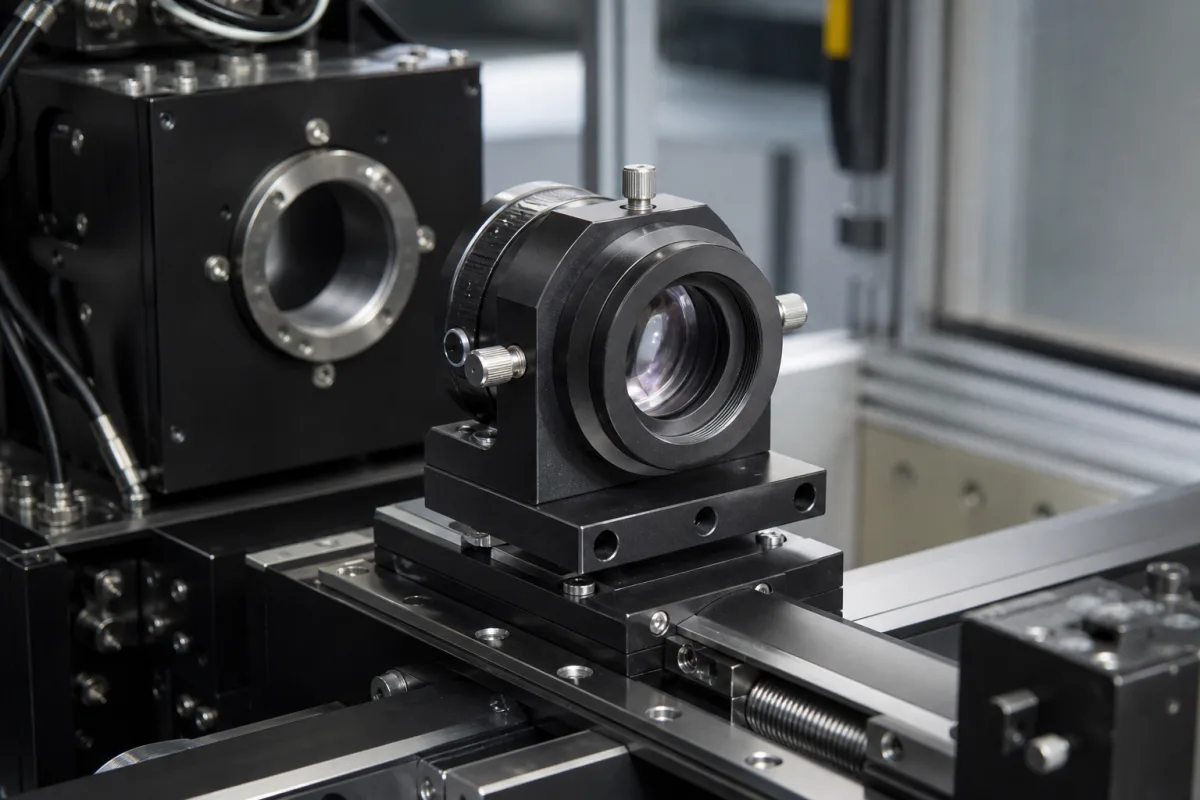
Focusing Lens Mount

Based on aggregated insights from multiple verified factory profiles within the CNFX directory, the standard Focusing Lens Mount used in the Computer, Electronic and Optical Product Manufacturing sector typically supports operational capacities ranging from standard industrial configurations to heavy-duty production requirements.

Technical Definition & Core Assembly

A canonical Focusing Lens Mount is characterized by the integration of Mounting Ring and Focusing Thread. In industrial production environments, manufacturers listed on CNFX commonly emphasize Aluminum alloy construction to support stable, high-cycle operation across diverse manufacturing scenarios.

A mechanical interface that securely holds and positions a lens within a focusing mechanism.
Product Specifications

Technical details and manufacturing context for Focusing Lens Mount

Definition
The focusing lens mount is a critical component of optical focusing systems that provides precise mechanical alignment and secure attachment for lenses. It ensures the lens maintains proper optical axis alignment while allowing controlled movement for focus adjustment. Within the focusing mechanism, it serves as the interface between the lens element and the adjustment mechanism, translating rotational or linear motion into precise lens positioning.
Working Principle
The lens mount typically employs threaded, bayonet, or friction-based retention systems to secure the lens. When the focusing mechanism is actuated, the mount translates mechanical input (rotational or linear motion) into controlled movement of the lens along the optical axis. This changes the distance between the lens and the focal plane, thereby adjusting focus. Precision machining ensures minimal play and consistent alignment throughout the focusing range.
Common Materials
Aluminum alloy, Stainless steel, Engineering plastic
Technical Parameters
  • Mount diameter and thread pitch for lens compatibility (mm) Per Request
Components / BOM
  • Mounting Ring
    Primary interface that directly contacts and secures the lens
    Material: Aluminum alloy or stainless steel
  • Focusing Thread
    Helical groove that converts rotational motion into linear lens movement
    Material: Stainless steel
  • Retention Mechanism
    Locking system (bayonet pins, screws, or clips) that prevents accidental lens detachment
    Material: Stainless steel or engineering plastic
Engineering Reasoning
0-150°C thermal cycling range, 0.1-10 μm axial positioning accuracy, 0.01-0.5 N·m torque retention
Thermal expansion mismatch exceeding 15 μm differential displacement, vibration amplitude >50 μm at 100-500 Hz, torque retention <0.005 N·m
Design Rationale: Coefficient of thermal expansion mismatch (CTE Δα > 12×10⁻⁶ K⁻¹) between lens material (e.g., fused silica, α=0.55×10⁻⁶ K⁻¹) and mount material (e.g., aluminum, α=23×10⁻⁶ K⁻¹) causing mechanical stress exceeding yield strength (σ_y > 250 MPa)
Risk Mitigation (FMEA)
Trigger CTE mismatch-induced thermal stress during 150°C thermal cycling
Mode: Lens cracking due to tensile stress exceeding fracture toughness (K_IC=0.75 MPa·m¹/² for fused silica)
Strategy: Kinematic mount design with flexure elements (spring constant k=100 N/mm) to accommodate 15 μm differential expansion
Trigger Resonant vibration at 350 Hz matching mount natural frequency
Mode: Lens positional drift exceeding 10 μm RMS, causing focal plane deviation
Strategy: Damping layer insertion (loss factor η>0.1) and mass tuning to shift resonant frequency to 650 Hz

Industry Taxonomies & Aliases

Commonly used trade names and technical identifiers for Focusing Lens Mount.

Applied To / Applications

This component is essential for the following industrial systems and equipment:

Industrial Ecosystem & Supply Chain DNA

Complementary Systems
Downstream Applications
Specialized Tooling

Application Fit & Sizing Matrix

Operational Limits
pressure: 0 to 2 bar
other spec: Vibration tolerance: < 5g RMS
temperature: -20°C to 80°C
Media Compatibility
✓ Clean dry air ✓ Inert gases (N2, Ar) ✓ Optical-grade vacuum
Unsuitable: Abrasive particulate environments
Sizing Data Required
  • Lens diameter (mm)
  • Required focal length adjustment range (mm)
  • Mounting interface standard (e.g., C-mount, F-mount)

Reliability & Engineering Risk Analysis

Failure Mode & Root Cause
Thermal fatigue cracking
Cause: Repeated thermal cycling from laser operation causes expansion/contraction stress, leading to micro-cracks in mounting material or weld joints.
Mechanical misalignment drift
Cause: Vibration from equipment or gradual loosening of fasteners causes optical axis deviation, reducing beam quality and system efficiency.
Maintenance Indicators
  • Visible discoloration or oxidation on lens mount surface indicating overheating
  • Audible high-frequency vibration or rattling during laser operation
Engineering Tips
  • Implement thermal interface monitoring with infrared thermography during preventive maintenance to detect abnormal heat patterns before failure
  • Use thread-locking compounds on all fasteners and establish torque verification procedures during scheduled maintenance intervals

Compliance & Manufacturing Standards

Reference Standards
ISO 10110-7:2017 (Optics and photonics - Preparation of drawings for optical elements and systems - Part 7: Surface imperfection tolerances) ANSI/ASME B46.1-2019 (Surface Texture, Surface Roughness, Waviness, and Lay) DIN 3140 (Dimensions for optical components and systems - Mounting dimensions for lenses and lens systems)
Manufacturing Precision
  • Bore diameter: +/-0.01mm
  • Mounting surface flatness: 0.005mm
Quality Inspection
  • Coordinate Measuring Machine (CMM) dimensional verification
  • Interferometric surface flatness testing

Factories Producing Focusing Lens Mount

Verified manufacturers with capability to produce this product in China

✓ 94% Supplier Capability Match Found

S Sourcing Manager from United Arab Emirates Feb 09, 2026
★★★★★
"Standard OEM quality for Computer, Electronic and Optical Product Manufacturing applications. The Focusing Lens Mount arrived with full certification."
Technical Specifications Verified
P Procurement Specialist from Australia Feb 06, 2026
★★★★☆
"Great transparency on the Focusing Lens Mount components. Essential for our Computer, Electronic and Optical Product Manufacturing supply chain. (Delivery took slightly longer than expected, but technical support was excellent.)"
Technical Specifications Verified
T Technical Director from Singapore Feb 03, 2026
★★★★★
"The Focusing Lens Mount we sourced perfectly fits our Computer, Electronic and Optical Product Manufacturing production line requirements."
Technical Specifications Verified
Verification Protocol

“Feedback is collected from verified sourcing managers during RFQ (Request for Quote) and factory evaluation processes on CNFX. These reports represent historical performance data and technical audit summaries from our B2B manufacturing network.”

14 sourcing managers are analyzing this specification now. Last inquiry for Focusing Lens Mount from Poland (1h ago).

Supply Chain Compatible Machinery & Devices

Industrial Smart Camera Module

Embedded vision system for industrial automation and quality inspection.

Explore Specs →
Industrial Wireless Power Transfer Module

Wireless power transfer module for industrial equipment applications

Explore Specs →
Industrial Smart Sensor Module

Modular industrial sensor with embedded processing and wireless connectivity

Explore Specs →
Surface Mount Resistor

Passive electronic component for current limiting and voltage division in circuits

Explore Specs →

Frequently Asked Questions

What materials are used in this focusing lens mount?

Constructed from aluminum alloy for lightweight durability, stainless steel for critical components, and engineering plastic for insulation and wear resistance.

How does the retention mechanism secure the lens?

The retention mechanism uses a precision locking system that firmly holds the lens in place while allowing smooth adjustment through the focusing thread for optimal optical alignment.

What industries typically use this type of lens mount?

Primarily used in computer, electronic, and optical product manufacturing for applications requiring precise lens positioning in imaging systems, laser equipment, and optical measurement devices.

Can I contact factories directly on CNFX?

CNFX is an open directory, not a transaction platform. Each factory profile provides direct contact information and production details to help you initiate direct inquiries with Chinese suppliers.

Get Quote for Focusing Lens Mount

Request technical pricing, lead times, or customized specifications for Focusing Lens Mount directly from verified manufacturing units.

Your business information is encrypted and only shared with verified Focusing Lens Mount suppliers.

Thank you! Your message has been sent. We'll respond within 1–3 business days.

Need to Manufacture Focusing Lens Mount?

Connect with verified factories specializing in this product category

Add Your Factory Contact Us
Previous Product
Focusing Helix
Next Product
Focusing Mechanism