Editorial Technical Reference

Headband Assembly

This page explains how Headband Assembly is classified within Computer, Electronic and Optical Product Manufacturing. Technical values and manufacturer relationships are research references; confirm the current specification and supplier evidence for each order.

Technical Definition & Core Assembly

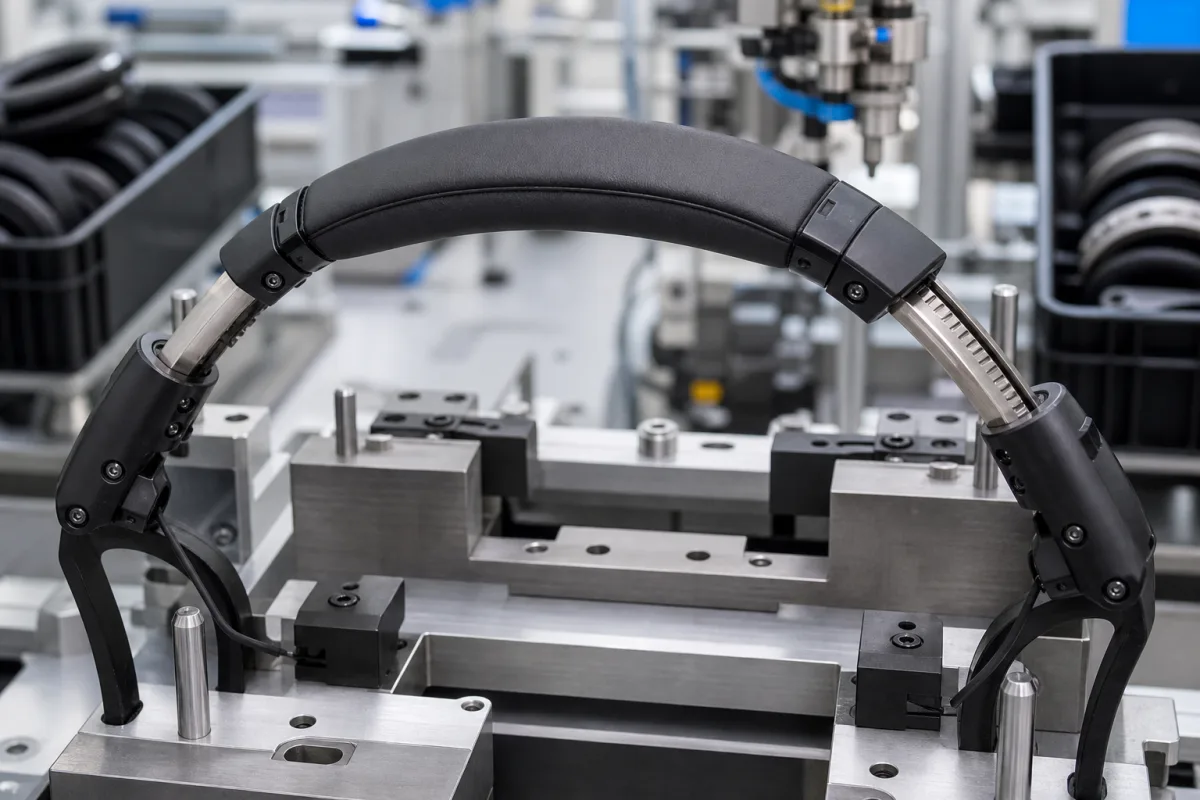
Structural component that connects the ear cups and provides adjustable fit for portable Bluetooth noise-cancelling headphones.

Headband Assembly in a manufacturing environment
Representative product image. Confirm appearance and specifications with the manufacturer.

Product Specifications

Technical details and manufacturing context for Headband Assembly

Definition
The headband assembly is a critical structural component in portable Bluetooth noise-cancelling headphones that spans the user's head, connecting the left and right ear cups. It provides the primary means of securing the headphones in place while distributing weight evenly across the head. This assembly typically incorporates adjustment mechanisms for size customization, padding for comfort during extended wear, and internal channels for routing audio cables and wires between the ear cups. In noise-cancelling models, it may also house additional electronics or wiring for the active noise cancellation system. The headband assembly is manufactured from a combination of materials including plastic polymer, stainless steel, memory foam, and synthetic leather, which together provide structural rigidity, flexibility, and comfort. Key parameters include a headband width of 18–22 mm, thickness of 2.0–3.0 mm, adjustable length range of 30–50 mm, clamping force of 3.0–5.0 N, and weight of 25–40 g. The assembly is designed to operate within a temperature range of -20 to 60 °C and can be stored between -30 and 70 °C, with relative humidity up to 95% non-condensing. Material hardness is specified as 70–90 Shore A, surface finish Ra 0.8–1.6 μm, tensile strength 40–60 MPa, and flexural modulus 1500–2500 MPa. These values are reference ranges that must be confirmed for the specific model and application. The headband assembly is a component intended for integration into headphone systems; it is not a standalone consumer product. For procurement and verification, the listed standards (e.g., IEC 60068-2-1, IEC 60068-2-2, IEC 60068-2-78, ISO 868, ISO 4287, ISO 527-2, ISO 178) serve as references for testing methods, not as proof of certification. Buyers should verify model-specific values and standards with the legal manufacturer or supplier.
Working Principle
The headband assembly functions as a structural bridge that maintains proper positioning of the ear cups against the user's ears. It utilizes mechanical tension and adjustable components to create a secure yet comfortable fit. The assembly's curvature and padding distribute pressure evenly across the head, while adjustment mechanisms (typically sliders or ratchets) allow users to customize the fit for optimal noise isolation and comfort. In Bluetooth models, it may contain internal wiring that connects the ear cups for audio signal transmission and battery power distribution. The clamping force, typically 3.0–5.0 N, ensures stable fit without discomfort. The adjustable length range of 30–50 mm accommodates different head sizes. The materials and dimensions are selected to provide the necessary strength and flexibility while maintaining a lightweight design (25–40 g).
Common Materials
Plastic polymer, Stainless steel, Memory foam, Synthetic leather
Technical Parameters
ParameterTypical rangeNotes & selection driver
Headband Width18–22 mmAffects comfort and clamping force
Headband Thickness2.0–3.0 mmDetermines structural strength
Adjustable Length Range30–50 mmAccommodates different head sizes
Clamping Force3.0–5.0 NEnsures stable fit without discomfort
Weight25–40 gContributes to overall headphone weight
Operating Temperature-20–60 °CMaterial performance outside this range may degradeIEC 60068-2-1, IEC 60068-2-2
Storage Temperature-30–70 °CPrevents warping or brittlenessIEC 60068-2-1, IEC 60068-2-2
Relative Humidity10–95 % RHNon-condensing; affects material stabilityIEC 60068-2-78
Material Hardness70–90 Shore ASofter for comfort, harder for durabilityISO 868
Surface FinishRa 0.8–1.6 μmAesthetic and tactile qualityISO 4287
Tensile Strength40–60 MPaEnsures structural integrity under stressISO 527-2
Flexural Modulus1500–2500 MPaAffects flexibility and springbackISO 178

Ranges are indicative industry figures for RFQ preparation, not a supplier commitment. Confirm every value and standard with the legal manufacturer before ordering.

Components / BOM
  • Headband Frame Part
    Primary structural element that provides rigidity and shape
    Material: Stainless steel or reinforced plastic
  • Adjustment Sliders Part
    Mechanism that allows length adjustment for different head sizes
    Material: Plastic with metal reinforcement
  • Headband Padding Part
    Cushioning layer for comfort and pressure distribution
    Material: Memory foam with synthetic leather cover
  • Yoke/Hinge Assembly
    Connection point between headband and ear cups allowing rotation
    Material: Metal alloy with plastic components
  • Internal Wiring Optional
    Runs audio and battery power between the two ear cups through the headband.

Industrial Ecosystem & Supply Chain Structure

Complementary Systems
Downstream Applications
Specialized Tooling

Application Fit & Sizing Matrix

Operational Limits
pressure: N/A (non-pressure application)
other spec: Head circumference range: 50-65 cm, Adjustment steps: 10-15 mm increments
temperature: -20°C to +60°C (operating), -30°C to +70°C (storage)
Media Compatibility
✓ Polycarbonate/ABS blend housings ✓ Memory foam ear cushions ✓ Synthetic leather padding
Unsuitable: High-moisture/sweat environments without protective coating
Sizing Data Required
  • Head circumference measurement
  • Ear cup pivot torque requirement
  • Desired clamping force range

Reliability & Engineering Risk Analysis

Failure Mode & Root Cause
Material fatigue and cracking
Cause: Repeated flexing and stress cycling during use leads to microscopic cracks in plastic or metal components, especially at stress concentration points like adjustment mechanisms or connection joints.
Connection failure and electrical discontinuity
Cause: Corrosion or wear at electrical contacts, broken solder joints, or damaged wiring insulation due to mechanical stress, moisture ingress, or poor manufacturing quality.
Maintenance Indicators
  • Audible crackling or intermittent sound during use indicating loose connections or failing components
  • Visible deformation, discoloration, or unusual wear patterns on headband surfaces or adjustment mechanisms
Engineering Tips
  • Implement regular inspection protocols focusing on stress concentration areas and electrical connections, using magnification tools to detect early cracking or corrosion
  • Apply protective coatings to vulnerable metal components and ensure proper storage in controlled humidity environments to prevent material degradation

Indicative industry ranges for design and RFQ preparation. Confirm the exact figures and applicable standard with the manufacturer before specifying.

Compliance & Manufacturing Standards

Applicable Standards
ANSI/ASQ Z1.4-2003 - Sampling procedures and tables for inspection by attributes EN 14683:2019 - Medical face masks - Requirements and test methods

Quoted from the published standard.

Manufacturing Precision
  • Headband length: +/- 2 mm
  • Elastic tension force: +/- 10% of specified value
Quality Inspection
  • Tensile strength test for elastic components
  • Dimensional verification using calibrated gauges

Manufacturers of Headband Assembly

Manufacturer profiles associated with Headband Assembly.

Sourcing Headband Assembly from China?
Tell us your specification and target quantity — we will match it against manufacturer records and come back with the factories that fit.
Request manufacturers We manufacture this

Manufacturer listings support early research and capability understanding. They are not certification, ranking, or transaction guarantees.

Share this page
Technical documentation
Request current drawings, revision history, and a signed specification sheet.
Manufacturing capability
Verify equipment lists, process limits, capacity, and representative production evidence.
Inspection readiness
Confirm test methods, calibrated equipment, sampling plans, and traceable reports.
Supplier transparency
Check the legal entity, factory address, ownership, certifications, and direct contacts.

CNFX does not score or rank suppliers. Buyers must verify all claims and documents with the legal manufacturer before ordering.

Supply Chain Compatible Machinery & Devices

Modular Industrial Edge Computing Device

This modular industrial edge computing device is a ruggedized system designed for deployment in harsh industrial environments to perform real-time data processing, analytics, and control functions at the network edge.

Explore Specs →
Industrial Smart Camera Module

The Industrial Smart Camera Module is a compact, self-contained vision processing unit designed for integration into industrial machinery and production lines.

Explore Specs →
Surface Mount Resistor

Passive electronic component for current limiting and voltage division in circuits

Explore Specs →
Surface Mount Capacitor

A surface mount capacitor is a fundamental electronic component used for energy storage, filtering, coupling, and decoupling in electronic circuits.

Explore Specs →

Frequently Asked Questions

What is the headband assembly used for?

It is a structural component that connects the left and right ear cups of portable Bluetooth noise-cancelling headphones, providing a secure and adjustable fit on the user's head.

What materials are used in the headband assembly?

The materials on file include plastic polymer, stainless steel, memory foam, and synthetic leather. These are typical for such components, but specific grades should be confirmed with the manufacturer.

What are the key dimensions and performance parameters?

Reference ranges include headband width 18–22 mm, thickness 2.0–3.0 mm, adjustable length 30–50 mm, clamping force 3.0–5.0 N, and weight 25–40 g. Operating temperature is -20 to 60 °C, storage -30 to 70 °C, and relative humidity up to 95% non-condensing. Material hardness is 70–90 Shore A, surface finish Ra 0.8–1.6 μm, tensile strength 40–60 MPa, and flexural modulus 1500–2500 MPa. These are reference values; verify for your specific model.

How should I verify the quality and compliance of this component?

The listed standards (e.g., IEC 60068-2-1, ISO 868) are references for testing methods. They do not imply certification. Always request documentation from the legal manufacturer or supplier and confirm that the component meets your application's requirements.

Data Basis

Editorial classification, named public sources where available, and source-reviewed manufacturer records.

Preliminary Technical Classification
This page supports structured research, RFQ preparation, and supplier evaluation. It does not replace buyer-led supplier qualification, standards review, or technical approval.
Buyer enquiry

Request manufacturing insight for Headband Assembly

Ask for use case, specification boundaries, supplier type, and RFQ preparation information for this product.

Where it goes
Straight to the CNFX editorial desk, and to the manufacturer if this product is linked to a claimed profile. Nothing is broadcast to a supplier list.
Your details stay here
We do not sell or rent enquiry data, and we do not add you to a mailing list. Used only to answer this request.
No commission, no middleman
CNFX is a directory. We take no cut of any order and never negotiate on a supplier's behalf.
What we don't claim
A listing is not an endorsement. Qualify every supplier and verify every figure yourself before ordering.

Your business information is used only to process this request.

Thank you! Your message has been sent. We'll respond within 1–3 business days.
Sorry, we couldn't send your message. Please try again, or email us at [email protected].

Need to Manufacture Headband Assembly?

Compare manufacturer profiles with relevant product and process capability.

Previous Product
XY Positioning Stage
Last Product
Get QuotesChat