Editorial Technical Reference

High-Resolution Medical Display

This page explains how High-Resolution Medical Display is classified within Computer, Electronic and Optical Product Manufacturing. Technical values and manufacturer relationships are research references; confirm the current specification and supplier evidence for each order.

Technical Definition & Core Assembly

A specialized display component designed for medical imaging applications requiring precise visualization of diagnostic images.
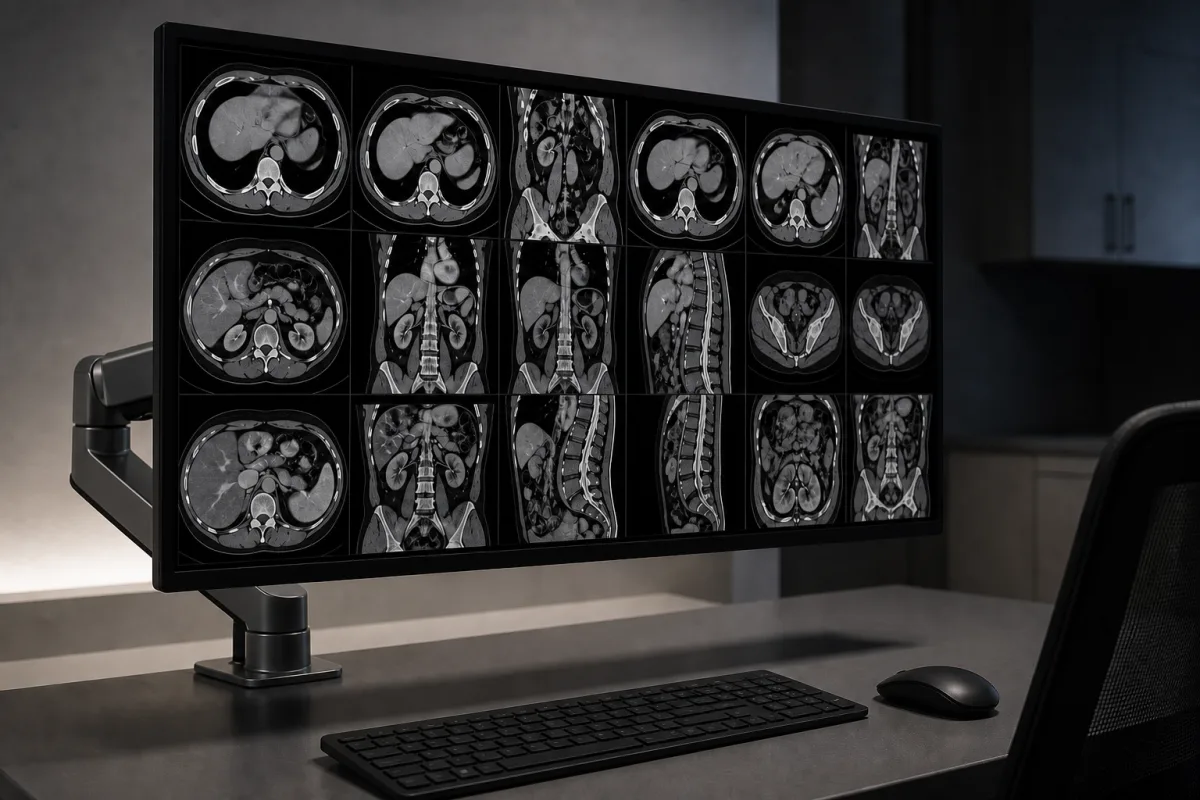
Representative product image. Confirm appearance and specifications with the manufacturer.

Product Specifications

Technical details and manufacturing context for High-Resolution Medical Display

Definition
The High-Resolution Medical Display is a critical component within a Treatment Planning Station, providing high-fidelity visualization of medical images such as CT scans, MRIs, and X-rays. It enables medical professionals to accurately assess anatomical structures, plan treatment procedures, and monitor patient progress with exceptional clarity and detail. This display is engineered for the demanding requirements of medical imaging, where precise grayscale and color rendering are essential for diagnostic accuracy. It utilizes advanced display technologies, typically IPS, OLED, or specialized medical-grade LCD panels, with high pixel density, calibrated color accuracy, and consistent brightness. The display receives digital image data from treatment planning software via standard video interfaces such as DisplayPort, HDMI, or DVI, and converts it into precise visual representations that meet medical diagnostic standards. Key parameters include a screen size ranging from 21.3 to 30 inches, a resolution of 3 to 5 megapixels (higher for mammography and pathology), a luminance of 1000 to 1200 cd/m², a contrast ratio of 1000 to 1500, a viewing angle of 178 degrees, and a color depth of 10 to 12 bits. It supports DICOM calibration with a 14 to 18-bit LUT, ensuring grayscale standard display function per DICOM PS3.14. The display operates in typical indoor environments with an operating temperature of 0 to 40°C and non-condensing humidity of 20 to 80% RH. Power consumption ranges from 60 to 120 W, weight without stand is 5 to 10 kg, and backlight lifetime is 50,000 to 100,000 hours. Materials include LCD/OLED panels, aluminum alloy frames, glass protective layers, and electronic circuit boards. For procurement, verify model-specific values and standards with the legal manufacturer or supplier.
Working Principle
The display uses advanced panel technologies such as IPS, OLED, or medical-grade LCD with high pixel density and calibrated color accuracy. It receives digital image data from the treatment planning software via video interfaces (DisplayPort, HDMI, DVI) and converts it into precise visual representations. The internal electronics process the signal to ensure consistent brightness and grayscale reproduction, adhering to DICOM calibration standards. The display's backlight system provides sustained luminance, and the panel's wide viewing angle ensures consistent image quality from various positions. The display is designed to meet medical diagnostic standards, enabling accurate interpretation of imaging data.
Common Materials
LCD/OLED panel, Aluminum alloy frame, Glass protective layer, Electronic circuit boards
Technical Parameters
ParameterTypical rangeNotes & selection driver
Screen Size21.3–30 inchMatches common medical imaging modalities
Resolution3–5 MPHigher for mammography and pathology
Luminance1000–1200 cd/m²Sustained luminance for DICOM calibration
Contrast Ratio1000–1500Typical for medical displays
Viewing Angle178 °Horizontal and vertical
Color Depth10–12 bitFor accurate color rendering
Input SignalDVI-D, DP, HDMIDual-link DVI for high resolutions
Operating Temperature0–40 °CTypical indoor environment
Operating Humidity20–80 % RHNon-condensing
Power Consumption60–120 WDepends on size and backlight
Weight5–10 kgWithout stand
Backlight Lifetime50000–100000 hTo half brightness
DICOM Calibration14–18 bit LUTEnsures grayscale standard display functionDICOM PS3.14

Ranges are indicative industry figures for RFQ preparation, not a supplier commitment. Confirm every value and standard with the legal manufacturer before ordering.

Components / BOM
  • Display Panel
    Primary image rendering surface using LCD, OLED, or other display technology
    Material: Glass, liquid crystals, organic compounds
  • Backlight Unit Optional
    Provides uniform illumination for LCD panels (not required for OLED)
    Material: LED arrays, light guides, diffusers
  • Controller Board
    Processes input signals and controls display operations
    Material: Printed circuit board, integrated circuits
  • Power Supply Unit
    Converts AC power to DC for display components
    Material: Electronic components, transformers, capacitors
  • Bezel and Housing Part
    Protects internal components and provides structural support
    Material: Aluminum alloy, plastic polymers

Applied To / Applications

This component is essential for the following industrial systems and equipment:

Industrial Ecosystem & Supply Chain Structure

Complementary Systems
Downstream Applications
Specialized Tooling

Application Fit & Sizing Matrix

Operational Limits
pressure: N/A (electronic component)
other spec: Humidity: 20% to 80% non-condensing, Brightness: 1000-2000 cd/m², Resolution: 2K-8K
temperature: 10°C to 40°C (operating), -20°C to 60°C (storage)
Media Compatibility
✓ DICOM-compliant imaging systems ✓ PACS workstations ✓ Surgical navigation systems
Unsuitable: High-vibration industrial environments (e.g., factory floors with heavy machinery)
Sizing Data Required
  • Required resolution (e.g., 4K, 5MP, 8MP)
  • Viewing distance and workspace layout
  • Clinical application (e.g., radiology, mammography, surgery)

Reliability & Engineering Risk Analysis

Failure Mode & Root Cause
Pixel Degradation
Cause: Thermal stress from prolonged high-brightness operation causing organic LED (OLED) or LCD backlight component fatigue, accelerated by inadequate cooling or ambient temperature fluctuations.
Signal Interface Failure
Cause: Corrosion or mechanical wear on high-density digital connectors (e.g., DisplayPort, DVI) from frequent plugging/unplugging, compounded by electrostatic discharge (ESD) events or contamination ingress.
Maintenance Indicators
  • Flickering, dead pixels, or color uniformity issues (e.g., yellowing/burn-in) indicating imminent display failure.
  • Intermittent signal loss, audible buzzing from power supply, or abnormal heat emission from display housing.
Engineering Tips
  • Implement calibrated brightness/contrast profiles and automatic sleep modes to reduce thermal cycling stress on display components.
  • Use certified shielded cables, maintain clean/dry connector environments, and perform regular ESD-safe cleaning of optical surfaces (e.g., anti-glare coatings).

Indicative industry ranges for design and RFQ preparation. Confirm the exact figures and applicable standard with the manufacturer before specifying.

Compliance & Manufacturing Standards

Applicable Standards
IEC 60601-1-3:2008 - Medical electrical equipment - Part 1-3: General requirements for basic safety and essential performance - Collateral standard: Radiation protection in diagnostic X-ray equipment ANSI/AAMI HE75:2009 - Human factors engineering - Design of medical devices

Quoted from the published standard.

Manufacturing Precision
  • Luminance uniformity: +/- 10% across display area
  • Color temperature consistency: +/- 100K across operating range
Quality Inspection
  • DICOM GSDF conformance verification
  • Dead pixel detection and classification test

Manufacturers of High-Resolution Medical Display

Manufacturer profiles associated with High-Resolution Medical Display.

Sourcing High-Resolution Medical Display from China?
Tell us your specification and target quantity — we will match it against manufacturer records and come back with the factories that fit.
Request manufacturers We manufacture this

Manufacturer listings support early research and capability understanding. They are not certification, ranking, or transaction guarantees.

Technical documentation
Request current drawings, revision history, and a signed specification sheet.
Manufacturing capability
Verify equipment lists, process limits, capacity, and representative production evidence.
Inspection readiness
Confirm test methods, calibrated equipment, sampling plans, and traceable reports.
Supplier transparency
Check the legal entity, factory address, ownership, certifications, and direct contacts.

CNFX does not score or rank suppliers. Buyers must verify all claims and documents with the legal manufacturer before ordering.

Supply Chain Compatible Machinery & Devices

Modular Industrial Edge Computing Device

This modular industrial edge computing device is a ruggedized system designed for deployment in harsh industrial environments to perform real-time data processing, analytics, and control functions at the network edge.

Explore Specs →
Industrial Smart Camera Module

The Industrial Smart Camera Module is a compact, self-contained vision processing unit designed for integration into industrial machinery and production lines.

Explore Specs →
Surface Mount Resistor

Passive electronic component for current limiting and voltage division in circuits

Explore Specs →
Surface Mount Capacitor

A surface mount capacitor is a fundamental electronic component used for energy storage, filtering, coupling, and decoupling in electronic circuits.

Explore Specs →

Frequently Asked Questions

What is the typical screen size range for this medical display?

The screen size ranges from 21.3 to 30 inches, matching common medical imaging modalities. Confirm the exact size for your specific model with the manufacturer.

What video interfaces does the display support?

It supports DVI-D, DisplayPort, and HDMI inputs. Dual-link DVI is used for high resolutions. Verify compatibility with your system.

What is the DICOM calibration capability?

The display supports DICOM calibration with a 14 to 18-bit LUT, ensuring grayscale standard display function per DICOM PS3.14. This is a reference; actual calibration must be verified with the manufacturer.

What are the operating environmental conditions?

The display operates in temperatures from 0 to 40°C and non-condensing humidity of 20 to 80% RH. Ensure your environment meets these ranges.

Data Basis

Editorial classification, named public sources where available, and source-reviewed manufacturer records.

Preliminary Technical Classification
This page supports structured research, RFQ preparation, and supplier evaluation. It does not replace buyer-led supplier qualification, standards review, or technical approval.
Buyer enquiry

Request manufacturing insight for High-Resolution Medical Display

Ask for use case, specification boundaries, supplier type, and RFQ preparation information for this product.

Where it goes
Straight to the CNFX editorial desk, and to the manufacturer if this product is linked to a claimed profile. Nothing is broadcast to a supplier list.
Your details stay here
We do not sell or rent enquiry data, and we do not add you to a mailing list. Used only to answer this request.
No commission, no middleman
CNFX is a directory. We take no cut of any order and never negotiate on a supplier's behalf.
What we don't claim
A listing is not an endorsement. Qualify every supplier and verify every figure yourself before ordering.

Your business information is used only to process this request.

Thank you! Your message has been sent. We'll respond within 1–3 business days.
Sorry, we couldn't send your message. Please try again, or email us at contact@cnfx.com.

Need to Manufacture High-Resolution Medical Display?

Compare manufacturer profiles with relevant product and process capability.

Previous Product
XY Positioning Stage
Last Product
Get QuotesChat