Industry-Verified Manufacturing Data (2026)

Treatment Planning Station

Based on aggregated insights from multiple verified factory profiles within the CNFX directory, the standard Treatment Planning Station used in the Computer, Electronic and Optical Product Manufacturing sector typically supports operational capacities ranging from standard industrial configurations to heavy-duty production requirements.

Technical Definition & Core Assembly

A canonical Treatment Planning Station is characterized by the integration of High-Resolution Medical Display and DICOM Interface Module. In industrial production environments, manufacturers listed on CNFX commonly emphasize Electronic components (CPUs, GPUs, memory) construction to support stable, high-cycle operation across diverse manufacturing scenarios.

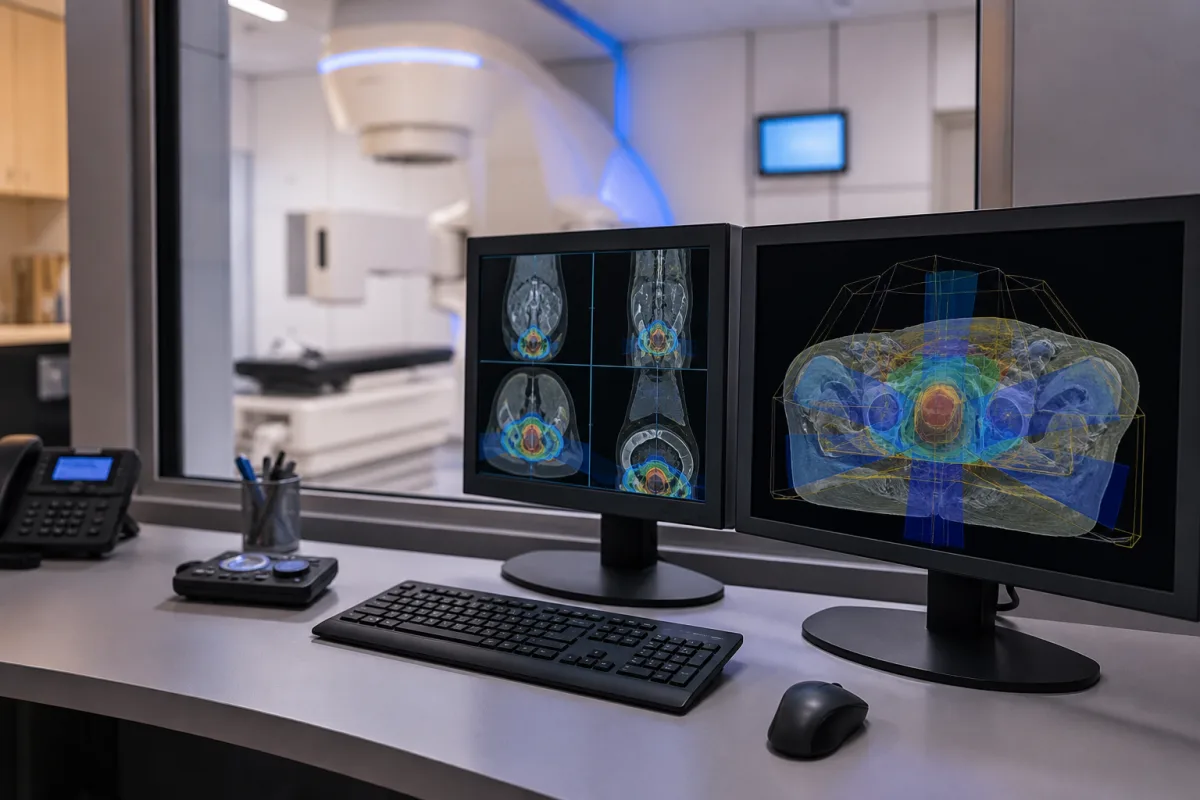
A specialized computer workstation used by radiation oncologists and medical physicists to design and optimize radiotherapy treatment plans.
Product Specifications

Technical details and manufacturing context for Treatment Planning Station

Definition
The Treatment Planning Station is a critical component within the Integrated Radiotherapy Treatment Planning and Delivery System. It serves as the central software and hardware interface where medical professionals import patient imaging data (such as CT, MRI, or PET scans), delineate target volumes and organs at risk, calculate radiation dose distributions, and simulate treatment delivery to create a precise, patient-specific radiotherapy plan. Its role is to ensure the prescribed radiation dose is delivered accurately to the tumor while minimizing exposure to surrounding healthy tissues.
Working Principle
The station operates by running complex treatment planning software (TPS) on high-performance computing hardware. It utilizes algorithms (e.g., convolution/superposition, Monte Carlo) to model the interaction of radiation beams with human tissue based on patient anatomy from 3D imaging. Users define beam parameters (energy, angle, shape via MLCs) and optimization constraints (dose to target, limits to organs). The software iteratively calculates dose distributions and optimizes the plan to meet clinical goals, resulting in a digital plan that is then exported to the treatment delivery system (linear accelerator).
Common Materials
Electronic components (CPUs, GPUs, memory), Plastic polymer casing, Glass (monitor screen), Metal alloys (structural frame)
Technical Parameters
  • System specifications (e.g., CPU cores, RAM, GPU capabilities, software version) critical for calculation speed and plan accuracy. (N/A) Customizable
Components / BOM
  • High-Resolution Medical Display
    Provides detailed visualization of patient anatomy, dose distributions (isodose lines, DVHs), and beam arrangements. Often a color-calibrated monitor for accurate grayscale imaging.
    Material: Glass, plastic, electronic components
  • DICOM Interface Module
    Handles import/export of medical images (CT, MRI) and treatment plans via the DICOM standard to ensure interoperability with imaging systems and linear accelerators.
    Material: Electronic components, software
  • Dose Calculation Engine
    The core software component that performs the physics-based calculations to predict radiation dose deposition in the patient's anatomy based on the defined treatment beams.
    Material: Software algorithms
Engineering Reasoning
15-35°C ambient temperature, 20-80% relative humidity non-condensing, 100-240V AC ±10%, 50-60Hz ±3Hz
Ambient temperature >40°C sustained for >30 minutes, relative humidity >90% sustained for >1 hour, voltage fluctuation >±15% from nominal, electromagnetic interference >10V/m at 80MHz-2GHz
Design Rationale: Semiconductor junction thermal runaway at >85°C die temperature, electrolytic capacitor electrolyte evaporation at >105°C case temperature, PCB delamination at >260°C reflow temperature, insulation breakdown at >3kV/mm electric field strength
Risk Mitigation (FMEA)
Trigger Power supply unit capacitor aging with ESR increase >200% from initial 0.1Ω value
Mode: Voltage regulation failure causing ±25% output deviation from 12V DC nominal
Strategy: Implement active power factor correction with 0.99 PF, use 105°C-rated polymer capacitors with 10,000-hour MTBF at 105°C, add redundant voltage regulation with automatic switchover
Trigger CPU thermal interface material degradation with thermal resistance increase >0.5°C/W
Mode: Processor thermal throttling at >95°C junction temperature reducing clock speed by 50%
Strategy: Use phase-change thermal interface material with 0.15°C/W thermal resistance, implement dual centrifugal fans with 80 CFM airflow each, add temperature sensors with PID-controlled fan speed regulation

Industry Taxonomies & Aliases

Commonly used trade names and technical identifiers for Treatment Planning Station.

Industrial Ecosystem & Supply Chain DNA

Complementary Systems
Downstream Applications
Specialized Tooling

Application Fit & Sizing Matrix

Operational Limits
pressure: N/A (electronic workstation)
other spec: Humidity: 20-80% non-condensing, Power: 100-240V AC, 50/60Hz, 10A max
temperature: 15-25°C (operating), 10-35°C (storage)
Media Compatibility
✓ Medical imaging data (CT, MRI, PET scans) ✓ DICOM-RT treatment planning protocols ✓ Radiotherapy machine interface protocols (LINAC, CyberKnife, TomoTherapy)
Unsuitable: High electromagnetic interference environments (near MRI scanners, industrial equipment)
Sizing Data Required
  • Number of concurrent treatment planning users
  • Volume of patient cases per day (images and plans)
  • Required treatment planning modalities (IMRT, VMAT, SBRT, brachytherapy)

Reliability & Engineering Risk Analysis

Failure Mode & Root Cause
Mechanical wear in positioning components
Cause: Repeated friction and stress on linear guides, bearings, or lead screws due to high-frequency patient positioning adjustments, leading to loss of precision and increased backlash.
Electrical/electronic component degradation
Cause: Thermal cycling and voltage fluctuations affecting power supplies, control boards, or sensors, potentially causing intermittent faults, data corruption, or complete system failure.
Maintenance Indicators
  • Unusual grinding, clicking, or whining noises during axis movement, indicating mechanical wear or misalignment.
  • Inconsistent or drifting positioning accuracy during calibration checks, suggesting sensor failure or mechanical slack.
Engineering Tips
  • Implement a predictive maintenance program using vibration analysis and thermal imaging to detect early signs of mechanical wear and electrical issues before they cause downtime.
  • Establish strict environmental controls (temperature, humidity, and power quality) and perform regular firmware updates to minimize electronic stress and ensure optimal software-hardware integration.

Compliance & Manufacturing Standards

Reference Standards
ISO 13485:2016 - Medical devices - Quality management systems IEC 60601-1:2005 - Medical electrical equipment - Part 1: General requirements for basic safety and essential performance ISO 14971:2019 - Medical devices - Application of risk management to medical devices
Manufacturing Precision
  • Positioning accuracy: +/- 0.5 mm for isocenter alignment
  • Dose calculation accuracy: +/- 2% for treatment planning algorithms
Quality Inspection
  • Software validation testing for treatment planning algorithms
  • Performance verification of imaging and dose calculation systems

Factories Producing Treatment Planning Station

Verified manufacturers with capability to produce this product in China

✓ 96% Supplier Capability Match Found

T Technical Director from Australia Feb 11, 2026
★★★★★
"Reliable performance in harsh Computer, Electronic and Optical Product Manufacturing environments. No issues with the Treatment Planning Station so far."
Technical Specifications Verified
P Project Engineer from Singapore Feb 08, 2026
★★★★☆
"Testing the Treatment Planning Station now; the technical reliability results are within 1% of the laboratory datasheet. (Delivery took slightly longer than expected, but technical support was excellent.)"
Technical Specifications Verified
S Sourcing Manager from Germany Feb 05, 2026
★★★★★
"Impressive build quality. Especially the technical reliability is very stable during long-term operation."
Technical Specifications Verified
Verification Protocol

“Feedback is collected from verified sourcing managers during RFQ (Request for Quote) and factory evaluation processes on CNFX. These reports represent historical performance data and technical audit summaries from our B2B manufacturing network.”

12 sourcing managers are analyzing this specification now. Last inquiry for Treatment Planning Station from Mexico (56m ago).

Supply Chain Compatible Machinery & Devices

Industrial IoT Gateway

Edge computing device connecting industrial equipment to cloud platforms.

Explore Specs →
Modular Industrial Edge Computing Device

Rugged computing platform for industrial data processing at the network edge

Explore Specs →
Industrial Smart Camera Module

Embedded vision system for industrial automation and quality inspection.

Explore Specs →
Industrial Wireless Power Transfer Module

Wireless power transfer module for industrial equipment applications

Explore Specs →

Frequently Asked Questions

What is the primary function of a Treatment Planning Station?

A Treatment Planning Station is a specialized computer system used by radiation oncologists and medical physicists to design, simulate, and optimize radiotherapy treatment plans for cancer patients, ensuring precise radiation dose delivery to tumors while minimizing exposure to healthy tissues.

What are the key components of a Treatment Planning Station?

Key components include a DICOM Interface Module for medical image integration, a Dose Calculation Engine for accurate radiation modeling, and a High-Resolution Medical Display for detailed visualization of anatomical structures and treatment plans.

How does a Treatment Planning Station integrate with hospital systems?

Treatment Planning Stations integrate seamlessly with hospital PACS and oncology information systems through DICOM standards, allowing import of CT/MRI/PET scans and export of treatment plans to radiation therapy delivery systems like linear accelerators.

Can I contact factories directly on CNFX?

CNFX is an open directory, not a transaction platform. Each factory profile provides direct contact information and production details to help you initiate direct inquiries with Chinese suppliers.

Get Quote for Treatment Planning Station

Request technical pricing, lead times, or customized specifications for Treatment Planning Station directly from verified manufacturing units.

Your business information is encrypted and only shared with verified Treatment Planning Station suppliers.

Thank you! Your message has been sent. We'll respond within 1–3 business days.

Need to Manufacture Treatment Planning Station?

Connect with verified factories specializing in this product category

Add Your Factory Contact Us
Previous Product
Transmitter/Sonde
Next Product
Treatment Timer