Industry-Verified Manufacturing Data (2026)

Precision Conveyor System

Based on aggregated insights from multiple verified factory profiles within the CNFX directory, the standard Precision Conveyor System used in the Computer, Electronic and Optical Product Manufacturing sector typically supports operational capacities ranging from standard industrial configurations to heavy-duty production requirements.

Technical Definition & Core Assembly

A canonical Precision Conveyor System is characterized by the integration of Linear Guide Rail and Carriage/Platform. In industrial production environments, manufacturers listed on CNFX commonly emphasize Anodized Aluminum Alloy (frame/rails) construction to support stable, high-cycle operation across diverse manufacturing scenarios.

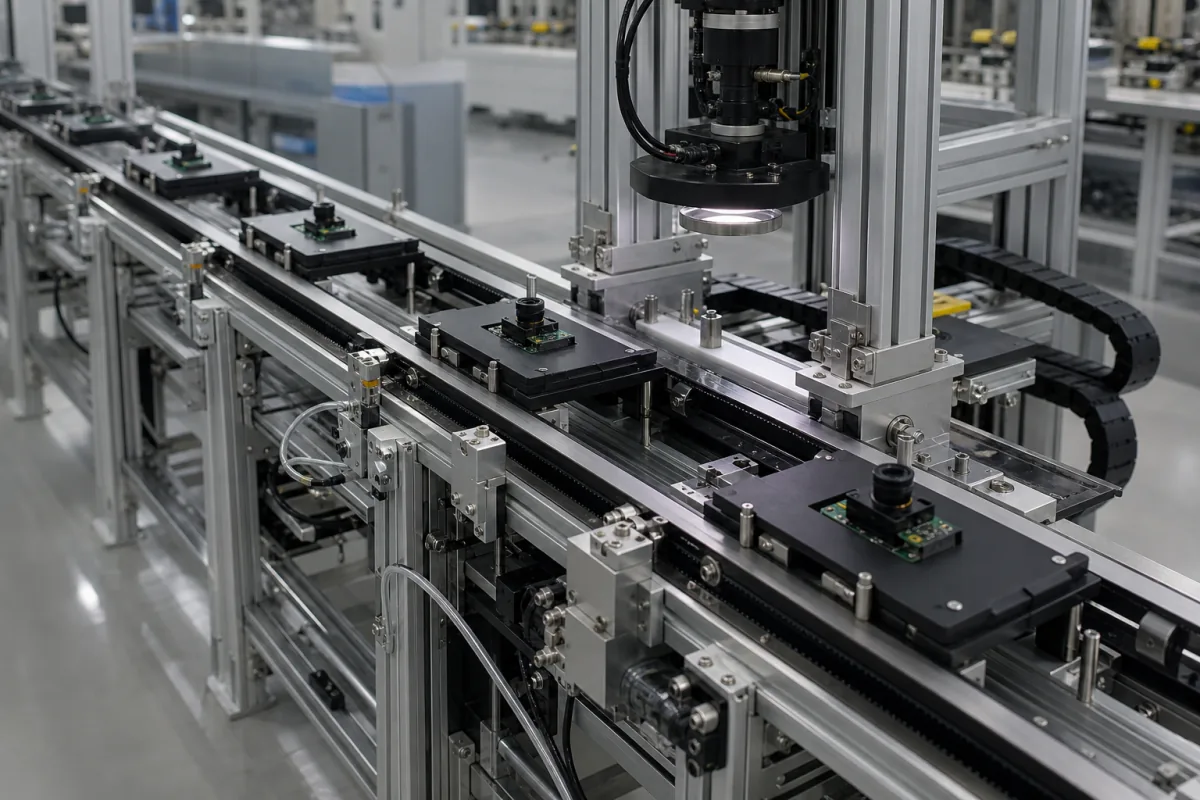
A high-accuracy conveyor system designed for precise positioning and movement of camera modules during assembly and calibration processes.
Product Specifications

Technical details and manufacturing context for Precision Conveyor System

Definition
The Precision Conveyor System is a critical component within the Integrated Multi-Sensor Camera Module Assembly and Calibration System. It provides controlled, stable, and repeatable transportation of camera modules between various assembly stations (e.g., lens mounting, sensor placement) and calibration zones (e.g., focus, alignment, multi-sensor synchronization). Its primary role is to ensure modules are delivered with micron-level positional accuracy and minimal vibration, which is essential for achieving the high tolerances required in advanced optical product manufacturing.
Working Principle
The system typically employs a servo motor or stepper motor driving a precision linear actuator (e.g., ball screw, linear motor) or a synchronized belt/pulley mechanism. Movement is controlled by a programmable logic controller (PLC) or dedicated motion controller that receives coordinates from the system's central computer. Feedback from high-resolution encoders or laser positioning sensors allows for closed-loop control, enabling real-time adjustments to speed, acceleration, and final position to achieve the required precision.
Common Materials
Anodized Aluminum Alloy (frame/rails), Stainless Steel (bearing surfaces/fasteners), Engineering Plastics (low-friction wear strips/guides)
Technical Parameters
  • Positional Repeatability (mm) Per Request
Components / BOM
  • Linear Guide Rail
    Provides a rigid, low-friction path for the carriage to travel along, ensuring straight-line motion and absorbing loads.
    Material: Hardened Steel or Stainless Steel
  • Carriage/Platform
    The moving part that directly holds and transports the camera module fixture or pallet.
    Material: Aluminum Alloy or Composite Material
  • Servo Drive System
    Converts electrical signals from the controller into precise mechanical movement of the carriage.
    Material: Various (enclosure: aluminum; internal: copper windings, magnets, steel)
  • High-Resolution Encoder
    Measures the exact position of the carriage and provides feedback to the controller for closed-loop precision.
    Material: Various (glass/steel scale, optical/ magnetic read head)
Engineering Reasoning
0.1-2.0 m/s linear velocity, ±0.05 mm positioning accuracy, 0.5-5.0 kg payload capacity
Positioning error exceeding ±0.1 mm, linear velocity deviation >0.05 m/s from setpoint, belt tension <15 N or >45 N
Design Rationale: Servo motor cogging torque ripple exceeding 0.5% of rated torque causes positioning inaccuracies; Polyurethane belt thermal expansion coefficient of 1.2×10⁻⁴/°C creates dimensional instability beyond ±2°C ambient variation
Risk Mitigation (FMEA)
Trigger Encoder resolution degradation below 0.001 mm/pulse due to optical sensor contamination
Mode: Stepper motor position overshoot exceeding 0.08 mm during camera module indexing
Strategy: Install IP67-rated optical encoder with redundant Hall-effect position verification at each carriage
Trigger Belt drive pulley eccentricity exceeding 0.02 mm TIR causing sinusoidal velocity variation
Mode: Camera module image blur during motion due to velocity fluctuations >3% RMS
Strategy: Implement ground and polished steel pulleys with 0.005 mm concentricity tolerance and dynamic tensioning system

Industry Taxonomies & Aliases

Commonly used trade names and technical identifiers for Precision Conveyor System.

Industrial Ecosystem & Supply Chain DNA

Complementary Systems
Downstream Applications
Specialized Tooling

Application Fit & Sizing Matrix

Operational Limits
pressure: Atmospheric (non-pressurized)
other spec: Positioning accuracy: ±0.05mm, Max load capacity: 5kg/m, Vibration tolerance: <0.1g RMS
temperature: 15°C to 35°C
Media Compatibility
✓ Camera modules ✓ Optical components ✓ Small electronic assemblies
Unsuitable: Abrasive or corrosive particulate environments
Sizing Data Required
  • Maximum conveyor length required
  • Required positioning accuracy (±mm)
  • Maximum component weight and dimensions

Reliability & Engineering Risk Analysis

Failure Mode & Root Cause
Belt misalignment and tracking failure
Cause: Improper tensioning, worn or damaged pulleys, accumulation of material on pulleys, or structural misalignment of conveyor frame leading to uneven belt wear and potential catastrophic failure.
Bearing seizure in drive or idler rollers
Cause: Inadequate lubrication, ingress of contaminants (dust, moisture), excessive loading beyond design capacity, or improper installation causing misalignment and overheating.
Maintenance Indicators
  • Audible high-pitched squealing or grinding noises from drive components indicating bearing wear or belt slippage
  • Visible excessive vibration or wobbling of rollers/pulleys during operation suggesting imbalance or structural issues
Engineering Tips
  • Implement laser alignment procedures during installation and periodic checks to ensure all pulleys, rollers, and drive components are within 0.5mm tolerance, preventing premature wear.
  • Establish condition-based monitoring using infrared thermography on bearings and vibration analysis on drive motors to detect early degradation before failure occurs.

Compliance & Manufacturing Standards

Reference Standards
ISO 340:2013 (Conveyor belts) ANSI/CEMA 402-2003 (Belt conveyors) CE Machinery Directive 2006/42/EC
Manufacturing Precision
  • Belt tracking alignment: +/- 2mm
  • Roller concentricity: 0.05mm TIR
Quality Inspection
  • Dimensional verification with CMM
  • Load testing with strain gauge analysis

Factories Producing Precision Conveyor System

Verified manufacturers with capability to produce this product in China

✓ 98% Supplier Capability Match Found

P Procurement Specialist from Singapore Jan 31, 2026
★★★★★
"Standard OEM quality for Computer, Electronic and Optical Product Manufacturing applications. The Precision Conveyor System arrived with full certification."
Technical Specifications Verified
T Technical Director from Germany Jan 28, 2026
★★★★★
"Great transparency on the Precision Conveyor System components. Essential for our Computer, Electronic and Optical Product Manufacturing supply chain."
Technical Specifications Verified
P Project Engineer from Brazil Jan 25, 2026
★★★★★
"The Precision Conveyor System we sourced perfectly fits our Computer, Electronic and Optical Product Manufacturing production line requirements."
Technical Specifications Verified
Verification Protocol

“Feedback is collected from verified sourcing managers during RFQ (Request for Quote) and factory evaluation processes on CNFX. These reports represent historical performance data and technical audit summaries from our B2B manufacturing network.”

10 sourcing managers are analyzing this specification now. Last inquiry for Precision Conveyor System from Thailand (1h ago).

Supply Chain Compatible Machinery & Devices

Industrial Smart Camera Module

Embedded vision system for industrial automation and quality inspection.

Explore Specs →
Industrial Wireless Power Transfer Module

Wireless power transfer module for industrial equipment applications

Explore Specs →
Industrial Smart Sensor Module

Modular industrial sensor with embedded processing and wireless connectivity

Explore Specs →
Surface Mount Resistor

Passive electronic component for current limiting and voltage division in circuits

Explore Specs →

Frequently Asked Questions

What makes this conveyor system suitable for camera module assembly?

The system features high-resolution encoders and servo drive technology for micron-level positioning accuracy, essential for aligning delicate camera components during assembly and calibration.

How does the material selection impact performance in cleanroom environments?

Anodized aluminum resists corrosion, stainless steel prevents particulate generation, and engineering plastics provide low-friction movement without lubrication, making it ideal for electronics manufacturing cleanrooms.

Can this system integrate with existing automation equipment?

Yes, the modular design with standardized interfaces allows seamless integration with robotic arms, vision systems, and PLC controls commonly used in computer and optical product manufacturing.

Can I contact factories directly on CNFX?

CNFX is an open directory, not a transaction platform. Each factory profile provides direct contact information and production details to help you initiate direct inquiries with Chinese suppliers.

Get Quote for Precision Conveyor System

Request technical pricing, lead times, or customized specifications for Precision Conveyor System directly from verified manufacturing units.

Your business information is encrypted and only shared with verified Precision Conveyor System suppliers.

Thank you! Your message has been sent. We'll respond within 1–3 business days.

Need to Manufacture Precision Conveyor System?

Connect with verified factories specializing in this product category

Add Your Factory Contact Us
Previous Product
Precision Aspheric Lens Element
Next Product
Precision Dispensing Head