Industry-Verified Manufacturing Data (2026)

Spectrometer Unit

Based on aggregated insights from multiple verified factory profiles within the CNFX directory, the standard Spectrometer Unit used in the Computer, Electronic and Optical Product Manufacturing sector typically supports operational capacities ranging from standard industrial configurations to heavy-duty production requirements.

Technical Definition & Core Assembly

A canonical Spectrometer Unit is characterized by the integration of Entrance Slit and Collimating Mirror. In industrial production environments, manufacturers listed on CNFX commonly emphasize Aluminum alloy construction to support stable, high-cycle operation across diverse manufacturing scenarios.

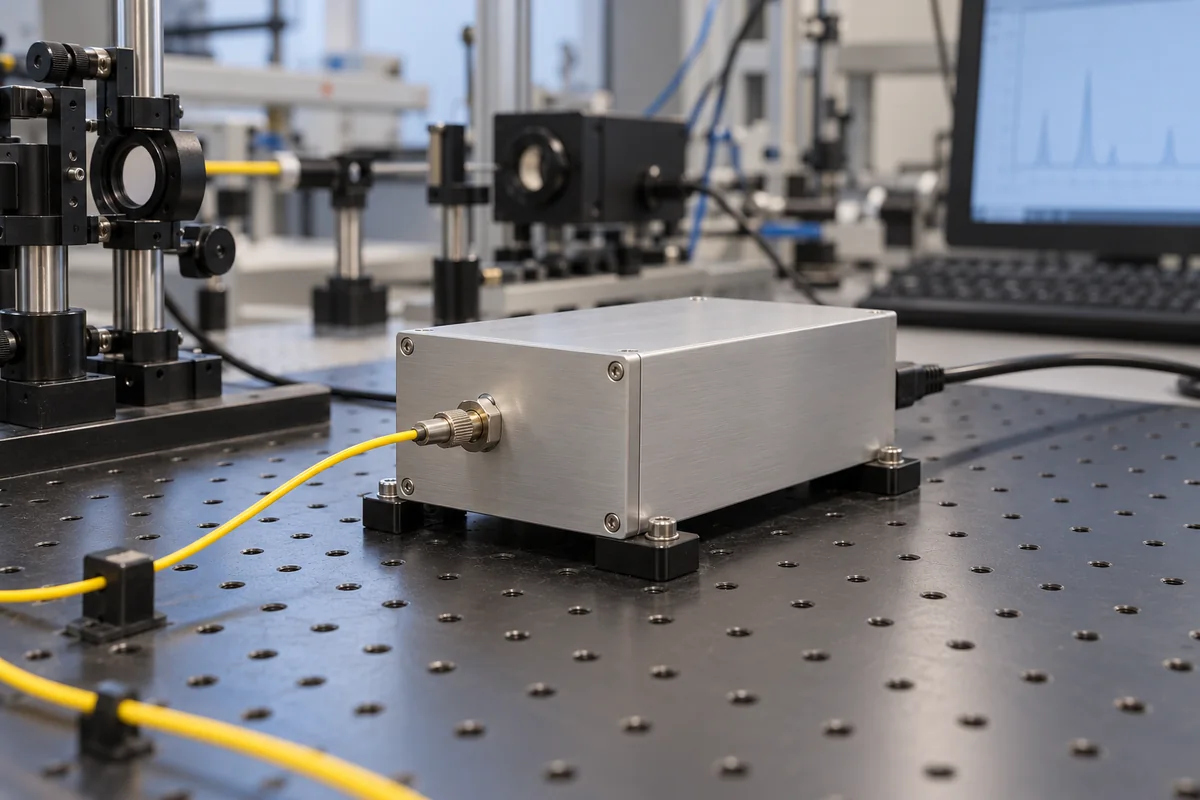
The core optical component of a spectroscopic analyzer that separates light into its constituent wavelengths for measurement.
Product Specifications

Technical details and manufacturing context for Spectrometer Unit

Definition
A spectrometer unit is the essential optical subsystem within a spectroscopic analyzer responsible for dispersing incoming light into its spectral components. It typically consists of an entrance slit, collimating optics, a diffraction grating or prism for wavelength separation, and focusing optics that direct the spectrum onto a detector array. This unit enables quantitative analysis of material composition by measuring the intensity of light at specific wavelengths.
Working Principle
Light enters through an entrance slit and is collimated into a parallel beam. This beam strikes a diffraction grating (or prism) where different wavelengths are diffracted at different angles according to the grating equation. The separated wavelengths are then focused onto a detector (such as a CCD or photodiode array), creating a spectrum that can be analyzed to determine material properties.
Common Materials
Aluminum alloy, Optical glass, Mirror coatings
Technical Parameters
  • Spectral resolution, typically ranging from 0.1 nm to 10 nm depending on application (nm) Standard Spec
Components / BOM
  • Entrance Slit
    Controls the amount of light entering the spectrometer and defines the spectral resolution
    Material: Stainless steel
  • Collimating Mirror
    Creates parallel light beams from the slit for uniform grating illumination
    Material: Aluminum with reflective coating
  • Diffraction Grating
    Disperses light into its constituent wavelengths through diffraction
    Material: Glass with ruled or holographic grating
  • Focusing Mirror
    Focuses the dispersed spectrum onto the detector array
    Material: Aluminum with reflective coating
Engineering Reasoning
200-1100 nm wavelength range, 15-35°C operating temperature, 20-80% relative humidity
Optical grating damage at >150 mW/mm² power density, detector saturation at >85% full scale reading, wavelength calibration drift >0.5 nm
Design Rationale: Diffraction grating thermal expansion coefficient mismatch (17 ppm/°C Invar vs 8 ppm/°C glass substrate) causing wavelength shift, photodiode dark current doubling every 10°C rise (Arrhenius equation), moisture-induced refractive index change in optical elements (n=1.0003 at 0% RH to n=1.0008 at 100% RH)
Risk Mitigation (FMEA)
Trigger Thermal shock exceeding 10°C/min gradient
Mode: Optical grating substrate cracking due to CTE mismatch stress
Strategy: Active temperature stabilization with PID control (±0.1°C), graded CTE adhesive layers (3-layer epoxy-silicone-polyimide)
Trigger Ambient vibration at 50-200 Hz resonance frequency
Mode: Wavelength calibration drift from grating angular displacement
Strategy: Kinematic mounting with 6-DOF isolation (0.5 Hz natural frequency), laser interferometer feedback for real-time position correction

Industry Taxonomies & Aliases

Commonly used trade names and technical identifiers for Spectrometer Unit.

Applied To / Applications

This component is essential for the following industrial systems and equipment:

Industrial Ecosystem & Supply Chain DNA

Complementary Systems
Downstream Applications
Specialized Tooling

Application Fit & Sizing Matrix

Operational Limits
pressure: 0.8 to 1.2 atm (operating), 0.5 to 1.5 atm (max)
other spec: Flow Rate: 0-5 L/min (for purge/cooling), Slurry Concentration: Not applicable (optical path must remain particle-free)
temperature: -10°C to 50°C (operating), -20°C to 70°C (storage)
Media Compatibility
✓ Gaseous media (e.g., clean air, inert gases) ✓ Liquid media (e.g., clear aqueous solutions, solvents) ✓ Solid samples via reflectance (e.g., powders, films)
Unsuitable: High-particulate slurry or abrasive media (causes optical fouling/scattering)
Sizing Data Required
  • Wavelength range required (nm)
  • Spectral resolution needed (nm or cm⁻¹)
  • Optical path length or sample interface type (transmission/reflectance)

Reliability & Engineering Risk Analysis

Failure Mode & Root Cause
Optical component degradation
Cause: Contamination from environmental dust, moisture ingress, or chemical exposure leading to lens/sensor fouling, coating damage, or misalignment, reducing spectral accuracy and sensitivity.
Electronic system failure
Cause: Thermal stress from continuous operation or poor ventilation causing component overheating, solder joint fatigue, or power supply instability, leading to erratic readings or complete shutdown.
Maintenance Indicators
  • Drift or instability in baseline readings during calibration checks, indicating optical or electronic degradation.
  • Unusual audible hum, clicking, or fan noise from the unit, suggesting cooling system failure or electrical arcing.
Engineering Tips
  • Implement strict environmental controls: maintain stable temperature/humidity, use clean/dry purge gas for optical paths, and install particulate filters on intake vents to prevent contamination.
  • Establish predictive maintenance with regular thermal imaging of electronic components and scheduled cleaning of optical surfaces using manufacturer-approved procedures and materials.

Compliance & Manufacturing Standards

Reference Standards
ISO 17025:2017 - General requirements for the competence of testing and calibration laboratories ASTM E1252-98(2021) - Standard Practice for General Techniques for Obtaining Infrared Spectra for Qualitative Analysis CE marking - Compliance with EU directives for electromagnetic compatibility and safety
Manufacturing Precision
  • Wavelength accuracy: +/- 0.2 nm
  • Photometric linearity: +/- 1% over specified range
Quality Inspection
  • Wavelength calibration verification using certified reference materials
  • Performance verification with NIST-traceable standards

Factories Producing Spectrometer Unit

Verified manufacturers with capability to produce this product in China

✓ 98% Supplier Capability Match Found

T Technical Director from Singapore Feb 19, 2026
★★★★★
"Impressive build quality. Especially the technical reliability is very stable during long-term operation."
Technical Specifications Verified
P Project Engineer from Germany Feb 16, 2026
★★★★☆
"As a professional in the Computer, Electronic and Optical Product Manufacturing sector, I confirm this Spectrometer Unit meets all ISO standards. (Delivery took slightly longer than expected, but technical support was excellent.)"
Technical Specifications Verified
S Sourcing Manager from Brazil Feb 13, 2026
★★★★★
"Standard OEM quality for Computer, Electronic and Optical Product Manufacturing applications. The Spectrometer Unit arrived with full certification."
Technical Specifications Verified
Verification Protocol

“Feedback is collected from verified sourcing managers during RFQ (Request for Quote) and factory evaluation processes on CNFX. These reports represent historical performance data and technical audit summaries from our B2B manufacturing network.”

18 sourcing managers are analyzing this specification now. Last inquiry for Spectrometer Unit from Poland (38m ago).

Supply Chain Compatible Machinery & Devices

Modular Industrial Edge Computing Device

Rugged computing platform for industrial data processing at the network edge

Explore Specs →
Industrial Smart Camera Module

Embedded vision system for industrial automation and quality inspection.

Explore Specs →
Industrial Wireless Power Transfer Module

Wireless power transfer module for industrial equipment applications

Explore Specs →
Industrial Smart Sensor Module

Modular industrial sensor with embedded processing and wireless connectivity

Explore Specs →

Frequently Asked Questions

What are the main components in this spectrometer unit's BOM?

The Bill of Materials includes an Entrance Slit, Collimating Mirror, Diffraction Grating, and Focusing Mirror, all precision-engineered for optimal light separation and measurement.

What materials are used in this spectrometer unit construction?

Constructed with durable aluminum alloy housing, high-quality optical glass components, and specialized mirror coatings to ensure precise wavelength separation and long-term reliability.

How does this spectrometer unit function in spectroscopic analysis?

The unit serves as the core optical component that separates incoming light into constituent wavelengths using diffraction grating technology, enabling accurate measurement and analysis in spectroscopic systems.

Can I contact factories directly on CNFX?

CNFX is an open directory, not a transaction platform. Each factory profile provides direct contact information and production details to help you initiate direct inquiries with Chinese suppliers.

Get Quote for Spectrometer Unit

Request technical pricing, lead times, or customized specifications for Spectrometer Unit directly from verified manufacturing units.

Your business information is encrypted and only shared with verified Spectrometer Unit suppliers.

Thank you! Your message has been sent. We'll respond within 1–3 business days.

Need to Manufacture Spectrometer Unit?

Connect with verified factories specializing in this product category

Add Your Factory Contact Us
Previous Product
Speaker Driver
Next Product
Squeegee Assembly