Editorial Technical Reference

DC Input Section

This page explains how DC Input Section is classified within Electrical Equipment Manufacturing. Technical values and manufacturer relationships are research references; confirm the current specification and supplier evidence for each order.

Technical Definition & Core Assembly

The section of a solar inverter responsible for receiving, conditioning, and managing the direct current (DC) power from photovoltaic (PV) panels.
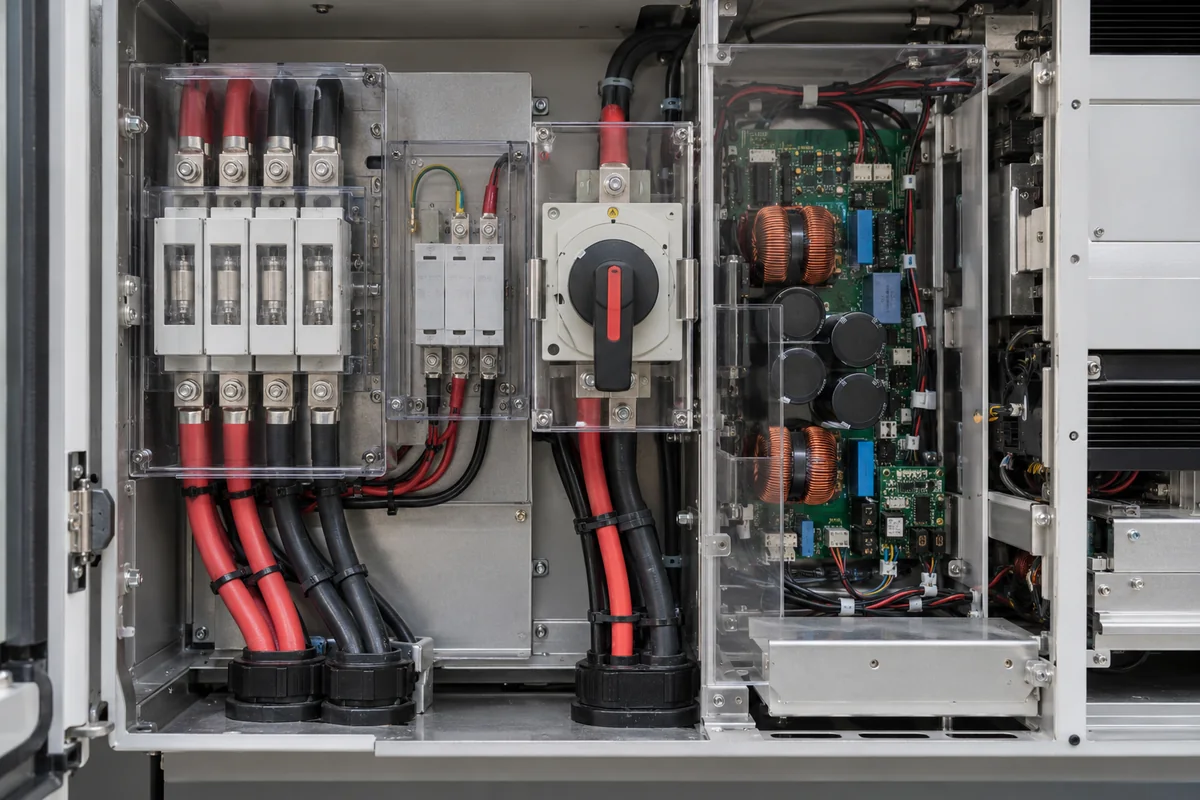
DC Input Section in a manufacturing environment
Representative product image. Confirm appearance and specifications with the manufacturer.

Product Specifications

Technical details and manufacturing context for DC Input Section

Definition
The DC Input Section is a critical subsystem within a solar inverter that interfaces directly with the photovoltaic array. Its primary functions include: receiving variable DC power from solar panels, providing initial filtering and protection against voltage spikes or reverse currents, monitoring input voltage and current levels, and preparing the DC power for conversion to alternating current (AC) by the inverter's power electronics stage. It ensures stable and safe operation by managing the variable output characteristics of the PV modules. This section typically includes input terminals, fuses or circuit breakers for overcurrent protection, and electromagnetic compatibility (EMC) filters to suppress electrical noise. Voltage and current sensors continuously monitor the input parameters. In many modern inverters, this section also includes a Maximum Power Point Tracking (MPPT) controller, which dynamically adjusts the electrical operating point of the PV modules to extract the maximum available power under varying sunlight and temperature conditions. The conditioned DC power is then fed to the DC-AC conversion stage. The DC Input Section is designed to handle a range of input voltages and currents, with typical maximum input voltage ratings between 1000 and 1500 V DC, and MPPT voltage ranges from 200 to 1000 V DC. Maximum input current per MPPT tracker is typically between 10 and 30 A, and the number of MPPT trackers can range from 2 to 4. Input connectors are typically MC4 or MC4-Evo2 types, and surge protection is provided according to Type II or III classifications. The operating temperature range is typically -25 to 60 °C, with derating above 45 °C. Ingress protection ratings are typically IP54 to IP65. Maximum DC input power can range from 10 to 150 kW, with an oversizing ratio up to 1.5. An input disconnect switch may be integrated or optional, and DC reverse polarity protection is provided. The weight of the section typically ranges from 15 to 80 kg. These values are reference ranges and must be verified for the specific model and application with the legal manufacturer or supplier.
Working Principle
The DC Input Section operates by first receiving the DC output from connected PV strings. It typically incorporates input terminals, fuses or circuit breakers for overcurrent protection, and electromagnetic compatibility (EMC) filters to suppress electrical noise. Voltage and current sensors continuously monitor the input parameters. In many modern inverters, this section also includes a Maximum Power Point Tracking (MPPT) controller, which dynamically adjusts the electrical operating point of the PV modules to extract the maximum available power under varying sunlight and temperature conditions. The conditioned DC power is then fed to the DC-AC conversion stage.
Common Materials
Copper (for busbars and conductors), Electronic components (capacitors, inductors, semiconductors), Plastic (for housing and insulation), Steel (for structural support and shielding)
Technical Parameters
ParameterTypical rangeNotes & selection driver
Maximum Input Voltage1000–1500 V DCExceeding this may damage the inverter.IEC 62109
MPPT Voltage Range200–1000 V DCOptimal power tracking range.
Maximum Input Current10–30 APer MPPT tracker.
Number of MPPT Trackers2–4More trackers for complex rooftops.
Input Connector TypeMC4–MC4-Evo2Compatibility with PV modules.IEC 62852
Surge ProtectionType II–IIIProtects against lightning surges.IEC 61643-31
Operating Temperature Range-25–60 °CDerating above 45°C.IEC 62109
Ingress Protection RatingIP54–IP65Dust and water resistance.IEC 60529
Maximum DC Input Power10–150 kWOversizing ratio up to 1.5.
Input Disconnect SwitchIntegrated–OptionalSafety isolation for maintenance.IEC 60947-3
DC Reverse Polarity ProtectionYesPrevents damage from miswiring.
Weight15–80 kgAffects mounting structure.

Ranges are indicative industry figures for RFQ preparation, not a supplier commitment. Confirm every value and standard with the legal manufacturer before ordering.

Components / BOM
  • DC Input Terminals Part
    Provide the physical connection points for the positive and negative cables from the PV array.
    Material: Copper alloy, plastic insulation
  • DC Switch / Isolator
    Allows for the safe disconnection of the PV array for maintenance or emergency shutdown.
    Material: Plastic housing, metal contacts
  • Surge Protection Device (SPD)
    Protects the inverter from voltage spikes caused by lightning or grid disturbances.
    Material: Metal oxide varistor (MOV), plastic housing
  • DC Fuses / Circuit Breakers
    Provide overcurrent protection for the input circuits.
    Material: Ceramic, metal, plastic
  • Input Filter (EMC Filter)
    Suppresses electromagnetic interference generated by the inverter from being conducted back to the PV array.
    Material: Ferrite cores, capacitors, inductors
  • DC Link Capacitors Part
    Stabilize the DC bus voltage by smoothing out ripples and providing energy storage.
    Material: Aluminum electrolytic or film capacitors
  • Voltage and Current Sensors
    Continuously monitor the PV string input parameters.
  • MPPT Controller Optional
    Adjusts the PV operating point to extract maximum available power.

Application & selection

Application Fit & Sizing Matrix

Operational Limits
current: Up to 30A per MPPT input (varies by model)
voltage: 150V to 1500V DC (typical range)
other spec: IP65 ingress protection, 85-95% efficiency, 1000V DC max insulation
temperature: -25°C to +60°C (operating), -40°C to +85°C (storage)
Media Compatibility
✓ Photovoltaic panel DC output ✓ Battery storage DC systems ✓ DC generator inputs
Unsuitable: High-frequency AC environments or corrosive chemical atmospheres
Sizing Data Required
  • Maximum PV array power (kWp)
  • Number of MPPT inputs required
  • Maximum DC input voltage (Vdc)

Risk, maintenance & compliance

Reliability & Engineering Risk Analysis

Failure Mode & Root Cause
Capacitor degradation
Cause: Electrolyte drying due to high operating temperatures or voltage stress, leading to reduced capacitance and increased ESR.
Rectifier diode failure
Cause: Thermal overstress from excessive current or poor heat dissipation, causing junction breakdown or open circuit.
Maintenance Indicators
  • Audible buzzing or humming from the input section indicating capacitor or transformer issues
  • Visible discoloration or bulging of capacitors on the PCB
Engineering Tips
  • Implement regular thermal monitoring of rectifier components and ensure adequate ventilation to prevent overheating
  • Use high-quality capacitors with appropriate voltage ratings and derate them by at least 20% for extended lifespan

Indicative industry ranges for design and RFQ preparation. Confirm the exact figures and applicable standard with the manufacturer before specifying.

Compliance & Manufacturing Standards

Applicable Standards
IEC 61010-1: Safety requirements for electrical equipment for measurement, control, and laboratory use UL 60950-1: Information technology equipment - Safety EN 61000-6-2: Electromagnetic compatibility (EMC) - Generic standards - Immunity for industrial environments

Quoted from the published standard.

Manufacturing Precision
  • Input voltage range: +/-5% of nominal rating
  • Terminal connection torque: +/-10% of specified value
Quality Inspection
  • Hi-pot (dielectric withstand) test: 1500V AC for 1 minute
  • Input ripple current measurement: ≤10% of rated input current
Technical documentation
Request current drawings, revision history, and a signed specification sheet.
Manufacturing capability
Verify equipment lists, process limits, capacity, and representative production evidence.
Inspection readiness
Confirm test methods, calibrated equipment, sampling plans, and traceable reports.
Supplier transparency
Check the legal entity, factory address, ownership, certifications, and direct contacts.

Compare the published product scope and source details, then include your specifications and quantity in an enquiry.

Manufacturers of DC Input Section

Manufacturer profiles associated with DC Input Section.

Sourcing DC Input Section from China?
Tell us your specification and target quantity — we will match it against manufacturer records and come back with the factories that fit.
Request manufacturers We manufacture this

Explore company information and manufacturing capabilities, then discuss the scope of your project with a relevant supplier.

Buyer enquiry

Request manufacturing insight for DC Input Section

Ask for use case, specification boundaries, supplier type, and RFQ preparation information for this product.

Where it goes
Straight to the CNFX editorial desk, and to the manufacturer if this product is linked to a claimed profile. Nothing is broadcast to a supplier list.
Your details stay here
We do not sell or rent enquiry data, and we do not add you to a mailing list. Used only to answer this request.
No commission, no middleman
CNFX is a directory. We take no cut of any order and never negotiate on a supplier's behalf.
What to include
Share your product specifications, quantity, destination and target delivery date.

Your business information is used only to process this request.

Thank you! Your message has been sent. We'll respond within 1–3 business days.
Sorry, we couldn't send your message. Please try again, or email us at [email protected].

Frequently Asked Questions

What is the primary function of the DC Input Section?

It receives DC power from PV panels, conditions it, and prepares it for conversion to AC. It also provides protection and monitoring.

What are typical maximum input voltage ratings?

Typical maximum input voltage is between 1000 and 1500 V DC, but always verify with the manufacturer for your specific model.

How does MPPT work in this section?

MPPT dynamically adjusts the electrical operating point to extract maximum power from PV modules under varying conditions.

What standards apply to this component?

Relevant standards include IEC 62109 for safety, IEC 62852 for connectors, IEC 61643-31 for surge protection, and IEC 60529 for ingress protection. Verify compliance with the manufacturer.

Related equipment

Applied To / Applications

This component is essential for the following industrial systems and equipment:

Industry Taxonomies & Aliases

Commonly used trade names and technical identifiers for DC Input Section.

Data Basis

Editorial classification, named public sources where available, and source-reviewed manufacturer records.

Preliminary Technical Classification
This page supports structured research, RFQ preparation, and supplier evaluation. It does not replace buyer-led supplier qualification, standards review, or technical approval.

Need to Manufacture DC Input Section?

Compare manufacturer profiles with relevant product and process capability.

Previous Product
Wire Tensioning System
Last Product
Get QuotesChat