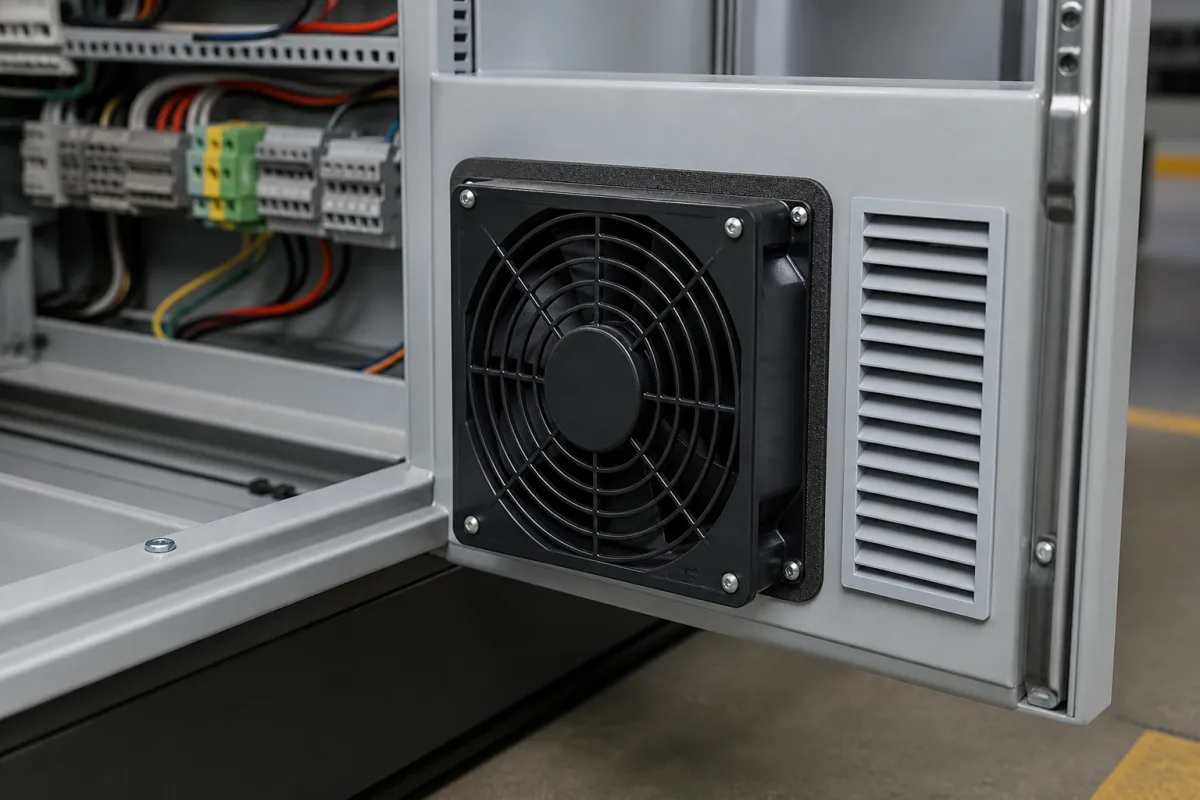
Ventilation fan for a control cabinet (the filter fan and outlet filter that move air through the enclosure, and what the filters take away)
The filter fan set into a control cabinet door or wall · unimpeded airflow against airflow with one or two outlet filters, chopped-fibre or pleated filter mats, IP 54 to IP 56 with a hose-proof hood, and how often filter mats are changed in dusty, misty or oily air
A cabinet filter fan pushes outside air through a filter mat into the enclosure, and the warm air leaves through an outlet (exhaust) filter. Every filter in that path takes away airflow, and a mat that clogs takes more. The figure that matters for cooling is the airflow with the outlet filters actually fitted, and keeping it there depends on the filter type and how often it is changed.
Filter fans and outlet filters for ventilating control cabinets and enclosures, with their filter mats. DC axial fans as components are covered on the Cooling fan (DC axial cooling fan for enclosures) page; fan bearings on the Cooling fan bearing assembly: a spring-preloaded pair of miniature ball bearings on the fan shaft page; cabinet heat balance and fan-flow formula on the Control system cabinet: the machine control panel that houses PLC, drives and protection page; cabinets themselves on the Control cabinet page.
CNFX editorial research · Sources checked October 13, 2026 · 4 sources
Rittal's data sheet for the TopTherm filter fan SK 3238.110 (115 V) gives an unimpeded air flow of 52 m³/h at 50 Hz with the chopped fibre filter supplied, 63 m³/h with an optional pleated filter, and "Air throughput with outlet filter" of 36/42 m³/h (50/60 Hz) with one 3238200 outlet filter and 46/54 m³/h with two. The 24 V DC SK 3238.124 lists 52, 63, 36 and 46 m³/h on the same basis. [1][2]
Editorial calculation from Rittal's 50 Hz figures: one outlet filter leaves 36 / 52 ≈ 69% of the unimpeded airflow with the chopped fibre mat, two outlet filters 46 / 52 ≈ 88%, and the pleated filter raises the unimpeded figure by 63 / 52 ≈ 21%. Rittal notes that "A pleated filter can optionally be used to increase the air throughput" in both filter fans and exhaust filters. [1]
Rittal describes the fan as diagonal, "more pressure-resistant" and giving "more constant air performance", with an L10 service life of 68,200 h at 40 °C for the 115 V unit, an operating range of −15 to 55 °C and 46 dB(A) at 50 Hz. [1]
Size the fan from the airflow with the planned number of outlet filters, not the unimpeded figure, and give the supplier the cabinet's heat loss and allowed internal temperature.
02
Filter mat type, protection rating and change intervals
Pfannenberg's support note says its filter fans and exhaust filters come with an IP55 fluted filter, except the PF 11000 and PFA 10000 with an IP54 filter mat; that filters should be inspected monthly; and that "if your cabinet starts running hotter unexpectedly" the filter is clogging. It warns that the fluted filter passes air while dirty but will eventually clog completely, and that water can damage its hydrophobic coating. [3]
nVent Hoffman's replacement IP55 filter mat EFMP220 (EN 779 class G4) for its EFP filter fans and EFAP exhaust filters is to be replaced "each year or sooner depending on the environment", to keep the enclosure's cooling capacity and protection degree. Rittal rates its units IP 54 with chopped fibre or pleated filter, and IP 56 with a hose-proof hood. [4][1]
Pfannenberg guideline
Fleece filter mat
Fluted filter
Coarse particles
Min. 2 times per year
Min. 1 time per year
Dust-laden / spray mist
Min. 6 times per year
Min. 3 times per year
Very high oil content
Min. 1 time per week
Min. 2 times a month
Without corresponding loads
Min. 2 times per year
Min. 1 time per year
Describe the air around the cabinet (dust, spray mist, oil), and for oily air ask whether a closed-loop cooling unit or air-to-water heat exchanger is the better choice, as Pfannenberg recommends.
03
Cabinet filter fan details
Paste it into your enquiry below or into an email to a maker, then replace every bracket.
1 company lists this product among what they make. Company figures are quoted from each
company's own website; every card states where the relationship came from.
Explore company information and manufacturing capabilities, then discuss the scope of your project with a relevant supplier.
Share this page
Compiled and source-reviewed by the CNFX editorial team.
Each manufacturer above links to the page on that company's own website where the product is listed, with the date we checked it. How we source and review
· Page last updated 13 October 2026
Buyer questions
How much airflow does an outlet filter take away?
On Rittal's SK 3238.110, from 52 m³/h unimpeded to 36 m³/h with one outlet filter and 46 m³/h with two. [1]
Does a pleated filter help?
Rittal lists 63 m³/h unimpeded with the pleated filter against 52 m³/h with chopped fibre. [1]
How often should filter mats be changed?
Pfannenberg gives at least twice a year for fleece mats in coarse dust, up to weekly in very oily air; nVent says each year or sooner. [3][4]
How do I know the filter is clogged?
Pfannenberg says the cabinet starts running hotter unexpectedly. [3]
Sources and what still needs a direct check
Sources checked 2026-10-13. Rittal publishes data sheets for its TopTherm filter fans; Pfannenberg USA publishes a support note on filter changes; nVent Hoffman publishes the EFMP220 filter mat sheet.