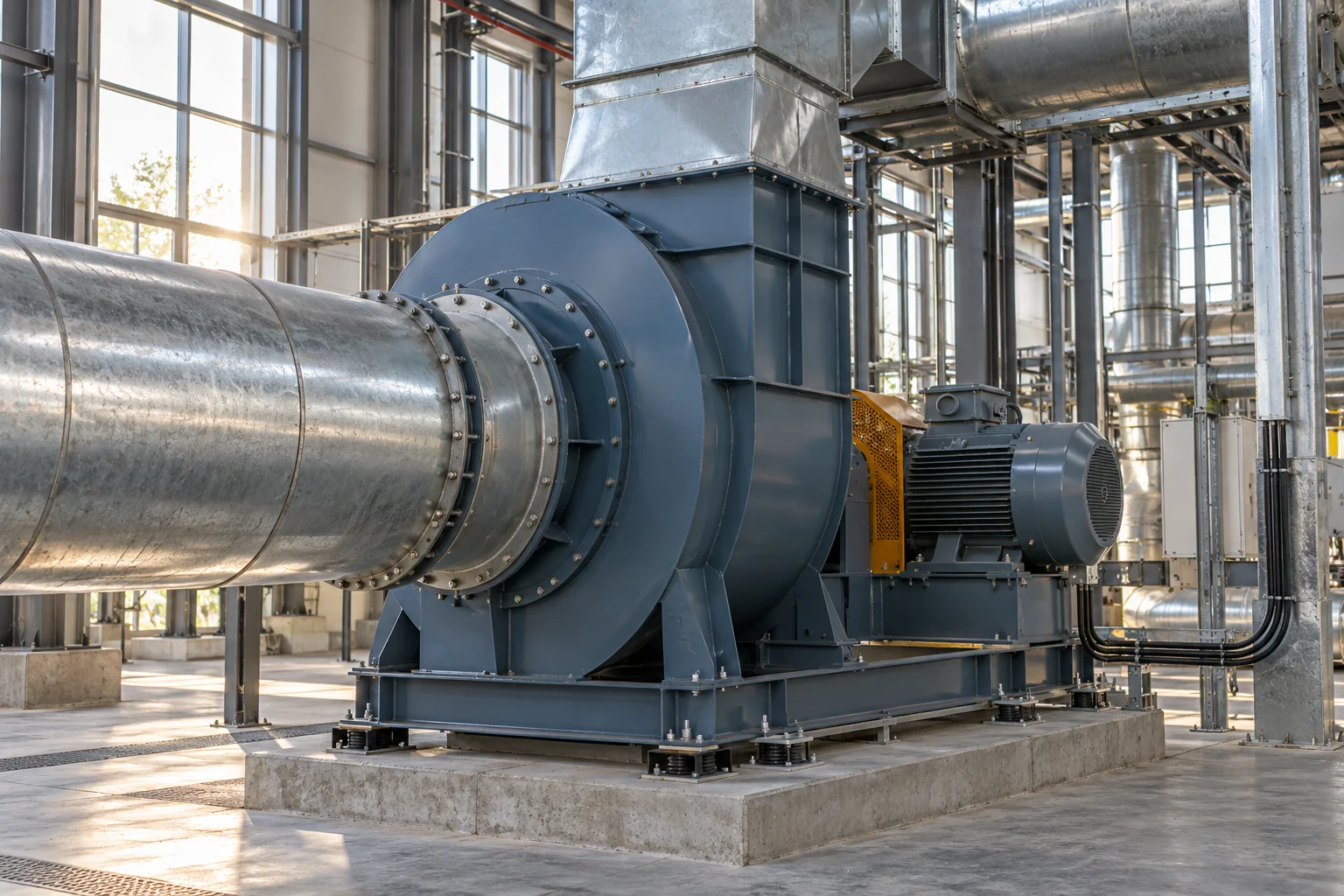
The wheel, housing and drive assembly are illustrated in Greenheck’s IP manual. The following is a functional component reference, not a manufacturing BOM with quantities, material grades or replacement part numbers [3].
Component
Function in the assembly
Impeller
The rotating blades transfer mechanical energy to the gas.
Housing / casing
Surrounds the wheel and directs discharge towards the outlet.
Motor
Supplies mechanical power to turn the wheel.
Shaft
Transmits torque to the impeller; the arrangement depends on the drive design.
Bearings
Support the rotating shaft and reduce friction.
Material grades and replacement-part dimensions depend on the selected model; they are not established by this category reference. The illustrated IP arrangement contains additional drive and installation parts [3].
02
Keep the rating and its conditions together
These 13 specification fields are what to record or ask for on a fan enquiry. They are not verified ratings for a supplied model, and no universal value applies to centrifugal fans.
State motor rating separately from fan shaft power; shaft power excludes motor and belt losses [1].
Voltage
V
Record the proposed motor supply voltage; confirm it against the motor nameplate [3].
Frequency
Hz
Record the motor supply frequency and whether a variable-frequency drive is included.
Operating temperature
°C
State normal, maximum and cold-start gas temperatures, plus ambient conditions [1].
Ingress protection
IP code
Request the rated enclosure and its documentation; do not assign one code to the entire assembly without evidence.
Impeller material
Material / grade
Request the wheel material, grade and any coating or wear protection for the specified gas.
Housing material
Material / grade
Request casing material and finish separately from the wheel.
Weight
kg
Request the supplied assembly mass and identify included equipment for the mounting design [3].
Noise level
dB, weighting stated
Identify sound power or sound pressure, operating duty and measurement conditions [4].
Efficiency
%
Identify static or total efficiency and the corresponding operating point [5].
The request fields for enclosure protection and construction materials are open procurement inputs, not manufacturer specifications or claims of suitability. A sound-pressure figure also depends on the receiver location and surroundings [4].
03
Specify the duty at the real gas conditions
Catalogue performance is based on standard air density of 0.075 lb/ft³, air at 70 °F at sea level and 50% relative humidity [1].
Hot gas example
At corresponding operating points for the same fan and speed, halving gas density halves pressure and shaft power, with unchanged volume flow [1]. Check the cold-start duty separately before selecting the motor.
Flow
Volumetric flow at inlet conditions. The density comparison below assumes the same fan, unchanged speed and corresponding operating points [1].
Pressure and power
Pressure and shaft power scale with density in that comparison; changed system resistance can shift the operating point [1].
Density inputs
Barometric pressure, wet and dry bulb temperatures and elevation; for a gas other than air, its composition [1]
Application
State the use: Shandong Bofeng lists workshop ventilation, dust collection, material conveying and boiler and kiln air supply for its industrial centrifugal fans [2]
The +10% speed example compares the same fan at corresponding operating points and unchanged gas density: 1.1, 1.1² = 1.21 and 1.1³ = 1.331. These are calculated ratios, not a guarantee for a changed duct system. Check the motor margin before increasing speed [1].
05
Avoid system effects at inlet and outlet
Fans are tested with smooth inlets and straight ducts; poor connections in the field make a fan perform below its curve [1].
Send the duct layout
Include the inlet and outlet arrangement, not only the duty point.
Ask for system-effect allowance
The system effect must be added to the system resistance when selecting speed and power [1].
Use straighteners where spin is unavoidable
Turning vanes in elbows or straighteners upstream of the inlet break up swirl [1].
Outlet duct length
AMCA's 100% effective duct length is at least 2.5 equivalent duct diameters for outlet velocities up to 2,500 fpm, plus 1 diameter per additional 1,000 fpm [1]
Outlet connection
FE-100 describes an AMCA laboratory arrangement with outlet area at 95–105% of the fan outlet and transition slopes no greater than 15° converging or 7° diverging [1]. Confirm the applicable test setup for the supplied fan.
Inlet elbows
An elbow at the inlet makes flow uneven, more air entering on the outside of the bend [1]
Drop boxes
Flow losses as high as 45% have been observed; a purpose-designed inlet box has minimal, predictable effect [1]
Swirl
Counter-rotating swirl raises power sharply for little extra pressure; pre-rotating swirl lowers pressure and power; avoid duct shapes that cause spin [1]
Obstructions
Undersized inlet ducts, butterfly valves or belt guards close to the inlet, and inlets close to walls all cause losses [1]
06
Judge a field test against the right tolerance
Twin City Fan’s FE-100 illustrates a laboratory tolerance band equivalent to approximately a 3% speed change, evaluated along the system line [1]. This is not a blanket acceptance limit for an installed fan. Agree the applicable test standard, edition, measurement conditions and acceptance criteria in the purchase specification.
Cyclone dust collection case
Flow
Static pressure
Power
Specified
15,000 CFM
18 in. w.g.
—
Field test, swirl from cyclone
12,800 CFM
13.1 in. w.g.
39.4 BHP
After straighteners in cyclone outlet
14,500 CFM
17.7 in. w.g.
53 BHP
Compare test points along the system line, not at constant flow or constant pressure [1]
Average fluctuating readings and record measurement locations; probe placement can change readings [1]
Correct to the actual gas density before comparing with the catalogue [1]
Ask the maker for its factory run test records: Bofeng states each fan is trial-run and tested for vibration and noise before packing [2]
Data from Twin City Fan's case study; the swirl leaving the cyclone turned in the impeller's direction, lowering pressure, flow and power until straighteners were added [1]. Field tests are rarely as accurate as laboratory tests [1].
07
Trace vibration through the wheel and drive train
Greenheck’s Model IP manual links maintenance to the actual assembly. Use the supplied model’s instructions and isolation procedure; this reference is not a substitute for them [3].
Wheel and housing
Inspect deposits, wear, corrosion and loose fasteners. Uneven dirt accumulation can unbalance the wheel [3].
Belt drive, where fitted
Check belt wear, tension and sheave alignment. Both excessive and insufficient tension can contribute to vibration [3].
Bearings and motor
Obtain the lubrication instructions for the fitted components; permanently lubricated motors do not require added grease. Do not apply a single interval to every fan [3].
Before corrective work, isolate and lock out the power supply and secure the impeller against rotation, including windmilling. Unexplained vibration needs qualified diagnosis [3].
08
Copy this RFQ and fill in the brackets
Paste it into your enquiry below or into an email to a maker, then replace every bracket.
Product: industrial centrifugal fan, quantity [ ]
Duty: flow [m³/h] at inlet conditions, static pressure [Pa] at the fan
Gas: [air / flue gas / dusty air], temperature normal / max / cold start [°C], density [kg/m³], elevation [m], dust load [g/m³]
Arrangement: drive [direct / belt], rotation and outlet angle, inlet box [yes/no]
Ducts: drawing of inlet and outlet connections (elbows, cyclone, dampers)
Motor: power with margin for cold start and +[ ]% speed, supply [V/Hz], VFD [ ]
Materials: impeller and casing [carbon / stainless / wear liner], max temperature [°C]
Tests: factory run test, vibration and noise records; performance curve at our density
Delivery to [country], target date [date]
12 companies list this product among what they make. Company figures are quoted from each
company's own website; every card states where the relationship came from.
Jiangsu Jingcai Fan Manufacturing Co., Ltd.
Jiangsu, CN
POTEN’s catalog separates medium/low-pressure, high-pressure and high-temperature centrifugal fans. It also lists a fan for asphalt mixing plants; that is a fan application, not evidence that this company supplies a complete asphalt plant.
Product scope checked 2026-10-09
Listed on the company's own website · profile compiled by CNFX from public sources
Listed there as: “Special centrifugal fan” View source page ↗potenfan.com · recorded 2026-09-10
KUNTAI lists a cabinet centrifugal fan alongside control cabinets and industrial humidifiers. Laser-cutting machines appear under its Technical section; that listing alone does not verify them as products offered for sale.
Product scope checked 2026-10-09
Listed on the company's own website · profile compiled by CNFX from public sources
Listed there as: “Cabinet Centrifugal Fan” View source page ↗x-kta.com · recorded 2026-09-07
LONGWELL lists forward- and backward-curved centrifugal fans, EC fans and direct- or belt-driven blowers. Battery energy storage appears under Solutions, so this reference supports a fan application rather than manufacture of a complete battery system.
Product scope checked 2026-10-09
Listed on the company's own website · profile compiled by CNFX from public sources
Listed there as: “centrifugal fans” View source page ↗longwellfans.com · recorded 2026-09-07
The official website lists centrifugal fans. Provide airflow, total pressure, gas composition and installation conditions, and request the performance curve and motor configuration for the duty point.
Managed by the manufacturer
Listed on the company's own website
Explore company information and manufacturing capabilities, then discuss the scope of your project with a relevant supplier.
Share this page
Compiled and source-reviewed by the CNFX editorial team.
Each manufacturer above links to the page on that company's own website where the product is listed, with the date we checked it. How we source and review
· Page last updated 13 October 2026
Buyer questions
How much more power does a fan need at 10% higher speed?
For the same fan at corresponding operating points and unchanged density, the fan-law calculation gives about 33% more shaft power, 21% more pressure and 10% more volume flow. [1]
Why does my fan deliver less air than its curve?
Check for system effects: inlet elbows, drop boxes or swirl. Drop boxes have caused flow losses as high as 45%. [1]
How long should the outlet duct be?
At least 2.5 equivalent duct diameters up to 2,500 fpm outlet velocity, plus one diameter per extra 1,000 fpm. [1]
Does air density change fan flow?
In the fan-law comparison for the same fan at unchanged speed and corresponding operating points, volume flow is unchanged while pressure and shaft power scale with density. A change in the system resistance can still move the operating point. [1]
Sources and what still needs a direct check
Sources checked 2026-10-09. Standards bodies and regulations define the requirements; manufacturer pages show published ranges for those models only. CNFX does not certify products or suppliers.
Bofeng performance curves and test standard for the supplied fan models.
Contract-specific fan test standard, edition and acceptance limits; FE-100’s laboratory example is not the acceptance specification for your installation.
Buyer enquiry
Request manufacturing insight
for Centrifugal Fan
Ask for use case, specification boundaries, supplier type, and RFQ preparation
information for this product.
Where it goes
Straight to the CNFX editorial desk, and to the manufacturer if this product is
linked to a claimed profile. Nothing is broadcast to a supplier list.
Your details stay here
We do not sell or rent enquiry data, and we do not add you to a mailing list.
Used only to answer this request.
No commission, no middleman
CNFX is a directory. We take no cut of any order and never negotiate on a
supplier's behalf.
What to include
Share your product specifications, quantity, destination and target delivery date.
CNFX focuses on the discovery and presentation of Chinese manufacturing capabilities. It is an open directory built for visibility, structure, and industry understanding.