Industry-Verified Manufacturing Data (2026)

High-Density Interconnect (HDI) PCB Substrate

Based on aggregated insights from multiple verified factory profiles within the CNFX directory, the standard High-Density Interconnect (HDI) PCB Substrate used in the Electronic Component Manufacturing sector typically supports operational capacities ranging from standard industrial configurations to heavy-duty production requirements.

Technical Definition & Core Assembly

A canonical High-Density Interconnect (HDI) PCB Substrate is characterized by the integration of Copper Conductive Layers and Dielectric Core Material. In industrial production environments, manufacturers listed on CNFX commonly emphasize FR-4 Epoxy Laminate construction to support stable, high-cycle operation across diverse manufacturing scenarios.

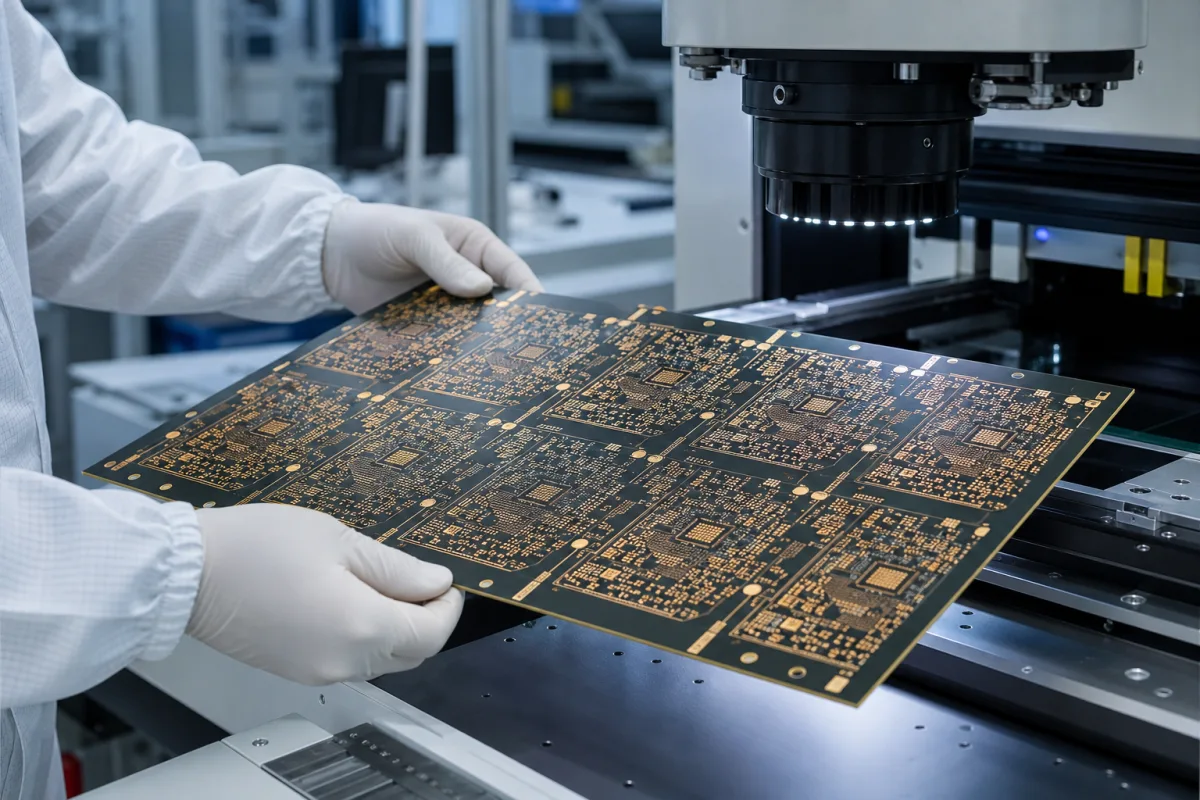
Advanced printed circuit board substrate enabling miniaturized electronic component integration

Product Specifications

Technical details and manufacturing context for High-Density Interconnect (HDI) PCB Substrate

Definition
A high-density interconnect PCB substrate is a specialized printed circuit board core material designed for mounting and interconnecting surface-mount electronic components with extremely fine pitch and high component density. It serves as the foundational structural and electrical platform within electronic assemblies, featuring microvias, fine line traces, and multiple conductive layers to accommodate complex circuitry in compact form factors. These substrates are essential for modern electronics where space constraints and performance demands require advanced packaging solutions beyond conventional PCB capabilities. They provide the physical interface and electrical pathways between integrated circuits, passive components, and external connectors within finished electronic devices.
Working Principle
Provides mechanical support and electrical interconnection through patterned conductive copper layers separated by dielectric insulating material, with plated through-holes and microvias creating vertical connections between layers to form complete circuits.
Common Materials
FR-4 Epoxy Laminate, Copper Foil, Polyimide Film, Solder Mask
Technical Parameters
  • Number of conductive copper layers in the substrate stackup (layers) Customizable
  • Smallest conductive line width achievable in the substrate design (μm) Customizable
Components / BOM
  • Copper Conductive Layers
    Provide electrical pathways for signal and power distribution
    Material: Electrodeposited Copper Foil
  • Dielectric Core Material
    Insulate between conductive layers and provide mechanical stability
    Material: FR-4 Epoxy Resin with Glass Fiber
  • Plated Through Holes
    Create vertical electrical connections between different substrate layers
    Material: Electroless Copper with Electrolytic Copper Plating
  • Solder Mask Layer
    Protect copper traces from oxidation and prevent solder bridging
    Material: Liquid Photoimageable (LPI) Epoxy
  • Surface Finish Optional
    Provide solderable and bondable surface for component attachment
    Material: Electroless Nickel Immersion Gold (ENIG)
Engineering Reasoning
0.1-2.0 mm substrate thickness, 25-150 μm line/space width, 0.15-0.25 mm via diameter
Delamination at 260°C for 10 seconds (lead-free reflow), copper peel strength <0.8 N/mm, dielectric breakdown at >100 kV/mm
Design Rationale: Coefficient of thermal expansion mismatch between copper (17 ppm/°C) and FR-4 epoxy (14-17 ppm/°C in-plane, 50-70 ppm/°C through-plane) causing interfacial stress
Risk Mitigation (FMEA)
Trigger Thermal cycling from -40°C to 125°C at 1000 cycles
Mode: Microvia barrel cracking at 45° angle fracture plane
Strategy: Sequential lamination with filled vias using 65% copper-filled epoxy
Trigger Electromigration at current density >10^5 A/cm²
Mode: Conductive filament formation between adjacent traces
Strategy: Electroless nickel immersion gold (ENIG) finish with 3-5 μm nickel barrier layer

Industry Taxonomies & Aliases

Commonly used trade names and technical identifiers for High-Density Interconnect (HDI) PCB Substrate.

Industrial Ecosystem & Supply Chain DNA

Complementary Systems
Downstream Applications
Specialized Tooling

Application Fit & Sizing Matrix

Operational Limits
pressure: Atmospheric to 1 atm (typical), vacuum-compatible for assembly processes
other spec: Layer count: 4-20+ layers, Line/space: 50/50 μm typical (down to 25/25 μm advanced), Via diameter: 100-200 μm (microvias <100 μm)
temperature: -55°C to +125°C (operational), up to +260°C (reflow soldering peak)
Media Compatibility
✓ Consumer electronics (smartphones, wearables) ✓ Medical devices (implantable, diagnostic) ✓ Automotive ADAS/ECU systems
Unsuitable: High-voltage power transmission (>1kV) or extreme mechanical vibration environments without additional reinforcement
Sizing Data Required
  • Required layer count and stackup configuration
  • Minimum feature size (line/space/via diameter)
  • Board thickness and dimensional constraints

Reliability & Engineering Risk Analysis

Failure Mode & Root Cause
Microvia Delamination
Cause: Thermal cycling stress exceeding adhesion limits of dielectric materials, often due to poor material selection or manufacturing defects in the high-density via structure.
Conductive Anodic Filament (CAF) Formation
Cause: Electrochemical migration along glass fibers in the substrate under humid conditions and applied voltage, leading to short circuits between closely spaced conductors.
Maintenance Indicators
  • Intermittent electrical failures or signal degradation during thermal cycling (audible through system error logs or performance monitoring)
  • Visible discoloration, blistering, or warping of the PCB substrate under magnification (visual inspection indicator)
Engineering Tips
  • Implement strict environmental controls (humidity < 40% RH, stable temperature) during operation and storage to minimize hygroscopic stress and electrochemical risks.
  • Use conformal coating compatible with HDI materials and apply precision thermal profiling during assembly to reduce residual stresses in microvias and layers.

Compliance & Manufacturing Standards

Reference Standards
IPC-6012E: Qualification and Performance Specification for Rigid Printed Boards IEC 61188-5-1: Printed boards and printed board assemblies - Design and use - Part 5-1: Attachment (land/joint) considerations - Generic requirements ISO 9001:2015: Quality management systems - Requirements
Manufacturing Precision
  • Line Width/Spacing: +/-0.02mm
  • Via Registration: +/-0.025mm
Quality Inspection
  • Automated Optical Inspection (AOI) for microvia integrity and pattern fidelity
  • Cross-Sectional Analysis for layer alignment and plating thickness verification

Factories Producing High-Density Interconnect (HDI) PCB Substrate

Verified manufacturers with capability to produce this product in China

✓ 98% Supplier Capability Match Found

T Technical Director from Singapore Feb 11, 2026
★★★★★
"As a professional in the Electronic Component Manufacturing sector, I confirm this High-Density Interconnect (HDI) PCB Substrate meets all ISO standards."
Technical Specifications Verified
P Project Engineer from Germany Feb 08, 2026
★★★★☆
"Standard OEM quality for Electronic Component Manufacturing applications. The High-Density Interconnect (HDI) PCB Substrate arrived with full certification. (Delivery took slightly longer than expected, but technical support was excellent.)"
Technical Specifications Verified
S Sourcing Manager from Brazil Feb 05, 2026
★★★★★
"Great transparency on the High-Density Interconnect (HDI) PCB Substrate components. Essential for our Electronic Component Manufacturing supply chain."
Technical Specifications Verified
Verification Protocol

“Feedback is collected from verified sourcing managers during RFQ (Request for Quote) and factory evaluation processes on CNFX. These reports represent historical performance data and technical audit summaries from our B2B manufacturing network.”

12 sourcing managers are analyzing this specification now. Last inquiry for High-Density Interconnect (HDI) PCB Substrate from Mexico (1h ago).

Frequently Asked Questions

What are the key advantages of HDI PCB substrates for electronic component manufacturing?

HDI PCB substrates enable higher component density, improved signal integrity, and reduced size/weight through finer traces, microvias, and multiple conductive layers, supporting advanced miniaturization in electronics.

How does dielectric thickness affect HDI PCB substrate performance?

Dielectric thickness impacts impedance control, signal speed, and thermal management. Thinner dielectrics allow tighter layer stacking for miniaturization, while proper selection ensures reliability and electrical performance in HDI designs.

What materials are commonly used in HDI PCB substrates and why?

Common materials include FR-4 epoxy laminate for cost-effective rigidity, polyimide film for flexibility and high-temperature resistance, copper foil for conductivity, and solder mask for protection. These enable durable, high-performance substrates for dense electronic integration.

Can I contact factories directly on CNFX?

CNFX is an open directory, not a transaction platform. Each factory profile provides direct contact information and production details to help you initiate direct inquiries with Chinese suppliers.

Get Quote for High-Density Interconnect (HDI) PCB Substrate

Request technical pricing, lead times, or customized specifications for High-Density Interconnect (HDI) PCB Substrate directly from verified manufacturing units.

Your business information is encrypted and only shared with verified High-Density Interconnect (HDI) PCB Substrate suppliers.

Thank you! Your message has been sent. We'll respond within 1–3 business days.

Need to Manufacture High-Density Interconnect (HDI) PCB Substrate?

Connect with verified factories specializing in this product category

Add Your Factory Contact Us
Previous Product
Automated Solder Paste Inspection (SPI) System
Next Product
High-Frequency Ceramic Capacitor