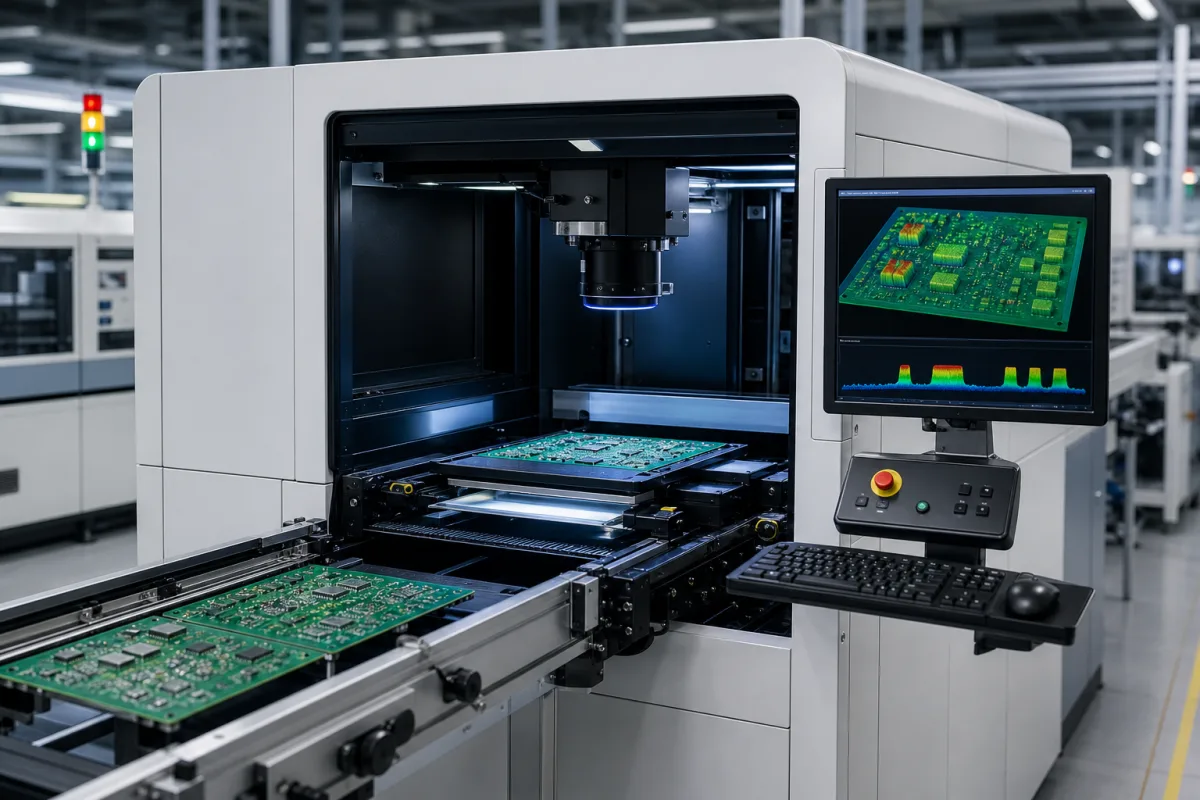
3D SPI after the stencil printer · Measurement principle and shadowing, resolution versus speed, volume accuracy and warp compensation
A solder paste inspection (SPI) system measures every paste deposit printed on a circuit board before components are placed, reporting volume, area, height, offset and bridging, so that printing faults can be fixed by washing the board instead of reworking solder joints. Ask three things first: which 3D measurement principle it uses and how it avoids shadowing, what resolution and inspection speed it reaches for your smallest pads and your line takt, and how its accuracy, repeatability and board-warp compensation are specified.
In-line and off-line 3D solder paste inspection machines for SMT lines. Stencil printers, post-reflow automated optical inspection (AOI) and X-ray inspection are outside this page.
CNFX editorial research · Sources checked October 12, 2026 · 5 sources
Test Research Inc. (TRI) explains in its SPI white paper that single-sided laser triangulation projects a laser line and captures images as it moves, needing more images and time for higher resolution, and that with one source the side of a deposit facing away from the laser falls into shadow, so actual paste volume cannot be computed accurately. TRI's own approach projects phase-shifted sinusoidal fringe patterns from two sides with white light while the board is scanned continuously, reconstructing height from four phase maps, and eliminating the shadow effect. [1]
TRI also argues that a paste defect can be fixed in under five minutes by wiping the paste off and reprinting, which is why inspection before placement is more cost-effective than finding defects only at the solder joint. [1] Omron's VP9000 uses the phase-shift method with a 360° ring light to extract the paste outline and stripe patterns from 3D projectors, whose pitch changes with paste height so that height is calculated by triangulation; its standard machine uses dual projectors and its high-speed machine a single projector. [2]
Editorial note: ask how many projection directions the offered machine uses and request a measurement of tall, closely spaced deposits, where shadowing from a single projection angle would show.
Give the supplier the board size and thickness range, smallest aperture and pad pitch, paste deposit heights, line takt time, in-line or off-line, conveyor height and direction, the required volume accuracy and gauge R&R, warp range, feedback link to the printer, data format for traceability, and power supply.
02
Match resolution to speed, and check accuracy and warp
Omron's VP9000 brochure lists digitally switched resolutions of 25/12.5/8.5 µm, 20/10/7 µm or 15/7.5/5 µm. On the standard machine with the 25 µm option, inspection speed is 8,900 mm²/s at standard resolution, 5,600 mm²/s at high and 1,900 mm²/s at super-high resolution. It states volume accuracy within 2% (3σ) on the standard machine and within 3% on the high-speed machine, and PCB warp compensation of ±5 mm, with warp measured and compensated in each field of view. [2]
NeoDen states for its ND S1 a height detection precision of 1 µm and repeatability (volume, area, height) below 1 µm at 3σ, with processing time under 0.7 s per frame, checking area, volume, height, shape, offset and bridging. [3]
Editorial calculation from Omron's figures: a 330 × 250 mm board (82,500 mm²) takes about 82,500 ÷ 8,900 ≈ 9.3 s to inspect at the 25 µm setting but about 82,500 ÷ 1,900 ≈ 43 s at 8.5 µm, before board transfer, so ask whether the highest resolution can be limited to fine-pitch areas. [2] Editorial note: accuracy and repeatability are stated under different conditions by each maker; ask for a gauge R&R study on your own board.
03
Put speed, camera and warp figures from three makers side by side
Koh Young describes its "KY8030-3" as using 3D dual-inspection technology "to eliminate critical shadow problems", with an inspection speed of 91.2 cm²/sec, and says the latest options make it twice as fast as its predecessor. Its warp compensation, called Z-tracking 3D Compensation, calculates and detects substrate warpage. [4]
MIRTEC's Korean-language page for its "MS-11" in-line 3D SPI lists a 15MP high-resolution camera with 10µm/15µm lenses and CoaXPress data transfer, and states that the Z axis detects and automatically compensates PCB warp of up to ±5mm within the field of view while capturing the board image. [5] Omron gives the same ±5 mm warp figure for the VP9000 [2], so a warp figure alone does not separate these machines; ask how many height points are taken per field of view.
The speed figures are not stated at matching conditions. Koh Young gives one figure without a resolution on the page reviewed [4], while Omron's falls from 8,900 to 1,900 mm²/s as resolution rises [2]. TRI explains that single-sided projection leaves part of a deposit in shadow so paste volume cannot be computed accurately [1]. Ask each supplier for speed at the resolution you need, with the number of projection directions used.
Editorial calculation: 91.2 cm²/sec is 9,120 mm²/s, about 2.5% above Omron's 8,900 mm²/s figure; on a 330 × 250 mm board (82,500 mm²) that is about 9.0 s against 9.3 s, before board transfer. [4][2]
Item
Koh Young KY8030-3
MIRTEC MS-11
Omron VP9000 (already cited)
Inspection speed
91.2 cm²/sec
—
8,900 mm²/s (89 cm²/s) at 25 µm standard resolution
Camera / lens
—
15MP camera; 10µm/15µm lens; CoaXPress data transfer
25/12.5/8.5 µm and other resolution sets
Warp handling
Z-tracking 3D Compensation
Z-axis detects and compensates PCB warp up to ±5mm within the FOV
±5 mm, measured in each field of view
Shadow handling
3D dual-inspection
—
Dual projectors (standard machine); single projector (high-speed machine)
Values are from the Koh Young and MIRTEC product pages; the MIRTEC values are translated from Korean, and neither page gives test conditions.
04
Compare what suppliers offer
Suppliers linked to this page list 3D solder paste inspection machines; each card links to the page reviewed.
Both suppliers reviewed build SMT line equipment, including printers, placement machines, reflow ovens and AOI; ask each for the measurement principle, resolution and speed table, accuracy test conditions and printer feedback options.
05
Trace the SPI components
This is a functional reference built from the sources cited; it is not one maker's design.
Fill the specification fields with values for your line
An SPI quotation needs values for your boards and line. The table explains each field, gives published values where a reviewed source states them, and says what to obtain from the supplier.
Field
What it means and published values
Ask the supplier for
Measurement Accuracy (μm)
E.g. NeoDen height precision 1 µm; Omron volume within 2% (3σ). [3][2]
Accuracy and test method.
Inspection Speed (cm²/sec)
E.g. Omron 8,900 mm²/s (89 cm²/s) at 25 µm [2]; Koh Young KY8030-3 91.2 cm²/sec. [4]
Explore company information and manufacturing capabilities, then discuss the scope of your project with a relevant supplier.
Share this page
Compiled and source-reviewed by the CNFX editorial team.
Published product pages show what a company offers, not tested performance. Confirm the legal seller, factory and scope for your order. How we source and review
· Page last updated 13 October 2026
Buyer questions
Why does a 3D SPI need projection from more than one side?
TRI explains that single-sided measurement leaves the far side of a deposit in shadow, so volume cannot be computed accurately; dual-sided projection removes the shadow. [1]
Does higher SPI resolution slow inspection?
Yes; Omron's VP9000 falls from 8,900 mm²/s at 25 µm to 1,900 mm²/s at 8.5 µm on its standard machine. [2]
How much board warp can an SPI compensate?
Omron's VP9000 states ±5 mm, compensated in each field of view. [2]
How fast is a 3D solder paste inspection machine?
Koh Young states 91.2 cm²/sec for its KY8030-3; Omron states 8,900 mm²/s (89 cm²/s) for the VP9000 at its 25 µm standard resolution, falling to 1,900 mm²/s at super-high resolution. Ask for speed at the resolution you need. [4][2]
Sources and what still needs a direct check
Sources checked 2026-10-12. TRI, Omron and NeoDen describe their own SPI machines and methods; accuracy figures are stated under each maker's conditions.