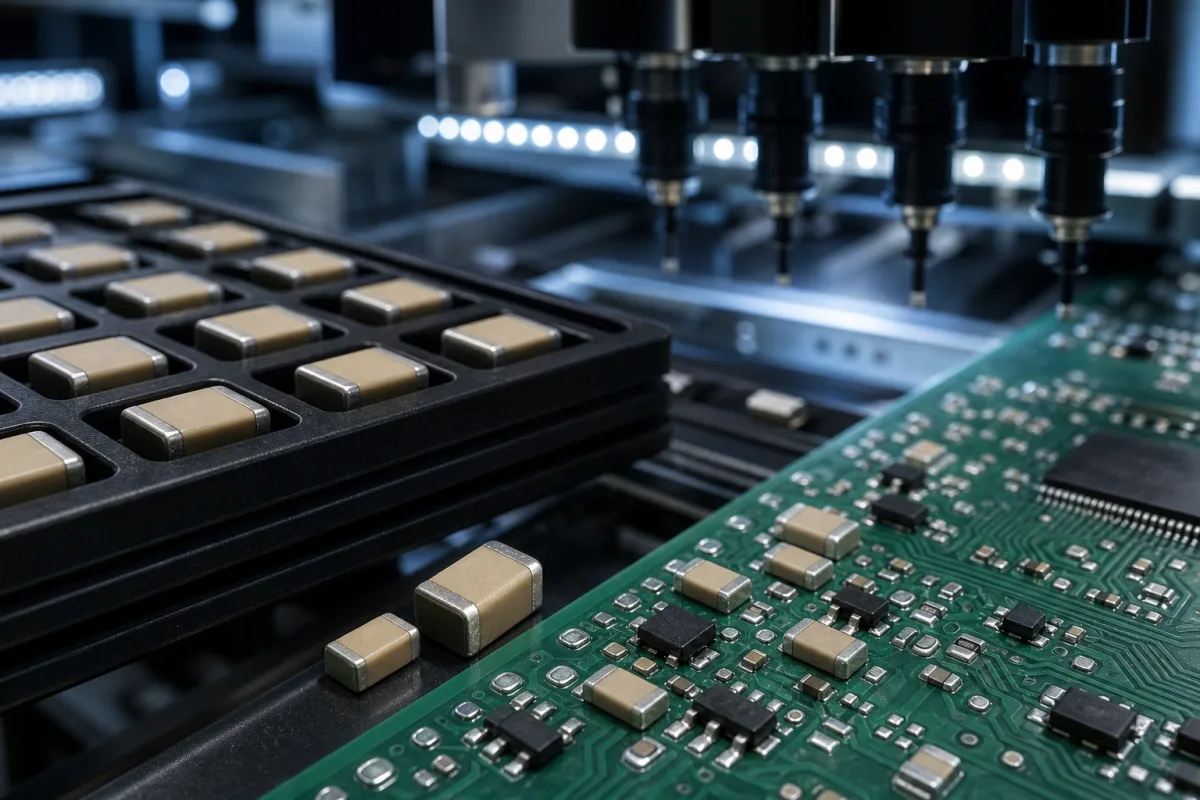
Multilayer ceramic chip capacitors · DC bias and ageing of high-dielectric types, rated-voltage rules with AC, self-heating limit, insulation resistance units
A surface-mount ceramic capacitor (MLCC) is a small chip of stacked ceramic dielectric and metal electrode layers soldered directly onto a circuit board for decoupling, filtering, timing and coupling. Ask three things first: which dielectric class you need — temperature-compensating (e.g. C0G) or high-dielectric-constant (e.g. X5R, X7R) — how much capacitance remains at your DC bias, temperature and age, and whether the applied DC plus AC stays within rated voltage without excessive self-heating.
Multilayer ceramic chip capacitors in standard SMD sizes for general, industrial and automotive electronics. Tantalum and aluminium electrolytic chip capacitors, film capacitors, leaded ceramic discs and high-voltage power capacitors are outside this page.
CNFX editorial research · Sources checked October 11, 2026 · 6 sources
Allow for DC bias, ageing and measurement conditions
Murata explains that high-dielectric-constant ceramic capacitors (such as X5R, X6S and X7R) show a DC bias characteristic: the larger the DC voltage applied, the more the effective capacitance falls below nominal, whereas temperature-compensating types such as C0G have no DC bias characteristic. [1]
Their capacitance also decreases over time (ageing), almost linearly on a logarithmic time scale, because the BaTiO3 ceramic's crystal structure changes below its Curie temperature of about 125 °C; heating above that temperature, for example during soldering, restores the capacitance, and ageing restarts on cooling. Temperature-compensating capacitors do not age. [2] Murata adds that a high-dielectric capacitor measured with an LCR meter may not show its nominal value because capacitance varies with temperature, AC and DC voltage, frequency and time; nominal values hold only under the measurement conditions of JIS C 5101-1 sub-section 4.7. [3]
Editorial note: for decoupling and filtering, choose the part by the capacitance remaining at your DC bias and temperature from the maker's characteristic curves, not by the nominal value; for timing or feedback circuits, temperature-compensating dielectrics avoid both bias and ageing effects.
Give the supplier the capacitance and tolerance, dielectric (C0G, X5R, X7R or other), rated voltage, operating DC bias and AC ripple, package size, operating temperature range, application (consumer, industrial, automotive), required standards or qualifications, reel packaging, and annual quantity.
02
Stay within rated voltage and self-heating limits
Murata states that the voltage across a ceramic capacitor must not exceed the rated voltage: with AC superimposed on DC, the zero-to-peak voltage must not exceed rated DC voltage; with AC or pulse voltage, the peak-to-peak voltage must not exceed it; and surges, static and pulses must also stay below it. [4]
There is no allowable ripple-current specification for ceramic capacitors; instead, Murata asks that under AC, pulse or high-frequency voltage the self-heating measured at 25 °C ambient stays below 20 °C (for rated voltages below 100 V DC) and that surface temperature in the circuit stays within the maximum operating temperature, since dielectric loss generates heat. [5] Insulation resistance is given either in MΩ or as a CR product in MΩ·µF; for example, a 500 Ω·F CR product on a 1 µF part means at least 500 MΩ. [6]
Editorial calculation: on a 25 V-rated capacitor carrying 15 V DC with a ripple of 8 V zero-to-peak, the peak is 15 + 8 = 23 V, within rating; 12 V of ripple would reach 27 V and exceed it. The voltages are assumed examples. [4]
03
C0G, X7R and X5R chips from 0.5 pF to 330 µF in the linked listing
The listing reviewed offers C0G, X7R and X5R chip capacitors from 0.5 pF to 330 µF at 4–200 V; ask for DC bias and temperature curves for the exact part number.
04
Dielectric, BaTiO3 base, internal electrodes, terminations and package size of an MLCC
Part
Role
Fix in the order
Ceramic dielectric
Sets class: temperature-compensating or high-dielectric. [1]
Capacitance, rated voltage, size, tolerance, temperature coefficient and insulation values for an MLCC quotation
Published values in this table come from the Murata notes cited on this page; where none states a value, the row says what to obtain from the supplier.
Field
What it means and published values
Ask the supplier for
Capacitance (F)
Nominal under JIS C 5101-1 conditions; falls with DC bias for high-dielectric types. [3][1]
1 company lists this product among what they make. Company figures are quoted from each
company's own website; every card states where the relationship came from.
Fujian Torch Electron Technology Co.,Ltd
Manufacturing site to be confirmed for the order
Lists SMD multilayer ceramic chip capacitors in C0G, X7R and X5R from 0.5 pF to 330 µF at 4–200 V.
Explore company information and manufacturing capabilities, then discuss the scope of your project with a relevant supplier.
Share this page
Compiled and source-reviewed by the CNFX editorial team.
Each manufacturer above links to the page on that company's own website where the product is listed, with the date we checked it. How we source and review
· Page last updated 13 October 2026
Buyer questions
Why does my ceramic capacitor measure low?
Murata says high-dielectric types vary with temperature, voltage, frequency and time; nominal values hold only under JIS C 5101-1 conditions. [3]
Do all ceramic capacitors lose capacitance under DC bias?
No; high-dielectric types such as X5R and X7R do, temperature-compensating types such as C0G do not. [1]
Can MLCC ageing be reversed?
Murata says heating above the Curie temperature (about 125 °C), as in soldering, restores the capacitance. [2]
How much AC can an MLCC take?
There is no ripple-current rating; keep peak voltage within rating and self-heating below 20 °C at 25 °C ambient. [5][4]
Sources and what still needs a direct check
Sources checked 2026-10-11. All five technical sources are Murata, a ceramic capacitor maker, answering application questions in its FAQ; Fujian Torch is a linked supplier.