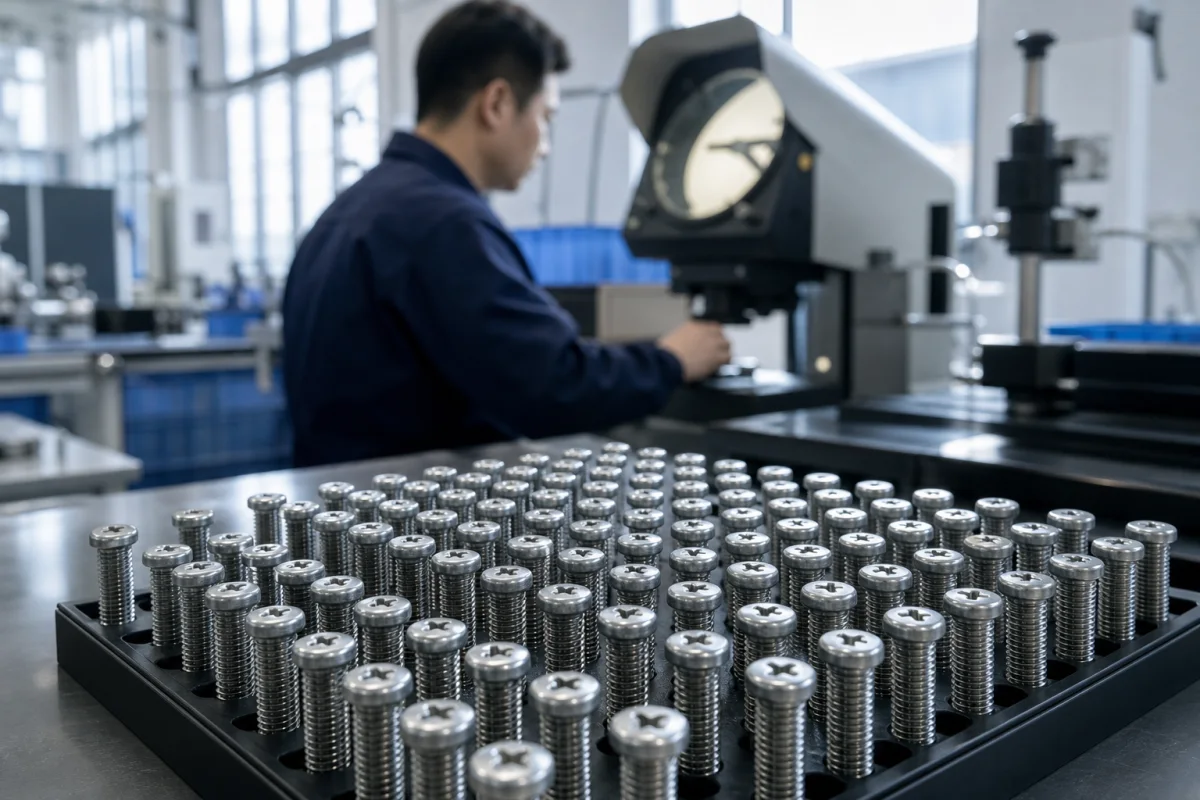
Machine screws · Material and strength, plating and hydrogen embrittlement, galvanic corrosion, head styles and countersink angles, torque coefficient and tightening accuracy
A machine screw is a headed fastener with a uniform machine thread along its shank, made from steel, stainless steel or non-ferrous metal by cold heading and thread rolling, with a slotted, cross-recess, hex-socket or other drive, that fastens parts into a tapped hole or a nut in equipment, enclosures and assemblies. Ask three things first: which thread, length, head and drive you need, which material, strength and finish suit the load and environment, and how it will be tightened.
Machine screws with uniform machine threads for tapped holes or nuts, in steel, stainless steel and non-ferrous metals. Self-tapping, wood, drywall and self-drilling screws, structural bolts, set screws and machine screw jacks are outside this page.
CNFX editorial research · Sources checked October 12, 2026 · 4 sources
NASA's Fastener Design Manual (RP-1228, 1990) names carbon steel, alloy steel and stainless steel as the materials of bolts and screws. It describes carbon steel as the cheapest of these and as zinc plated in the usual case it describes, with an ultimate strength of about 55 ksi; alloy steel can be heat treated up to 300 ksi but needs a protective coating; stainless steels range from 70 to 220 ksi, need no coating in the cases it describes and have a wider service temperature range. [1]
The manual warns that the plating can set the limit on maximum service temperature, that carbon and alloy steel become brittle below −65 °F, that 400-series stainless with only 12% chromium will corrode in some environments, and that contact between dissimilar metals can cause galvanic corrosion. Because electrolytic plating generates hydrogen, the manual says plated parts must be baked after plating to prevent hydrogen embrittlement; cadmium-plated parts, for example, are baked at 375 °F for 23 hours within 2 hours of plating. [1]
Editorial calculation: 55 ksi is about 379 MPa and 220 ksi about 1,517 MPa (1 ksi ≈ 6.895 MPa). Ask suppliers for the property class or grade to the standard you specify, with test certificates, rather than a material name alone. [1]
Give the supplier the thread (metric or unified, pitch), nominal diameter and length, head style and drive, standard (for example ISO or ASME dimensional standard), material and property class, finish and its thickness, any baking requirement against hydrogen embrittlement, environment and temperature, packaging, inspection and quantities.
02
Set head style and tightening
NASA notes that the difference between bolts and screws is not clearly defined by industry, but head styles are well defined; countersunk (flat) head angles can vary from 60° to 120°, with 82° and 100° named by the manual as the standard values. [1]
For quick torque calculations the manual gives T = K × F × d (torque = torque coefficient × axial load × diameter). It warns that the K of 0.2 assumed in quick calculations should not be used blindly and that 0.15 is a more realistic typical value for steel on steel; its table gives K from 0.074 at a friction coefficient of 0.05 to 0.250 at 0.20. Citing the Industrial Fasteners Institute, it lists preload accuracy of about ±35% by feel, ±25% with a torque wrench, ±15% by turn of the nut and ±10% with load-indicating washers. [1]
The FAA's Advisory Circular AC 43.13-1B divides screws into structural screws, machine screws and self-tapping screws. It lists four basic machine screw head styles: flathead (countersunk) for a flush surface, roundhead for general non-structural use, fillister head (usable as cap screws in light mechanical applications), and socket head, driven into tapped holes with internal wrenches where high strength or compact assemblies are needed. It names the AN, NAS and MS drawings for each, and warns that self-tapping screws should never replace standard screws, nuts, bolts or rivets in aircraft structure. [2]
Editorial calculation: to reach 3,000 N of preload in an M5 screw (d = 5 mm), T = 0.15 × 3,000 × 0.005 ≈ 2.3 N·m; with K = 0.2 the same torque would be 3.0 N·m, about 33% more. With a torque wrench, actual preload could still vary by about ±25%. [1]
NASA-STD-5020B, NASA's standard for threaded fastening systems in spaceflight hardware, requires every threaded fastening system to include at least one locking feature that does not depend on preload, and a mechanical locking feature such as safety wire on any bolt subject to rotation in operation. It notes that jam nuts may not qualify if they need preload to work. It recommends that a fastener used with a nut, nut plate or insert extend at least twice the thread pitch past the outboard end so that all internal threads are fully engaged. [3]
A fastener distributor's table shows how much friction moves the result for stainless screws. TR Fastenings' table of pre-loads and tightening torques for coarse-thread stainless screws lists, for an M5 screw in property class A2-70, a pre-load of 4.85 kN at a tightening torque of 3.4 N·m with a friction coefficient of 0.1, 3.93 kN at 5.1 N·m with 0.2, and 3.19 kN at 6.1 N·m with 0.3, with a minimum breaking torque of 7.8 N·m; the A1-50 class at 0.1 gives 2.26 kN at 1.6 N·m. [4] Editorial calculation: back-calculating K = T ÷ (F × d) from these rows gives about 0.14 at μ 0.1, 0.26 at μ 0.2 and 0.38 at μ 0.3, so the single K value in the formula above only holds if the friction condition is known; at μ 0.3, the 6.1 N·m torque is close to the 7.8 N·m breaking torque. [4][1]
03
Compare what suppliers offer
Suppliers linked to this page list machine screws; each card links to the page reviewed.
Listings include pan, countersunk, wafer and hex-head machine screws in steel and stainless steel, precision micro screws and security screws.
04
Trace what defines the screw
This is a functional reference built from the sources cited; it is not one maker's design.
Fill the specification fields with values for your assembly
A machine screw quotation needs values for your assembly. The table explains each field, gives published values where a reviewed source states them, and says what to obtain from the supplier.
Explore company information and manufacturing capabilities, then discuss the scope of your project with a relevant supplier.
Share this page
Compiled and source-reviewed by the CNFX editorial team.
Published product pages show what a company offers, not tested performance. Confirm the legal seller, factory, certificates and scope for your order. How we source and review
· Page last updated 13 October 2026
Buyer questions
Why do plated screws need baking?
NASA explains that electrolytic plating generates hydrogen, so parts must be baked after plating to prevent hydrogen embrittlement. [1]
What torque coefficient should be used for screws?
NASA warns against using 0.2 blindly and gives 0.15 as a more realistic typical value for steel on steel. [1]
How accurate is torque-wrench tightening?
NASA, citing the Industrial Fasteners Institute, gives about ±25% preload accuracy for a torque wrench. [1]
What head styles do machine screws come in?
FAA AC 43.13-1B lists flathead (countersunk), roundhead, fillister head and socket head as the four basic machine screw head styles. [2]
How far should a screw extend past its nut?
NASA-STD-5020B recommends at least twice the thread pitch past the outboard end of the nut, nut plate or insert, so all internal threads are engaged. [3]
What tightening torque does an M5 stainless machine screw need?
One fastener table for A2-70 lists 3.4 N·m for 4.85 kN pre-load at friction 0.1 and 5.1 N·m for 3.93 kN at friction 0.2, with a minimum breaking torque of 7.8 N·m. [4]
Sources and what still needs a direct check
Sources checked 2026-10-12. NASA's manual is general fastener engineering guidance; values for your screws must come from the supplier's standard, property class and certificates. FAA AC 43.13-1B and NASA-STD-5020B add aviation and spaceflight practice for screw selection and locking.