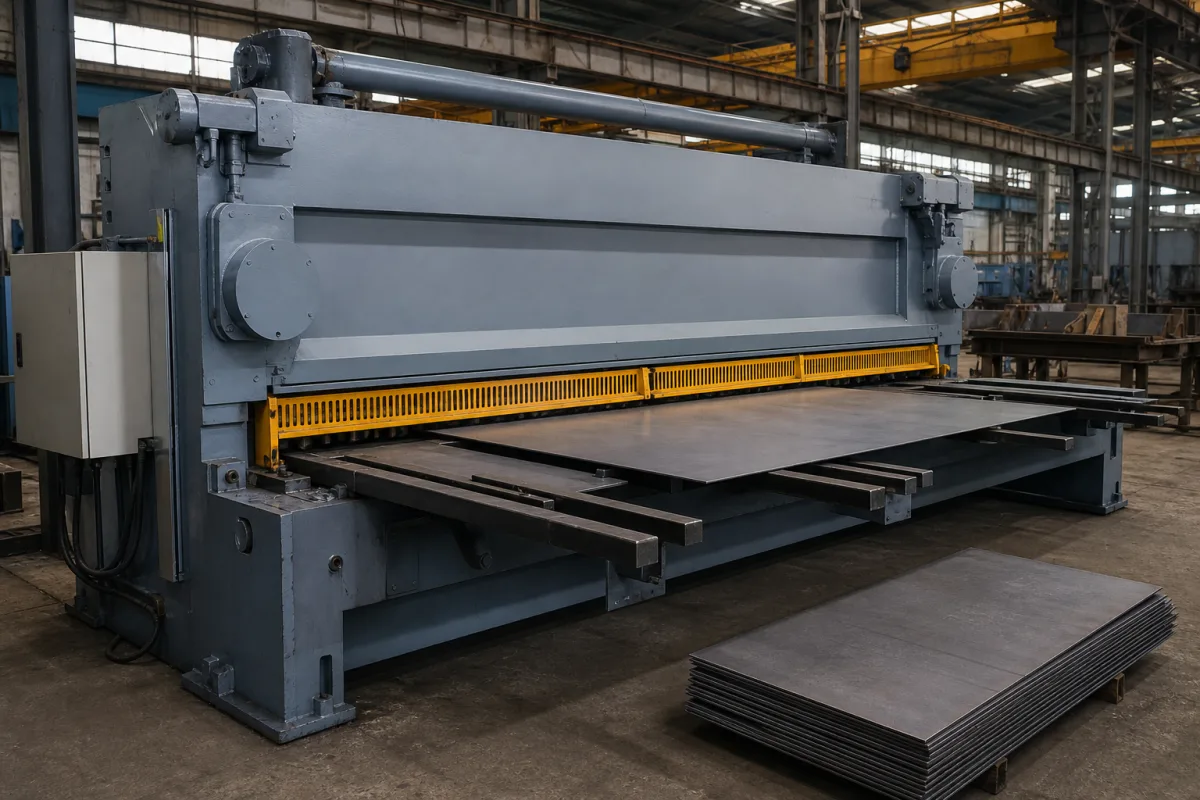
Sheet metal cutting · Capacity basis, guillotine or swing beam, blade clearance and rake
A guillotine shear cuts sheet and plate along a straight line between an upper and a lower blade. Ask three things first: the thickest and longest cut in your strongest material, how often you change thickness and material, and what accuracy and back-gauge control you need.
Hydraulic and mechanical guillotine and swing-beam shears for sheet and plate. Shear blades sold alone, coil slitting lines, laser cutters and plastic sheet lines are outside this page.
CNFX editorial research · Sources checked October 12, 2026 · 5 sources
KRRASS, a shear maker, explains that model names give capacity and length: a QC11K-10×4000 is a guillotine shear rated for 10 mm and 4,000 mm cutting length, while QC12K is its swing-beam series. KRRASS rates shearing capacity on mild steel and gives thickness factors of 1.0× for mild steel, 0.65× for stainless steel, 1.3× for aluminium and 0.5× for high-strength steel, and advises choosing 20–30% extra capacity for occasional thicker material. [1]
KRRASS describes its guillotine shears as having adjustable rake angle and blade clearance, linear blade movement and CNC back-gauge options for thicker plate and precision work, and its swing-beam shears as compact, arc-motion machines for thin to medium sheet. [1]
Size the machine for the strongest material at its thickest, not only for mild steel, and ask the supplier for its derated capacity for each material you cut.
Give the supplier the materials and grades, thickest cut in each, longest cut, tolerances, cut volume, back-gauge range and control, front support and sheet handling, power supply and floor space.
02
Set blade clearance and rake for each material
Durma, a shear and press brake maker, sets blade clearance as a percentage of thickness depending on material: mild steel 5–6% up to 3 mm and 6–8% from 3 to 10 mm, stainless steel 6–8% up to 3 mm and 8–10% from 3 to 10 mm, aluminium 4–5% and 5–6%, and high-strength steel 8–10% up to 10 mm, as starting values to be checked against the machine manual. Clearance that is too small causes secondary shearing, rough edges and faster blade wear; too large causes tearing and burrs. [2]
Editorial calculation: clearance = thickness × percentage. For 5 mm mild steel at 6% that is 0.30 mm, as Durma's example shows; for 8 mm stainless at 8–10% it is 0.64–0.80 mm; for 3 mm aluminium at 4–5% it is 0.12–0.15 mm. [2]
A shearing study by Ko, Jung, Kim and Lee (Journal of the Korean Society for Power System Engineering, Vol. 11 No. 3, 2007) tested two automotive steel sheets, SPCEN and SPRC35E, varying clearance, cutting angle and blade wear. It found that the cutting angle had no effect on burr height while clearance stayed below 10% of sheet thickness, and none on burr height or shape while blade wear stayed below 10% of thickness. It reported a critical clearance of 10–15% of thickness for both steels, and different burr amounts and shapes between them. [3]
Editorial calculation: for 2 mm sheet, 10% of thickness is 0.20 mm and 15% is 0.30 mm, so in that study burr control depends on keeping the gap and blade wear within a few tenths of a millimetre. [3]
Ask how clearance and rake are adjusted (manual, motorised or CNC), whether settings are stored per material, and how blade wear is compensated.
03
Read how rake, strokes and hold-downs change with capacity
Cincinnati Incorporated (CI), a US shear and press brake maker, publishes a specification table for its hydraulic "HS Series" shears, which it offers in standard capacities "for cutting 1/4” gauge up to 3/4” metal plate". For the 12-foot models, the table gives mild steel capacity, rake, hold-down force and count, back gauge range, stroke rate, motor power and shipping weight. [4]
At the same cutting length, the table shows rake, hold-down force, motor power and weight rising with capacity while the maximum stroke rate falls from 45 to 25 strokes per minute. [4] KRRASS rates capacity on mild steel and reduces it for stainless and high-strength steel [1], and CI's capacities are also stated for mild steel; ask any supplier for the capacity on your material and for the rake used at that thickness.
Rake is not the only setting behind edge quality: the Ko et al. study found that cutting angle had no effect on burr height while clearance stayed below 10% of sheet thickness [3], and Durma gives blade clearance as a percentage of thickness by material [2]. CI states that the HS Series allows setting adjustments "to get the best possible edge condition" [4]; ask which of rake, clearance and hold-down pressure the operator can adjust on the machine quoted. CI's mechanical "G Series" shears are listed with a 1/4" mild steel capacity at cutting lengths of 74-1/4" to 146-1/4" [5].
Editorial calculation: 146.75 in is about 3,727 mm; 1/4” and 3/4” are 6.35 and 19.05 mm; a rake of 0.250 in./ft. is about 20.8 mm per metre (about 1.2°) and 0.750 in./ft. about 62.5 mm per metre (about 3.6°); 17,600 lbs and 39,600 lbs are about 8.0 t and 18.0 t. [4]
CI model
Mild steel capacity
Max. cutting length (in.)
Rake (in./ft.)
Holddowns: force (tons) / number
Strokes/minute (approx. max / min)
Motor HP
Approx. shipping wgt. (lbs)
250HS12
1/4”
146.75
0.250
9.9 / 14
45 / 20
25
17,600
375HS12
3/8”
146.75
0.438
17.2 / 15
45 / 15
25
25,000
500HS12
1/2”
146.75
0.500
23.8 / 15
30 / 15
40
28,600
750HS12
3/4”
146.5
0.750
37.3 / 15
25 / 5
40
39,600
Values are from CI's HS and G Series pages; CI states engineering data are subject to change without notice.
04
Which makers pair shears with press brakes or slitting lines
KRRASS lists guillotine and swing-beam shears; ZFY lists QC11K guillotine and QC12K swing-beam shears; JSTMT, Prima and Tsinfa list shearing machines with press brakes and laser cutters; Jinggong lists hydraulic guillotine shears alongside panel and slitting lines. [1]
05
Where blade wear, beam motion and the back gauge sit in the machine
Part
Role
Fix in the order
Upper and lower blades
Shear the sheet; clearance set by material; wear affects burr. [2][3]
Blade material and edges.
Blade beam
Moves linearly (guillotine) or in an arc (swing beam). [1]
KRRASS and ZFY list guillotine and swing-beam shears; Tsinfa and Jinggong list hydraulic shears, Jinggong alongside panel and slitting lines; JSTMT and Prima pair shearing machines with press brakes.
KRRASS
Manufacturing site to be confirmed for the order
Lists guillotine and swing-beam shearing machines.
Explore company information and manufacturing capabilities, then discuss the scope of your project with a relevant supplier.
Share this page
Compiled and source-reviewed by the CNFX editorial team.
Each manufacturer above links to the page on that company's own website where the product is listed, with the date we checked it. How we source and review
· Page last updated 13 October 2026
Buyer questions
Can a 10 mm shear cut 10 mm stainless steel?
KRRASS rates capacity on mild steel and applies factors of 0.65× for stainless and 0.5× for high-strength steel, so a 10 mm shear handles about 6.5 mm stainless; ask for the derated figure. [1]
How do I set shear blade clearance?
Multiply thickness by a material percentage, for example 6% of 5 mm mild steel gives 0.30 mm, then check against the machine manual. [2]
Guillotine or swing-beam shear?
Guillotine shears move the blade linearly with adjustable rake and clearance for thicker plate and precision work; swing-beam shears are simpler machines for thin to medium sheet. [1]
Does rake angle change burr height?
A 2007 study of SPCEN and SPRC35E sheet found no effect of cutting angle on burr height while clearance was under 10% of thickness; it put the critical clearance at 10–15%. [3]
How fast does a hydraulic plate shear cycle?
Cincinnati Incorporated lists its 12-foot HS Series shears at approximately 45 strokes per minute maximum for 1/4" and 3/8" mild steel capacity, falling to 30 for 1/2" and 25 for 3/4". [4]
Sources and what still needs a direct check
Sources checked 2026-10-12. KRRASS and Durma are shear and press brake makers; their guidance is their own. Values are starting references, not machine-specific settings.