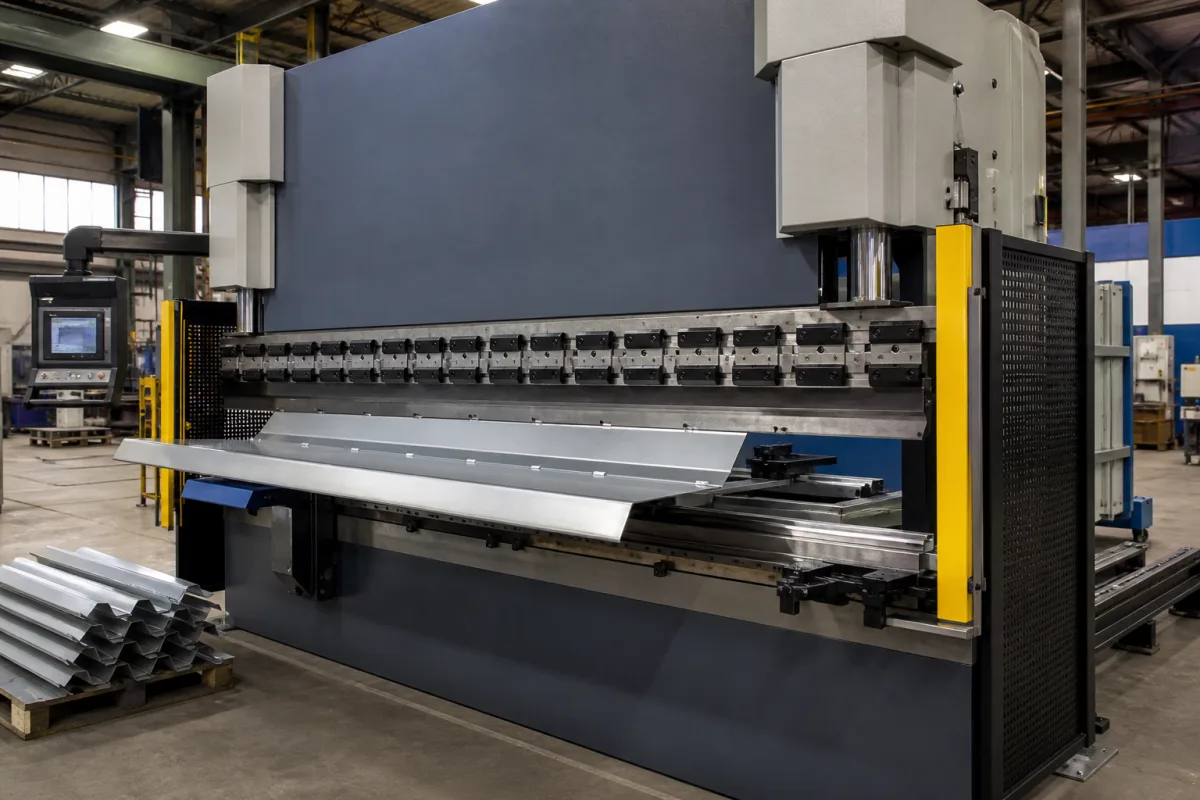
Sheet metal forming · Tonnage, axes and point-of-operation safety
A press brake is bought by tonnage and length, but the parts decide both. Work out the force for your thickest, longest bend in your real material, choose the die opening that goes with it, then specify the axes and back gauge your parts need. Plan guarding at the same time: the operator's hands are a few centimetres from the punch.
Hydraulic and electro-hydraulic CNC press brakes for air bending sheet and plate, including tandem and robotic cells. Mechanical presses and roll forming are outside this page.
CNFX editorial research · Sources checked October 10, 2026 · 5 sources
Durma, a press brake maker, gives a planning formula for 90° air bending of mild steel with about 450 MPa tensile strength: P (kN) = 650 × S² × L ÷ V, with thickness S and die opening V in millimetres and bend length L in metres. Its chart, for a V-die of about eight times thickness, gives roughly 24.9 tonnes-force per metre for 3 mm and 49.7 for 6 mm, and its material table gives stainless steel a relative force of 1.5 against 1.0 for mild steel. [2]
Force scales with the square of thickness, in direct proportion to length and inversely with the die opening. Durma notes that doubling the bend length of its 3 mm example from 1 m to 2 m roughly doubles the force to 50 tonnes, and treats results as estimates to be checked against machine and tooling limits. [2]
As an editorial calculation example only, using that formula: a 3 m bend in 6 mm mild steel over a 48 mm V-die needs about 650 × 36 × 3 ÷ 48 ≈ 1,460 kN, or about 149 tonnes-force; in stainless at 1.5 times it is about 224 tonnes-force. A narrower die raises the force, a wider one lowers it and enlarges the inside radius.
Give the supplier your thickest and longest bends, the material grade and tensile strength, the inside radius you need and any short, thick parts. Also ask the maximum load per metre the bed and tooling accept, not only the total tonnage.
02
Specify the axes and back gauge your parts need
Shenchong describes the axes of a 4+1-axis CNC press brake: Y1 and Y2 control the cylinders on each side, X moves the back gauge forward and back, R moves it up and down, and V is CNC crowning of the table. For its 80 t, 3,200 mm model it lists a 400 mm throat, 160 mm stroke, 410 mm open height and ±0.01 mm Y1/Y2 parallel tolerance. [3]
Throat depth, stroke and open height decide whether deep boxes and tall flanges fit; back-gauge travel and axes decide how many set-ups complex parts need. Suppliers also offer electro-hydraulic, all-electric, torsion-bar, tandem and robotic versions; Senfeng, for example, lists all-electric machines from 60 to 1,300 kN and tandem machines up to 6,000 kN. [4][5]
Treat accuracy figures as supplier statements: ask how they are measured and what bend-angle tolerance the machine holds on your material.
03
Plan point-of-operation guarding before installation
OSHA's press brake directive (CPL 2-1.25) requires operators to be protected by physical barriers or physical devices, such as two-hand controls, holdouts or restraints and presence sensors, wherever feasible. Others who are not operating the machine must be protected by barriers or restricted access. [1]
OSHA accepts guarding by safe distance only when barriers and devices are not feasible and the work is one-time fabrication of made-to-order parts, backed by a documented procedure, training, supervision and a safe history. Operators must then stay at least 4 inches (10.16 cm) from the point of operation, and the procedure must be inspected at least annually. The directive cites ANSI B11.3 as the consensus standard for press brake safeguarding. [1]
Ask the supplier which safeguarding devices are supplied and certified for the market of use, and how they work with short flanges and box bending.
04
Compare what suppliers build
Senfeng, CNHAWE and Shenchong list CNC hydraulic, electro-hydraulic, all-electric, torsion-bar and tandem press brakes and robotic bending cells. [4][5][3]
CNHAWE lists flagship and economy CNC, electric servo, tandem, torsion-bar NC and robotic bending cell models; Senfeng lists high-tonnage machines from 6,000 to 14,000 kN. [5][4]
05
Frame, Y1/Y2 cylinders, hydraulic unit, tooling, back gauge, CNC and safeguarding of a press brake
Materials and ratings come from the data sheet of the machine you order.
Part
Role
Fix in the order
Frame and table
Carry the bending load; crowning compensates deflection. [3]
Protect the operator at the point of operation. [1]
Device type and certification.
06
Tonnage, bending length, stroke, throat depth, accuracy and power values for a press brake quotation
Published values in this table come from Durma's force formula and Shenchong's machine data; where neither states a value, the row says what to obtain from the supplier.
Field
What it means and published values
Ask the supplier for
Tonnage (t)
From thickness, length, die opening and material; stainless about 1.5 × mild steel. [2]
Rated force and allowable load per metre.
Bending length (mm)
Table length; force rises in proportion to bend length. [2]
12 companies list this product among what they make. Company figures are quoted from each
company's own website; every card states where the relationship came from.
Jinan Senfeng Laser Technology Co., Ltd.
Manufacturing site to be confirmed for the order
Lists electro-hydraulic, all-electric, tandem, torsion-bar and high-tonnage press brakes and a robotic bending system.
Explore company information and manufacturing capabilities, then discuss the scope of your project with a relevant supplier.
Share this page
Compiled and source-reviewed by the CNFX editorial team.
Each manufacturer above links to the page on that company's own website where the product is listed, with the date we checked it. How we source and review
· Page last updated 13 October 2026
Buyer questions
How do I calculate press brake tonnage?
Durma's planning formula for mild steel of about 450 MPa is P (kN) = 650 × S² × L ÷ V, with S and V in mm and L in metres; Durma's material table gives stainless steel a relative force of 1.5 against 1.0 for mild steel. [2]
What die opening should I use?
Durma's tonnage chart assumes a V-die of about eight times the material thickness; its calculator expects at least six times. A narrower die raises the force needed. [2]
Can operators rely on keeping their hands away?
OSHA allows safe-distance guarding only when barriers and devices are not feasible and for one-time custom parts, with documented procedures, training and at least 4 inches (10.16 cm) clearance. [1]
Sources and what still needs a direct check
Sources checked 2026-10-10. The OSHA directive is a US government enforcement guideline. Durma is a press brake manufacturer; its formula is a planning estimate for mild steel. Supplier pages describe their own offers. ANSI B11.3 and ISO 16092-3 were not read for this page.