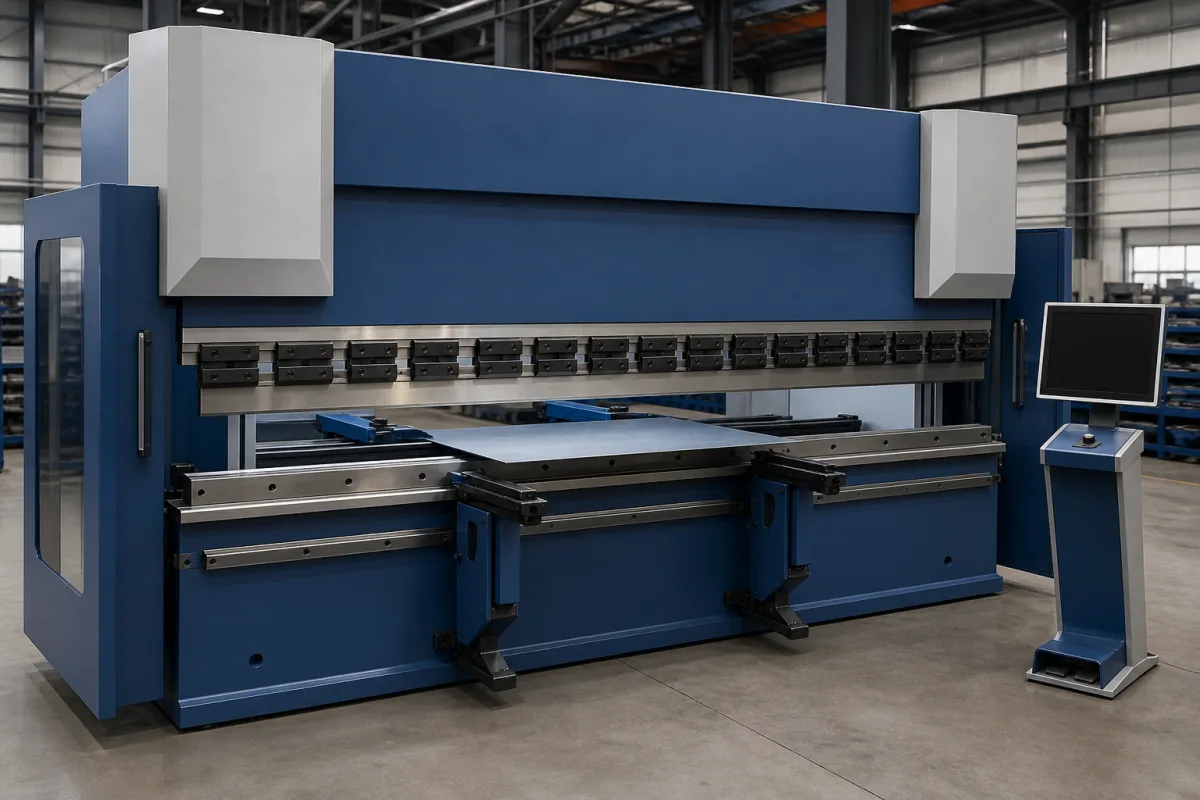
CNC press brake with angle measurement: reading the bend angle during the stroke and letting the CNC correct the punch depth
CNC press brakes with bend angle measurement · Why the air-bent angle moves with punch depth and springback, laser and camera sensors that read the angle during the stroke and correct the depth, sensor accuracy against the ±0.3° the bend reaches, and stand-alone laser protractors
This page covers CNC press brakes fitted with bend angle measurement: laser or camera sensors on the beam or table that read the angle of each bend and feed the CNC, which corrects the punch depth before or during the stroke, plus stand-alone laser protractors used at the machine. Ask three things first: whether the system measures during the bend and corrects automatically or only checks afterwards, which die openings, materials and part sizes it can measure, and what bend accuracy, not just sensor accuracy, the supplier will demonstrate on your parts.
CNC press brakes with in-process bend angle measurement and correction, and laser angle measuring devices used on press brakes. Bending force, V-die selection, axes and guarding are covered on the Hydraulic press brake page, controls on the CNC control system for press brakes page, back gauges on the Press brake back gauge and Back gauge system pages, and thick-plate springback on the Heavy plate bending press page. Folding machines and panel benders are outside this page.
CNFX editorial research · Sources checked October 12, 2026 · 5 sources
In air bending the angle follows the punch depth, so springback and material changes move it
Tim Heston, senior editor of The Fabricator, explains that in air bending the punch and die angles have no direct effect on the bend angle: it is set by how far the punch tip descends into the die opening, the depth of penetration. A narrower die angle lets the punch go deeper to allow for springback, the tendency of the sheet to open slightly once the punch releases. [1] data M Engineering, which makes the LaserCheck system, builds strain gauge sensors into it specifically to detect that springback on the press brake. [4]
Editorial calculation: an angle error of ±0.3° moves the tip of a 100 mm flange by about ±0.5 mm, and ±0.1° by about ±0.17 mm, which is why bend accuracy matters as much as the back gauge setting for long flanges.
Give the supplier the materials and thickness ranges, the shortest and longest flanges, the die openings and tool shapes (including gooseneck or horn tools), the angle tolerances, the batch sizes, and whether measurement must correct every bend or only check first parts.
02
Measure during the stroke and correct, or check after: four published systems
The Fabricator's product report on LVD's Easy-Form Laser describes measurement symmetrically at the front and back of the die, projecting lines of light points onto the workpiece and the die face and calculating every 20 ms; the result goes to the CNC, which recalculates the depth to reach the correct angle without interrupting the bend. [2] Vision Components' VCnano3D-Z laser profilers for press brakes measure at up to 400 Hz with an accuracy of <±0.1° (typ.), connect directly to the machine's PLC for real-time control, are integrated in Delem controls, and use a blue laser with ambient light suppression for stainless steel, copper, brass and foiled sheet. [3] data M Engineering's LaserCheck combines laser triangulation with strain gauges that detect springback; its sensor accuracy is better than ±0.1°, while it gives ±0.3° (typ.) as the bending accuracy, which depends on the control, the machine, the tools and the material. [4]
KEBA's KeMes angle meter fixes to the upper die with magnets and needs only a narrow gap between upper dies; it requires no intervention in the machine control, so existing press brakes can be upgraded, and logs up to 30,000 values to CSV over USB. [5] Editorial note: the gap between sensor accuracy and bend accuracy in the LaserCheck figures is the reason to ask for a bend test on your own material, not a sensor specification.
System
How it measures
Published accuracy
LVD Easy-Form Laser
Light-point lines front and back of die; every 20 ms; CNC corrects depth. [2]
12 companies list this product among what they make. Company figures are quoted from each
company's own website; every card states where the relationship came from.
ACCURL CNC MACHINE (ANHUI) MANUFACTORY CO., LTD.
Manufacturing site to be confirmed for the order
Lists CNC press brakes with optional bending angle measurement, including IRIS Plus laser transmitter and receiver on the upper beam and LaserCheck.
Explore company information and manufacturing capabilities, then discuss the scope of your project with a relevant supplier.
Share this page
Compiled and source-reviewed by the CNFX editorial team.
Each manufacturer above links to the page on that company's own website where the product is listed, with the date we checked it. How we source and review
· Page last updated 13 October 2026
Buyer questions
Why does the bend angle change from part to part on a CNC press brake?
In air bending the angle is set by how deep the punch goes into the die, so springback after the punch releases moves the final angle. [1]
How does in-process angle measurement correct the bend?
LVD's Easy-Form Laser measures front and back of the die every 20 ms and sends the angle to the CNC, which recalculates the punch depth during the bend. [2]
What bend accuracy can angle measurement reach?
data M states a sensor accuracy better than ±0.1° and a bending accuracy of ±0.3° (typ.), depending on control, machine, tools and material. [4]
Sources and what still needs a direct check
Sources checked 2026-10-12. The Fabricator explains air bending and reports LVD's system; Vision Components, data M (via a press brake maker's page) and KEBA describe their own sensors; suppliers list their machines.