Editorial Technical Reference

Industrial Dough Divider Blade Assembly

This page explains how Industrial Dough Divider Blade Assembly is classified within Manufacture of Bakery and Farinaceous Products. Technical values and manufacturer relationships are research references; confirm the current specification and supplier evidence for each order.

Technical Definition & Core Assembly

Precision cutting assembly for portioning dough in industrial bakery production lines.
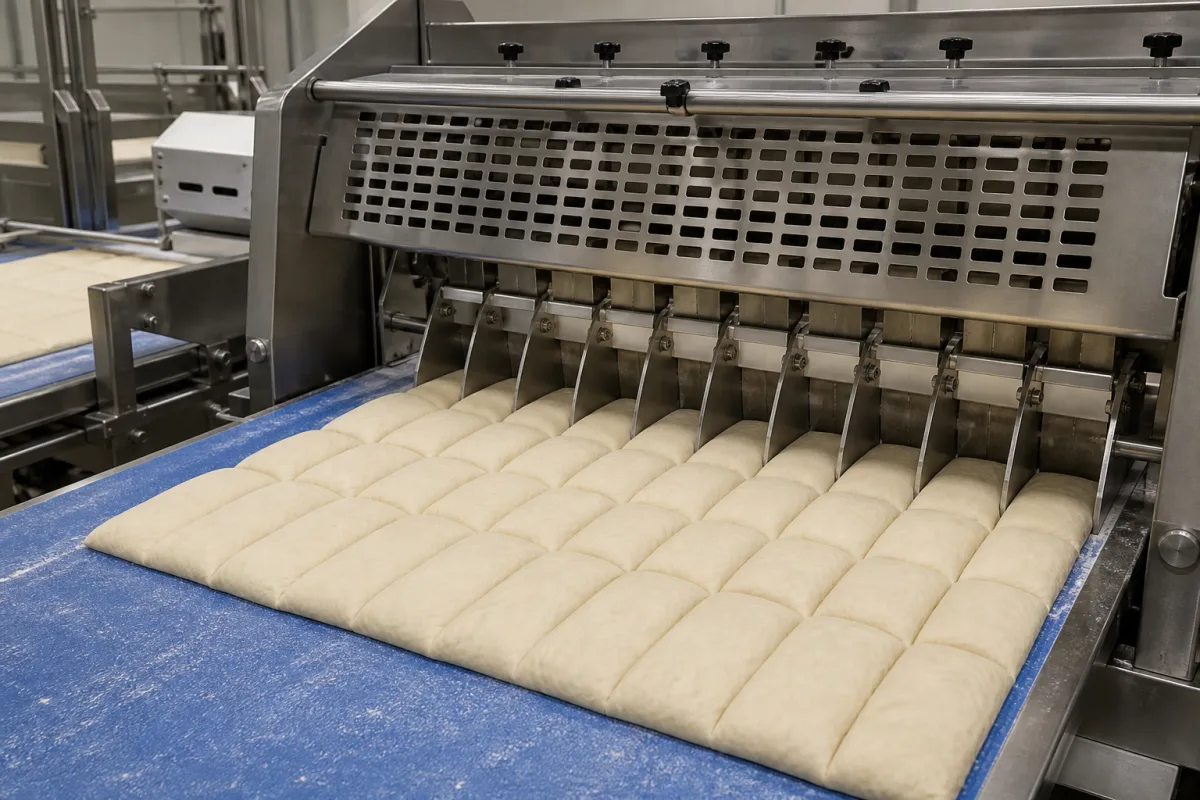
Industrial Dough Divider Blade Assembly in a manufacturing environment
Representative product image. Confirm appearance and specifications with the manufacturer.

Product Specifications

Technical details and manufacturing context for Industrial Dough Divider Blade Assembly

Definition
This industrial dough divider blade assembly is a critical wear component in automated bakery production systems, specifically designed for high-volume dough dividing operations. It ensures consistent portion weights and shapes for products like bread loaves, rolls, and pastries. The assembly integrates directly into industrial dough dividers and rounders, forming part of the B2B supply chain for bakery equipment manufacturers and maintenance providers. Its precision directly impacts product uniformity, waste reduction, and overall line efficiency in large-scale food manufacturing.

The assembly typically consists of multiple cutting blades or wires mounted in a rigid frame. The blade count ranges from 12 to 48 units, and the cutting width spans 200 to 600 mm. The portion weight range is adjustable from 20 to 500 grams, depending on the model and application. The maximum operating pressure is rated at 1.6 bar, and the blade material hardness is 58–62 HRC per ASTM E18. The mounting interface follows DIN 5480, and the operating temperature range is -10°C to 60°C. Cutting tolerance is ±0.05 mm per ISO 2768-m, and the blade material grade is 1.4110 per DIN EN 10088. The cycle rate is 30–60 cycles per minute, power requirement is 0.5–1.5 kW, and the assembly weight is 80–150 kg.

Materials used include food-grade stainless steel (e.g., AISI 304, 316), hardened tool steel, and food-safe polymers (e.g., PTFE, POM) for guides and bushings. These materials ensure durability and compliance with food safety requirements.

When selecting or replacing this component, verify model-specific values and standards with the legal manufacturer or supplier. The listed standards are procurement references, not proof of certification. Regular inspection and maintenance are essential to maintain cutting accuracy and prevent premature wear.
Working Principle
The assembly operates mechanically: driven blades or wires within a rigid frame cut through bulk dough as it passes through a divider hopper. The blades move in a synchronized manner, slicing the dough into individual portions of predetermined weight and volume. The cutting action is controlled by the divider's drive system, which may be hydraulic or pneumatic, applying pressure up to the rated maximum. The blade geometry and cutting tolerance ensure uniform portion sizes, critical for consistent baking results. The assembly's design allows for adjustment of portion weight by changing the cutting frequency or blade configuration. Proper alignment and tension of the blades are essential for accurate cutting and to minimize dough sticking.
Common Materials
Food-grade stainless steel (e.g., AISI 304, 316), Hardened tool steel, Food-safe polymer (e.g., PTFE, POM) for guides/bushings
Technical Parameters
ParameterTypical rangeNotes & selection driver
Blade CountRequired12–48 unitsNumber of individual cutting blades or wires in the assembly
Cutting WidthRequired200–600 mmTotal effective cutting span of the assembly
Portion Weight RangeRequired20–500 gAdjustable target weight range for individual dough pieces (e.g., 50-200g)
Maximum Operating Pressure1.6 barMaximum hydraulic or pneumatic pressure the assembly is rated for
Material Hardness (Blade)Required58–62 HRCRockwell hardness of the primary cutting steel componentsASTM E18
Mounting Interface StandardRequiredDIN 5480 N/AStandardized interface for attachment to divider models (e.g., 'Type B flange')DIN 5480
Operating Temperature Range-10–60 °CBelow -10°C blade brittleness risk.
Cutting Tolerance±0.05 mmCritical for uniform portion weights.ISO 2768-m
Blade Material Grade1.4110Stainless steel for food contact.DIN EN 10088
Cycle Rate30–60 cycles/minHigher rates may reduce accuracy.
Power Requirement0.5–1.5 kWDepends on drive motor.
Weight80–150 kgAffects installation and handling.

Ranges are indicative industry figures for RFQ preparation, not a supplier commitment. Confirm every value and standard with the legal manufacturer before ordering.

Components / BOM
  • Primary Cutting Blade/Wire Part
    Executes the primary shearing action to separate dough portions
    Material: Hardened tool steel or food-grade stainless steel
  • Blade Holder / Frame
    Provides structural rigidity and precise alignment for all cutting elements
    Material: Food-grade stainless steel (AISI 304/316)
  • Tensioning Mechanism Optional
    Maintains optimal tension on cutting wires (for wire-type assemblies)
    Material: Stainless steel with food-safe polymer bushings
  • Wear Plate / Liner Part
    Protects non-cutting surfaces from dough adhesion and abrasion
    Material: Food-safe polymer (e.g., PTFE, UHMW-PE) or coated steel

Industry Taxonomies & Aliases

Commonly used trade names and technical identifiers for Industrial Dough Divider Blade Assembly.

Industrial Ecosystem & Supply Chain Structure

Complementary Systems
Downstream Applications
Specialized Tooling

Application Fit & Sizing Matrix

Operational Limits
pressure: Max 5 bar (72.5 psi) hydraulic pressure
other spec: Dough viscosity range: 500-5000 cP, Slurry concentration: Not applicable (solid dough processing)
temperature: 0°C to 50°C (32°F to 122°F)
Media Compatibility
✓ Wheat-based dough ✓ Rye-based dough ✓ Multigrain dough
Unsuitable: High-acidity dough (pH <4.0) with corrosive ingredients
Sizing Data Required
  • Dough batch volume (L/hr)
  • Desired portion weight (g)
  • Production line speed (cycles/min)

Reliability & Engineering Risk Analysis

Failure Mode & Root Cause
Blade edge dulling and deformation
Cause: Repeated impact with dough containing hard contaminants (e.g., bone fragments, metal shavings) or abrasive particles (e.g., sand, mineral residues), combined with cyclic stress from high-speed cutting operations leading to plastic deformation and edge rolling.
Corrosion and pitting at blade-root interface
Cause: Exposure to corrosive cleaning agents (chlorine-based sanitizers, acidic detergents) and moisture ingress in the assembly joint, exacerbated by improper drying after wash-down cycles, leading to galvanic corrosion between dissimilar metals (e.g., stainless steel blade and aluminum housing).
Maintenance Indicators
  • Audible change in cutting sound: high-pitched screeching or irregular thumping indicating blade misalignment, edge damage, or bearing wear in the drive mechanism.
  • Visual dough inconsistency: ragged cuts, uneven portion weights, or dough smearing on blade surfaces, signaling blade dullness, contamination buildup, or excessive clearance in the assembly.
Engineering Tips
  • Implement inline contaminant detection (e.g., metal detectors, X-ray systems) upstream of the divider and establish strict raw material inspection protocols to prevent abrasive or hard foreign objects from reaching the blades.
  • Adopt a precision cleaning and drying regimen: use pH-neutral, corrosion-inhibiting cleaners, ensure complete drying with compressed air directed at blade-root interfaces, and apply food-grade anti-corrosion coatings on non-cutting surfaces during scheduled maintenance.

Indicative industry ranges for design and RFQ preparation. Confirm the exact figures and applicable standard with the manufacturer before specifying.

Compliance & Manufacturing Standards

Applicable Standards
ANSI/NSF 2 - Food Equipment CE Marking - Machinery Directive 2006/42/EC

Quoted from the published standard.

Manufacturing Precision
  • Blade Edge Sharpness: +/- 0.005mm
  • Assembly Alignment: +/- 0.1mm
Quality Inspection
  • Material Composition Verification via XRF Analysis
  • Surface Roughness Measurement per ISO 4287

Manufacturers of Industrial Dough Divider Blade Assembly

Manufacturer profiles associated with Industrial Dough Divider Blade Assembly.

Sourcing Industrial Dough Divider Blade Assembly from China?
Tell us your specification and target quantity — we will match it against manufacturer records and come back with the factories that fit.
Request manufacturers We manufacture this

Manufacturer listings support early research and capability understanding. They are not certification, ranking, or transaction guarantees.

Share this page
Technical documentation
Request current drawings, revision history, and a signed specification sheet.
Manufacturing capability
Verify equipment lists, process limits, capacity, and representative production evidence.
Inspection readiness
Confirm test methods, calibrated equipment, sampling plans, and traceable reports.
Supplier transparency
Check the legal entity, factory address, ownership, certifications, and direct contacts.

CNFX does not score or rank suppliers. Buyers must verify all claims and documents with the legal manufacturer before ordering.

Frequently Asked Questions

What materials are used in the blade assembly?

The assembly uses food-grade stainless steel (e.g., AISI 304, 316), hardened tool steel, and food-safe polymers like PTFE or POM for guides and bushings. The blade material grade is 1.4110 per DIN EN 10088.

What is the cutting tolerance?

The cutting tolerance is ±0.05 mm per ISO 2768-m, which is critical for uniform portion weights.

What is the operating temperature range?

The operating temperature range is -10°C to 60°C. Below -10°C, there is a risk of blade brittleness.

How do I verify compatibility with my divider?

Check the mounting interface standard (DIN 5480) and confirm model-specific dimensions and parameters with the legal manufacturer or supplier.

Data Basis

Editorial classification, named public sources where available, and source-reviewed manufacturer records.

Preliminary Technical Classification
This page supports structured research, RFQ preparation, and supplier evaluation. It does not replace buyer-led supplier qualification, standards review, or technical approval.
Buyer enquiry

Request manufacturing insight for Industrial Dough Divider Blade Assembly

Ask for use case, specification boundaries, supplier type, and RFQ preparation information for this product.

Where it goes
Straight to the CNFX editorial desk, and to the manufacturer if this product is linked to a claimed profile. Nothing is broadcast to a supplier list.
Your details stay here
We do not sell or rent enquiry data, and we do not add you to a mailing list. Used only to answer this request.
No commission, no middleman
CNFX is a directory. We take no cut of any order and never negotiate on a supplier's behalf.
What we don't claim
A listing is not an endorsement. Qualify every supplier and verify every figure yourself before ordering.

Your business information is used only to process this request.

Thank you! Your message has been sent. We'll respond within 1–3 business days.
Sorry, we couldn't send your message. Please try again, or email us at [email protected].

Need to Manufacture Industrial Dough Divider Blade Assembly?

Compare manufacturer profiles with relevant product and process capability.

Previous Product
Industrial Dough Laminator
Last Product
Get QuotesChat