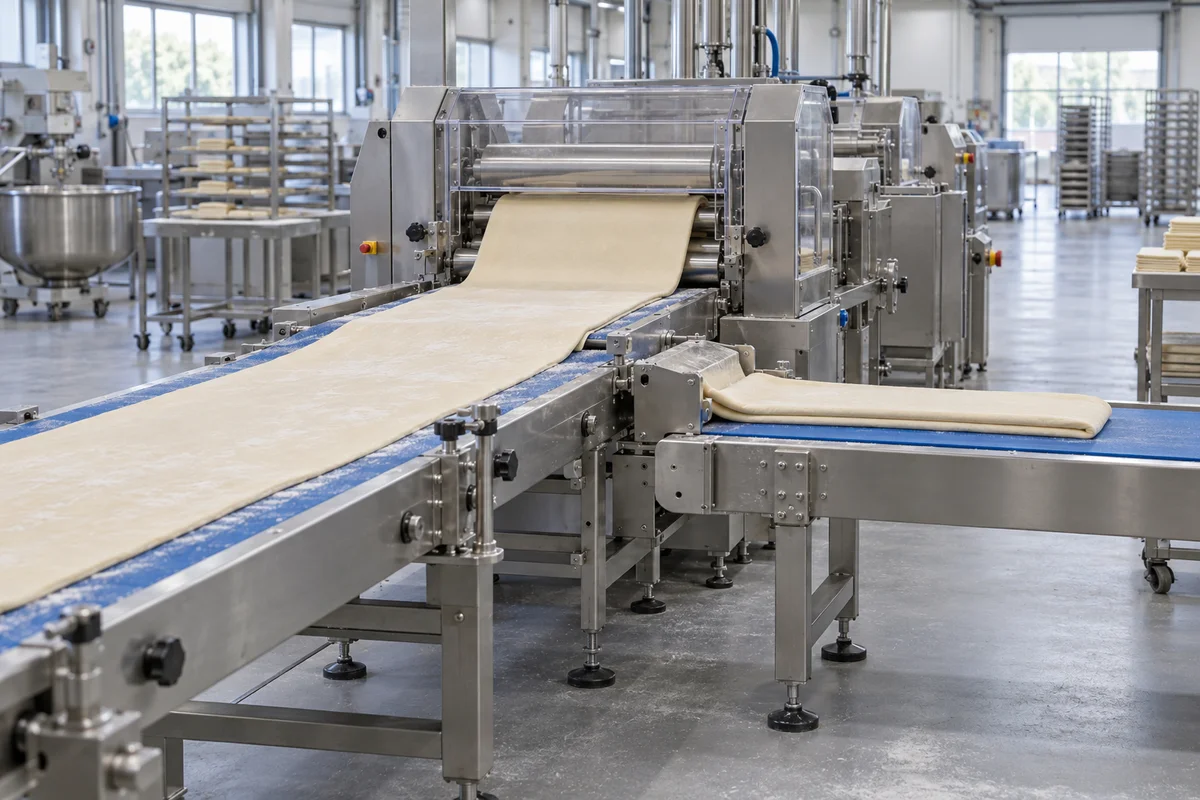
Choose the output first: dough blocks for resting, a continuous laminated band, or shaped pastries. That choice changes the folding stations, reduction heads and floor plan. This guide follows the dough and fat through the line, then checks published ZLINE and RONDO configurations against the bakery’s recipe and downstream equipment.
CNFX editorial research · Sources checked October 10, 2026 · 5 sources
Follow the dough band through the parts that create layers
This is a functional assembly map grounded in the named manufacturers’ descriptions. It distinguishes what forms, encloses, folds and reduces the band. It is not a numbered spare-parts BOM for every line [1][2].
Assembly
Function and documented scope
Dough band former / feed hopper
Turn bulk dough into the initial band. RONDO lists a band former in block and laminating versions; ZLINE gives a 2,100 mm hopper height for ZKS-600. Feeding geometry and handling method must match the supplied layout [2][1].
Fat pump and nozzle
Meter a separate band of fat before enclosure. ZLINE describes level and pressure sensing; RONDO marks its pump optional in the version table. Neither establishes an included heating/cooling system for every pump [1][2].
Folding belts and fan-fold station
Folding belts enclose fat; the later fan-fold station builds layers by laying the band back and forth. RONDO lists one station in L-block/L-laminating lines and two in U/Z versions. ZLINE offers swing or retractable laminators [2][1].
Main reduction / satellite heads
Reduce the thicker dough package in stages. RONDO lists one satellite head in I-block, two in L-block/L-laminating and three in U/Z-block/U/Z-laminating versions. This does not specify which reduction design ZKS-600 includes [2][1].
Thickness adjustment, cross roller and calibrator
ZLINE adjusts dough thickness through touchscreen or pressing-machine controls. RONDO’s continuous feeding/laminating routes use a cross roller and calibrator. No encoder model or thickness-error tolerance is published here [1][2].
Cutting / end section
RONDO block lines list a rotary cutter and the described end route includes manual folding. Its separate make-up line uses cutting tools, optional depositor and guillotine. A pastry cutter is not an additional laminating stage [2].
Temperature / resting provision
Condition dough according to the recipe. The separate ZLINE ZLKS 380 offers customized cooling options; it does not prove an integral temperature-management unit on ZKS-600. Specify included cooling, outside rest space and transfer conditions [5][3].
Control panel and drives
Coordinate machine settings and recipes. RONDO’s MLC schedule lists PLC, 12-inch colour touchscreen and 100 programs; ZLINE describes touch/button thickness adjustment and saved recipes without those model-specific values. Cabinet IP and internal device models remain unverified [2][1].
ZLINE’s 304 construction statement and RONDO’s stainless construction description do not identify every roller, coating, belt, seal or lubricant. Obtain the assembly-specific material/contact declaration and drawing revision for replacements. A “digital encoder” is a component, not a material specification [1][2].
02
Compare the same type of output before comparing widths
ZLINE’s ZKS-600 page describes a pastry-sheet line. RONDO’s July 2023 MLC 4.0 brochure separates block, feeding, laminating and make-up versions. The make-up line cuts, fills or shapes a supplied band; its table is not the installation schedule of every MLC laminator [1][2].
Match the dough band, not just the conveyor belt
ZLINE distinguishes 600 mm dough from its 650 mm belt; RONDO lists belt widths separately by version. Obtain usable dough width and downstream lane/cut requirements. Width alone cannot establish kg/h, usable piece yield or a need to re-sheet [1][2].
Model or version
Published data
How to use it
ZLINE ZKS-600 sheet line
600 mm dough; 650 mm belt; final thickness 3–30 mm; up to 1,500 kg/h; up to 49 butter layers [1]
Ask for the recipe, final thickness, fat ratio and running conditions behind the output claim. The page does not establish all endpoints together.
RONDO MLC Block Lines
700 or 900 mm belt; speed up to 8 m/min. I / L / U-or-Z block variants list up to 4 / 40 / 400 fat layers respectively [2]
Select the actual variant and block/resting route; the brochure describes manual folding at the block end section.
RONDO MLC Laminating Lines
700 or 900 mm belt; speed up to 12 m/min. L version: band with up to 10 fat layers; U-or-Z version: up to 100 [2]
These versions produce a continuous band for make-up. Belt speed alone gives no mass throughput without the band’s cross-section, density and effective running time.
RONDO MLC Make-up Line
940 mm belt, 1,000 mm table width; 9 / 12 / 15 m length; 0.5–12 m/min [2]
These values belong to downstream shaping equipment. They cannot be substituted for the width or footprint of the block/laminating versions.
03
Count fat layers along the actual folding route
RONDO’s brochure explains one band-forming, fat-enclosing and reduction sequence on pages 2–3, then lists different component combinations on pages 6–7. Its statements about undamaged layers are design claims; confirm the result with your recipe during the agreed trial [2].
Do not multiply unrelated layer maxima
ZLINE says one laminator creates at most 8 layers, while its ZKS-600 table gives at most 49 butter layers. It does not explain the exact fold/pass combination that links those statements. Ask for the route and counting convention; do not infer a station count or guaranteed finished cross-section [1].
Four hours to three days describes the whole croissant process
RONDO’s FAQ includes mixing, rising, laminating, shaping and baking in this broad time span. It is not a required residence time inside a laminator, cooling tunnel or retarder. Set individual hold times with the recipe and trial [3].
Form and enclose
The band former prepares the dough; the fat pump lays a continuous butter or margarine band. Folding belts close dough around it. The version table marks the fat pump as optional, so confirm whether the quoted system includes it [2].
Reduce, then fan-fold
Orbital rollers in a satellite head reduce thickness. The described fan-fold station creates 2–10 fat layers and a second satellite head reduces the thicker folded band. This sequence is distinct from simply closing the first dough sheet around fat [2].
Choose blocks or continuous feeding
For the brochure’s block process, the line cuts pieces automatically and an operator folds them manually; it describes 2–40 layers at that point. Alternatively, a cross roller and calibrators bring the band to final dimensions for downstream make-up [2].
Include resting and any repeat pass
The brochure permits rested dough blocks to pass through again, with the satellite head joining them into a continuous band. Agree the pass sequence, handling labour and resting capacity for the target layers; do not treat a maximum layer count as a one-pass promise [2].
04
Keep roll-in ratio, fat texture and room conditions separate
AAK distinguishes firm, plastic laminating fats that remain in layers from softer fats intended to mix into shortcrust. That explains why a pump-compatible fat still needs a recipe and processing trial; it does not provide a universal fat temperature or machine setting [4].
Write the denominator into the recipe
If a supplier confirms a mass ratio of 1 kg added fat to 10 kg base dough, the added-fat share of that combined mass is 1/(1+10) ≈9.1%, not 10%. This arithmetic excludes fat already in the dough and any other additions. It illustrates why the ratio basis must be written down; it is not a measured formulation or nutrition claim.
ZLINE pump geometry
The source lists nozzle width 250–290 mm and fat-band thickness 2–20 mm, with level detection and pressure-responsive feed control. These are fat-pump dimensions, not the finished 600 mm dough-band width or 3–30 mm sheet thickness [1].
Roll-in ratio
The ZKS-600 row says butter/margarine : dough = 1:1 to 1:10, without a measurement method. Confirm the mass basis, whether “dough” is before adding roll-in fat, and how feed is measured. This is not a declared finished-product total-fat percentage [1].
Temperature guidance
RONDO’s croissant article recommends ambient conditions below 18 °C for butter lamination and 18–22 °C for margarine. These are its process recommendations, not a fat-core temperature, cooling-unit setpoint or guaranteed operating range for ZKS-600. Obtain the selected fat supplier’s working guidance [3].
Cooling equipment scope
ZLINE’s separate ZLKS 380 cooling-line page lists natural cooling tunnels, forced-air circulation or refrigerated options. It supplies no numeric temperature/humidity range and does not prove that ZKS-600 includes any of them [5].
05
Keep the working dimensions and utility ratings in their own columns
The following fields turn a line proposal into checkable requirements. An absent value stays a question for the selected configuration, rather than becoming a category-wide “typical” range.
Parameter / unit
What is established and what to request
Roller width · mm
ZKS-600 states 600 mm dough and 650 mm belt, not roller-face width. The separate ZLKS 380 lists 380 mm dough and 450 mm roll width. Do not transfer the latter to ZKS-600 [1][5].
Thickness range · mm
ZKS-600 final sheet: 3–30 mm. Its individual laminator description allows output up to 80 mm thick. These describe different process positions; neither is a stated thickness tolerance [1].
Production speed · m/min
MLC block version: up to 8 m/min; feeding/laminating/make-up: up to 12 m/min. ZKS-600 lists up to 1,500 kg/h without a line-speed schedule. Specify usable output on the recipe and final sheet [2][1].
Motor / electrical power · kW
ZKS-600 labels 27 kW under “Energy consumption”; it does not define installed versus operating demand. A separate cooling-line model lists 105 kW. Obtain the actual connected-load schedule including cooling; kW is power, not kWh per batch [1][5].
Temperature control range · °C
No numeric conditioning range is stated for either reviewed ZLINE line. RONDO’s room recommendations for butter/margarine are process advice, not an equipment control specification [5][3].
Folding stages · count
Record enclosure, fan-fold stations, manual folds and repeat passes separately. RONDO’s component/version table supports named station counts; fat-layer totals are a different quantity [2].
Operating air pressure · bar / MPa
RONDO requires air for fat pump/make-up equipment but gives no pressure or flow in this brochure. Obtain supply pressure, demand and air quality for the actual included pneumatic functions [2].
Electrical supply · V / Hz / phase
ZKS-600: 380 V, 50 Hz, three-phase, with supply to demand. MLC brochure: 3×200–480 V, 50/60 Hz; confirm the actual ordered connection and electrical drawing [1][2].
Ingress protection
No IP65 rating for the ZKS-600 control panel is established by the reviewed data. Request ratings for cabinets, motors and sensors together with the approved cleaning exposure [1].
Machine mass · kg
ZKS-600 table: 18,000 kg. Confirm included modules, shipping splits and installed floor reactions; mass alone does not establish stability or a floor-loading design [1].
Dimensions · L×W×H
ZKS-600: 25.0×8.5×2.4 m for its L layout. RONDO footprints depend on block/feeding/laminating version; the 9/12/15 m lengths belong to the make-up line [1][2].
Roller / contact materials
ZLINE’s overall 304 statement does not document a precision-ground roller grade or coating. Request the actual roller surface, conveyor belt and other contact-part schedule and cleaning compatibility [1].
Control system
ZLINE advertises recipes and remote support; RONDO specifies PLC, 12-inch touchscreen and 100 programs. Confirm the delivered controller, recipe variables, user permissions and remote-support boundary [1][2].
06
Reserve space for the chosen version and its process buffers
The line envelope is only the start of the installation drawing. Agree loading, maintenance access, dough resting, return paths and downstream equipment separately.
ZKS-600: the table labels an L layout, 25.0×8.5×2.4 m, 18,000 kg and a 2,100 mm dough hopper height. Confirm the included modules, working/shipping mass, floor loads and lifting route [1].
RONDO block footprints: I 8,300×1,850 mm; L 8,000×6,000 mm; U/Z 8,000×7,200 mm. Laminating footprints: L 8,000×6,900 mm; U/Z 8,000×7,200 mm. These brochure layouts are not a clearance-approved site plan [2].
RONDO’s connection schedule assigns air to the fat pump and make-up lines and water to make-up lines. It does not publish required air pressure or consumption; do not assign a generic roller-adjustment pressure [2].
For sheet products, ZLINE offers paper/film feed and downstream tunnel freezer/packing connections. Establish the delivered equipment boundary, transfer width, product condition and stop/restart behaviour [1].
ZLINE advertises recipe storage and remote support with an internet connection. Agree recipe contents, access control and who can authorize remote changes; storing a recipe does not verify a good bake or a complete mechanical format change [1].
The source describes 304 stainless construction but provides no cabinet IP rating, belt compound, roller coating, approved cleaning chemical or washdown procedure. Request the actual hygiene and maintenance manual, removable-part list and isolation method. Accessible components and stainless steel do not establish that electrical enclosures or all rollers can be sprayed [1][2].
07
Send the recipe route and bakery layout with the RFQ
Paste it into your enquiry below or into an email to a maker, then replace every bracket.
Output: [rested dough blocks / continuous band / finished sheet shapes], quantity [ ]
Recipe: flour/dough system, base dough mass and fat already included [ ]
Roll-in fat: exact grade, mass ratio to base dough, supplier working conditions [ ]
Layer route: target fat layers, enclosure/folds/stations, repeat passes and manual work [ ]
Sheet: usable dough width, final thickness and agreed tolerance [ ]
Capacity: usable kg/h at the above recipe, trial duration and reject basis [ ]
Conditions: dough/fat temperatures, room conditions, resting/cooling stages [ ]
Included equipment: band former, fat pump, reduction heads, cutters, cooling and make-up [ ]
Site: approved layout, access, hopper loading, floor loads and utilities [ ]
Hygiene/service: contact materials, cleaning/isolation, removable parts and wear-part drawings [ ]
Acceptance: agreed recipe trial, layer/weight/thickness checks and bake evaluation [ ]
Installation/training, destination and delivery date [ ]
The linked Chinese supplier publishes a named pastry-sheet line and a separate cooling-line model. Its scope is described below from those pages; model claims and construction statements still require confirmation in the supplied configuration.
Anhui Zline Bakery Machinery Co., Ltd.
Hefei, Anhui (Feixi production base, per official site), CN
ZKS-600 is listed as an L-shaped pastry-sheet laminating line with 600 mm dough width, 3–30 mm final sheet thickness and up to 1,500 kg/h. Its separate ZLKS 380 page offers customized cooling and a different width/power schedule. Request the selected layer route, reduction heads, fat ratio and cooling boundary; do not merge the two models.
Product scope checked 2026-10-10
Listed on the company's own website · profile compiled by CNFX from public sources
Explore company information and manufacturing capabilities, then discuss the scope of your project with a relevant supplier.
Share this page
Compiled and source-reviewed by the CNFX editorial team.
Each manufacturer above links to the page on that company's own website where the product is listed, with the date we checked it. How we source and review
· Page last updated 13 October 2026
Buyer questions
How many fat layers can a laminating line make?
ZLINE lists up to 49 butter layers for ZKS-600 without explaining its complete fold/pass route. RONDO separately lists I/L/U-or-Z block versions up to 4/40/400 layers and L/U-or-Z continuous laminating versions up to 10/100. Specify the version, counting method, manual work and repeat/resting sequence. [1][2]
What output does a 600 mm laminating line give?
ZLINE publishes up to 1,500 kg/h for ZKS-600 with a 600 mm dough width and 650 mm belt. Its page does not bind that maximum to every thickness, fat ratio or recipe. Agree output on the actual product; dough width alone is insufficient. [1]
Why use a satellite head?
RONDO describes orbital rollers reducing band thickness while preserving dough and fat layers. That is its stated design purpose, not a witnessed result for your dough or proof that ZKS-600 uses the same head. Verify the supplied reduction arrangement and run the agreed recipe trial. [2]
How long does croissant production take?
RONDO’s four-hours-to-three-days range describes the whole croissant process, including preparation, rising, laminating, shaping and baking. It is not the residence time of an individual laminator or cooling tunnel. [3]
Sources and what still needs a direct check
Sources checked 2026-10-10. Standards bodies and regulations define the requirements; manufacturer pages show published ranges for those models only. CNFX does not certify products or suppliers.
ZKS-600 reduction-head design, exact route behind ≤49 layers and the relation to the ≤8-layer laminator description require the selected configuration drawing.
Published capacities and maximum layers are manufacturer statements; this review includes no witnessed production or recipe/bake trial.
Confirm fat-to-dough measurement basis, recipe-specific temperatures and whether cooling/resting equipment is included. ZLKS 380 data does not fill ZKS-600 gaps.
No roller coating, full contact-material schedule, cabinet IP rating, cleaning program or pressure/air-consumption value is verified for ZKS-600.
The RONDO brochure is dated July 2023; confirm the current offered revision and named version before using the footprint or component count.
Buyer enquiry
Request manufacturing insight
for Industrial Dough Laminator
Ask for use case, specification boundaries, supplier type, and RFQ preparation
information for this product.
Where it goes
Straight to the CNFX editorial desk, and to the manufacturer if this product is
linked to a claimed profile. Nothing is broadcast to a supplier list.
Your details stay here
We do not sell or rent enquiry data, and we do not add you to a mailing list.
Used only to answer this request.
No commission, no middleman
CNFX is a directory. We take no cut of any order and never negotiate on a
supplier's behalf.
What to include
Share your product specifications, quantity, destination and target delivery date.
Need to Manufacture Industrial Dough Laminator?
Compare manufacturer profiles with relevant product and process capability.