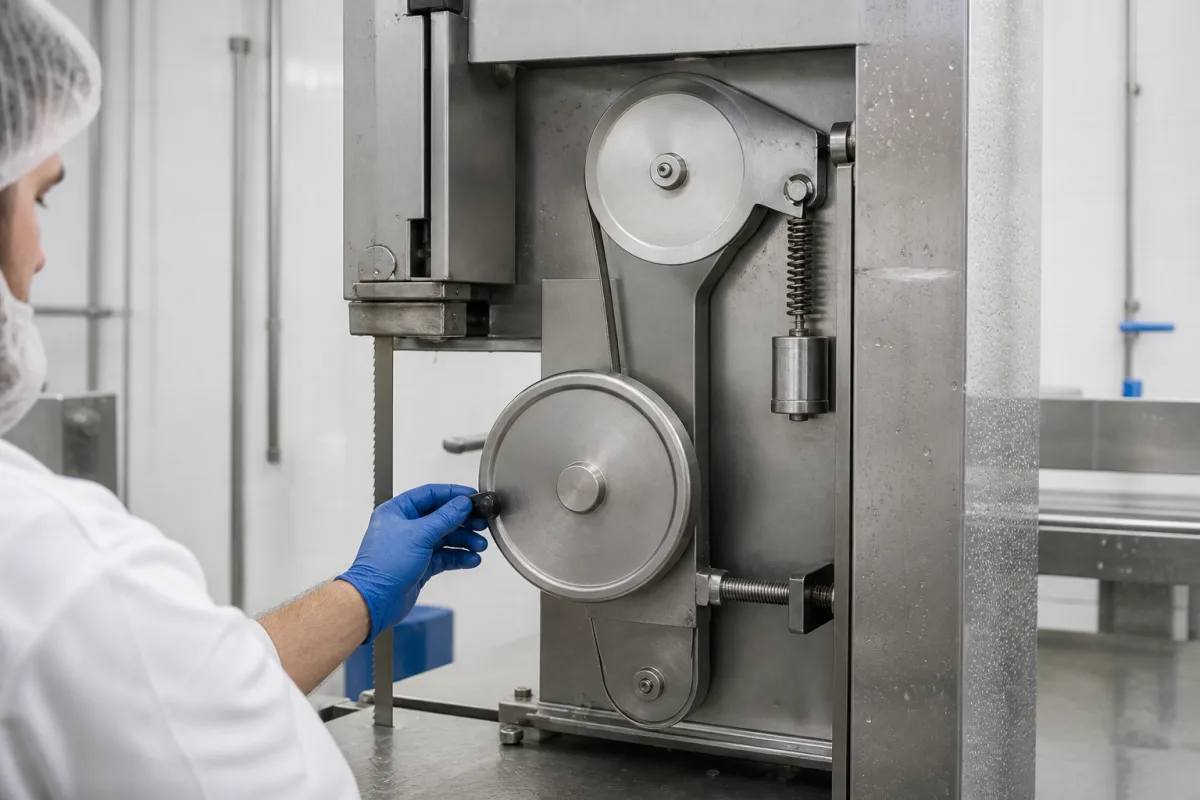
Band saw blade tensioning mechanism for meat and fish saws: setting blade stress, checking it independently of the screw, and keeping the wheel mount cleanable
The screw, spring and wheel mount that stretch the blade on a meat, poultry and fish band saw · 15,000–20,000 psi for carbon blades and up to 35,000 psi for bi-metal, forces from about 130 lbf on a 5/8 × .014 in blade to about 2,450 lbf on a 2 × .035 in frozen-block blade, and why a torque setting is not a tension reading
A band saw blade only cuts straight when it is stretched between its two wheels hard enough to grip the drive wheel and resist the cut, and no harder. On a meat or fish saw the mechanism that does the stretching, a threaded rod or screw, a spring and a movable wheel mount, also has to survive fat, bone dust, frozen product and daily washdown, which is where the food versions part company with workshop saws.
Blade tensioning mechanisms of band saws for meat, poultry, fish and frozen food blocks: the adjusting screw or handwheel, tension spring, movable wheel mount or pivoting housing, release for blade changes, and the gauges and tensiometers used to set them, judged by the tension the blade needs and how reliably and hygienically it is applied. Fish filleting machines with circular blades are covered on the Industrial fish filleting machine page; servo blade units of fish and meat portion cutters on the Cutting assembly for fish and meat portion cutters page. Woodworking and metal-cutting band saws are referred to only for their published tension ranges.
CNFX editorial research · Sources checked October 13, 2026 · 4 sources
How much pull the mechanism must give: 15,000–20,000 psi on a carbon meat blade, up to 35,000 psi on bi-metal, and the force that means for each blade size
Blade tension is quoted as stress, so the force the screw and spring must produce grows with blade cross-section. Sawblade.com lists carbon blades at “Typical tension: 15,000–20,000 PSI” and bi-metal blades at “Required tension: Up to 35,000 PSI”, and works the example that a 1/2 × .025 in blade needs 312.5 lbf to reach 25,000 psi. [1] Starrett's food-processing bulletin lists carbon Meatkutter blades for fresh and frozen meat, poultry and fish and a bi-metal frozen blade for temperatures down to −76 °F (−60 °C). [2]
Editorial calculation: force = width × thickness × stress, the same method as the Sawblade.com example; for 5/8 × .022 in, 0.625 × 0.022 = 0.01375 in², and 0.01375 × 20,000 ≈ 275 lbf. [1] The 35,000 psi column applies only where the blade is bi-metal; the Meatkutter Premium is described as polished high-carbon steel with hardened teeth and back. [2][1]
Hobart's patent gives the purpose of the tension in the first place: to let blades of slightly varying length be fitted and changed, and to give enough tractive force through friction with the drive wheel to deliver the cutting force from wheel to blade. [3] Sawblade.com lists the failure modes either side: too tight brings premature breakage, twisting, weld failure and gullet cracks; too loose brings vibration, wandering and out-of-square cuts. It also advises releasing tension after use, because a blade left under full tension as it cools can warp and weaken its weld. [1]
State every blade width and thickness the saw must run, carbon or bi-metal, and the coldest product temperature; ask for the tension range of the mechanism in force, not only in handwheel turns.
02
Checking tension independently of the screw: why one torque setting gave different tension in a clean and a greasy saw
Best and Donovan's tensiometer patent describes a hand-held meat band saw whose idler wheel sits on a mounting plate moved by a threaded bolt. The tension device had been set with a torque wrench, but animal fat and grease collect in the housing, which must periodically be steam cleaned or sterilised, and the same torque setting was found to give different actual blade tensions depending on whether the housing was clean. [4]
Its answer was a portable tensiometer separate from the tension device: two pivoted arms seated on the blade and on the saw housing, with a spring biasing the blade toward the housing and a scale and indicator showing when the desired tension is reached. [4] Sawblade.com makes the same point for built-in gauges, which can assume one blade size and read wrongly after a width change, and recommends a hand-held tension meter or, once calibrated, a remembered number of crank turns. [1]
Ask how the tension is read on the saw, whether the scale is valid for every blade size supplied, and whether a separate tension meter is provided or recommended.
03
A wheel mount that can be washed: Hobart's pivoting lower-wheel housing in place of slideways
Hobart's patent explains that earlier meat saws moved the upper or lower band wheel along a slideway to change tension, keeping the cutting flight at a set angle to the meat table, but the slideways collected cuttings, made the slide hard to move and were difficult to clean. Its design instead mounts the lower wheel, motor and gear transmission in a protective housing that pivots on the frame about an axis parallel to the wheel axis, moved toward or away from the upper wheel by a threaded rod turned with a handle. [3]
Placing the motor away from the pivot lets its weight assist in tensioning the blade, reducing the force needed at the adjustment, and the closed housing is easier to clean and keeps contamination out of the drive components. [3]
Ask which parts of the tensioning mechanism are in the product zone, how they are cleaned, and whether tension can be released for blade changes without tools.
04
What to send when specifying a band saw blade tensioning mechanism
Paste it into your enquiry below or into an email to a maker, then replace every bracket.
Saw: [meat, poultry, fish or frozen block; wheel diameter; hand-held or floor]
Blades: [widths and thicknesses; carbon or bi-metal; TPI]
Tension: [stress or force range; quick release for blade changes]
Measurement: [built-in scale; separate tension meter; calibration per blade size]
Hygiene: [parts in the product zone; washdown or steam cleaning; materials]
Product: [coldest temperature; bone-in or boneless]
Explore company information and manufacturing capabilities, then discuss the scope of your project with a relevant supplier.
Share this page
Compiled and source-reviewed by the CNFX editorial team.
Each manufacturer above links to the page on that company's own website where the product is listed, with the date we checked it. How we source and review
· Page last updated 13 October 2026
Buyer questions
What tension does a meat band saw blade need?
Sawblade.com lists “Typical tension: 15,000–20,000 PSI” for carbon blades and up to 35,000 psi for bi-metal; on a 5/8 × .022 in blade, 15,000–20,000 psi is about 206–275 lbf (editorial calculation). [1][2]
Why not set blade tension with a torque wrench?
In a patented case, the same torque gave different blade tension depending on whether the saw housing was clean or full of fat and grease, which led to a separate tensiometer. [4]
How does a pivoting housing help on a meat saw?
Hobart replaced contamination-prone slideways with a pivoting housing carrying the lower wheel, motor and gearing, adjusted by a threaded rod; it is easier to clean and the motor weight assists tensioning. [3]
Which blades does a frozen fish saw use?
Starrett lists carbon Meatkutter Frozen blades from 5/8 × .014 in to 2 × .035 in for frozen fish, meat and fish blocks down to −4 °F (−20 °C), and a bi-metal frozen blade down to −76 °F (−60 °C). [2]
Sources and what still needs a direct check
Sources checked 2026-10-13. Tension ranges and setting practice come from Sawblade.com's blade tension guide; blade sizes and materials from Starrett's food processing bulletin; the pivoting wheel housing from a Hobart patent; the torque-versus-tension problem and tensiometer from a Best and Donovan patent.