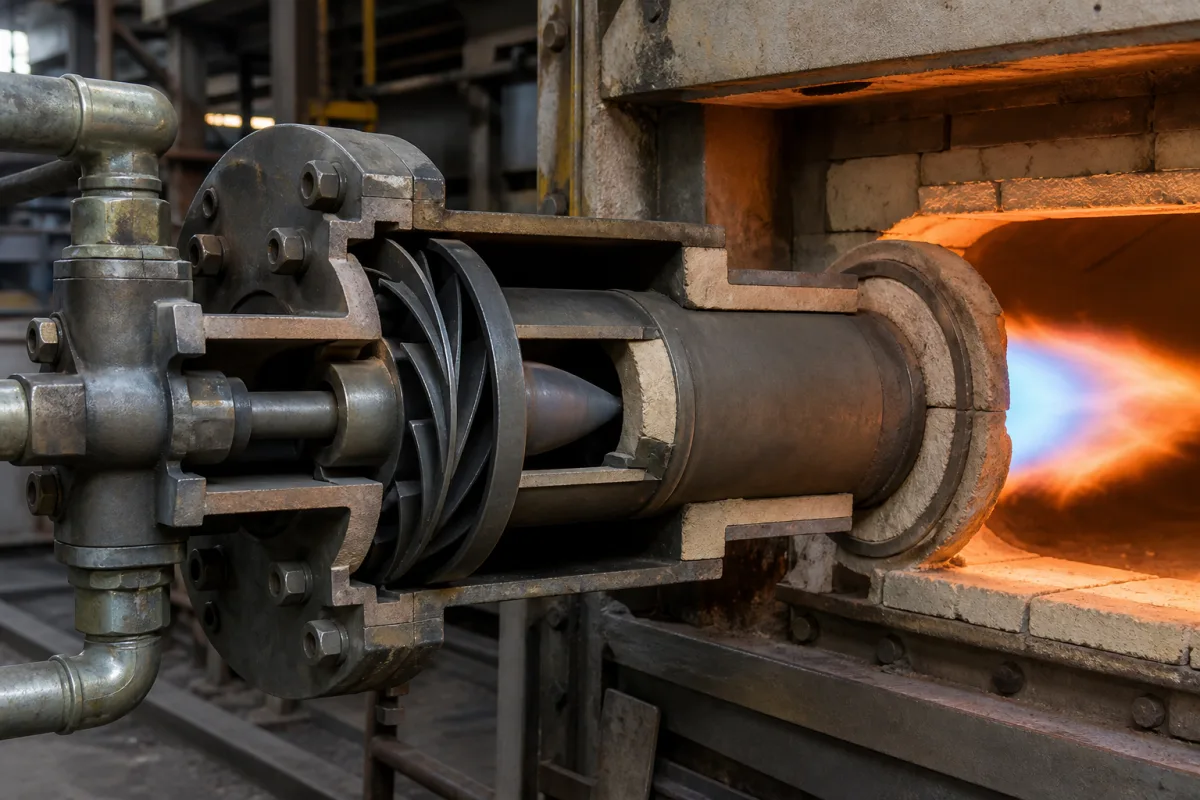
Blast furnace gas burner nozzle: swirl gas and air nozzles sized for a fuel with less than a tenth of the heating value of natural gas
Gas and air nozzles for burning low-calorific blast furnace gas · about 3,270 kJ/Nm³, large volume flows, swirl openings at 30° to 80°, swirl degree 0.1 to 0.2, split main and auxiliary nozzle rings for turndown
In the blast furnace gas analysed in one 2023 furnace study, nitrogen and carbon dioxide made up about 71% of the volume, carbon monoxide 22% and hydrogen 4%, so a burner must pass a very large gas volume for each kilowatt and keep a cool, slow-burning flame attached. The nozzle is where that is decided: how the gas and air streams are sized, angled and swirled, and whether the nozzle can keep exit velocity in a workable band when the load falls. Different heat users have worked out different answers; this page follows three of them with their figures.
Gas and air nozzles, swirlers and nozzle heads of burners firing blast furnace gas and similar low-calorific steelworks gases, in hot blast stoves, hot gas generators for drying, and steel reheating and treatment furnaces: nozzle opening angles, swirl, nozzle ring arrangement and the volume flows they must pass. Complete industrial burners with fuel trains, ratio control and flame safeguards are covered on the Industrial burner page; refractory burner blocks, tiles and quarls on the Burner assembly page; blast furnaces with their hot stoves on the Blast furnace page.
CNFX editorial research · Sources checked October 12, 2026 · 3 sources
Nearly twelve times the volume of natural gas for the same heat: what a 3,270 kJ/Nm³ fuel asks of the nozzle
In tests at an ArcelorMittal experimental furnace in Asturias reported by CIRCE and ArcelorMittal (Processes, 2023), the blast furnace gas burned contained 22.34% CO, 4.13% H2, 48.98% N2, 22.04% CO2, 1.68% H2O and 0.82% O2, with a lower heating value of 3,270 kJ/Nm³ against 38,019 kJ/Nm³ for the natural gas used. The authors give a plant-dependent range for BFG of about 20–30% CO, 2–6% H2, 45–60% N2 and 20–25% CO2. [1]
Fired at 900 kW with combustion air at about 500 °C, BFG held the furnace at about 1,030 °C, compared with about 1,347 °C on 700 kW of natural gas with oxygen injection and about 1,250 °C on a 70/30 BFG and natural gas blend; the authors note that the BFG case ran at 200 kW more power yet 200 to 300 °C lower temperature, and that BFG flow would need to be doubled to approach natural gas temperatures. In the simulations the high BFG flow overrode the swirl, giving straight flames, while the blend's flames rotated and were short. [1]
Editorial calculation: 900 kW ÷ 3,270 kJ/Nm³ = 0.275 Nm³/s, about 990 Nm³/h of BFG, against 700 kW ÷ 38,019 kJ/Nm³ = 0.0184 Nm³/s, about 66 Nm³/h of natural gas; per kilowatt, BFG needs 38,019 ÷ 3,270 ≈ 11.6 times the fuel volume before combustion air is counted. [1]
The authors conclude that burning equipment must be adapted to keep flame geometry when fuels of very different heating value are used, with different nozzles and swirling methods, and that the piping and ports for BFG must be sized for its large volume flows. [1]
Send the supplier your BFG analysis (CO, H2, CO2, N2, H2O), heating value range, supply pressure and temperature, and the firing rate range, so the nozzle area and exit velocity can be calculated for the actual gas.
02
Gas and air openings inclined 30° to 80°: a hot stove swirl burner that halves flame length
Nippon Kokan's patent for a swirling burner in a blast furnace hot stove starts from two older designs. Twisted-blade swirl burners, mainly used on relatively small blast furnaces, developed oscillatory combustion as flow increased; ceramic-grill burners, with a grill about 200 mm thick ejecting air and gas as parallel streams, mixed poorly, so the flame grew long, unburned gas reached the checker bricks and flame length changed strongly with excess air. [2]
Its burner uses an annular blast member below the vertical combustion chamber, with fuel gas passages and air passages stacked alternately around a central cylindrical space and gas and air openings all inclined the same way. The patent selects an inclination of 30° to 80° to the tangent toward the radius and 30° to 90° to the vertical, which builds an upward swirl with a counter-flow region at the centre that acts as a flame holder. [2]
In the combined version with a grill, it sets the ratio of air and gas through the swirl openings to that through the grill at 0.1 to 10 and the degree of swirl S = Pt / (Pt + Pa), swirling flow power over total flow power, at 0.1 to 0.2. The inventors report that in their experiments flame length fell to about half that of the conventional grill nozzle and no longer varied with air-fuel ratio, and that no oscillatory combustion appeared when large gas quantities were burned. [2]
Ask for the opening angles to the tangent and to the vertical, the swirl degree at your firing rate, and test data on flame length and stability across the air-fuel ratio range.
03
Main and auxiliary nozzle rings with 15° to 75° swirl plates: holding flame at low and high load
Zhongye Changtian's patent for a low-calorific-value gas burner on a drying hot gas generator names blast furnace gas and converter gas as the fuels it addresses. It describes the problem with a single large sleeve burner: above 1,500 × 10⁴ kcal/h its outside diameter exceeds 2 m, and with one gas channel and one air channel the outlet velocity is low at low load, inviting flashback, flame-out and burning of the burner head, and high at high load, inviting flame lift-off and incomplete combustion. [3]
Its design splits the burner into an outer main burner and an inner auxiliary burner, each with a ring of gas pipes ending in nozzles with mixing tips, each with its own gas and air control valves. Arc-shaped swirl plates on the inside of each gas pipe and on its outside in the air stream turn the flows; the patent gives three or more plates per pipe with a spiral angle adjustable from 15° to 75°. [3]
For a heat supply of about 2,000 × 10⁴ kcal/h, the patent gives the annular nozzle cross-section diameter as 1,800 mm and states that this is about 30% smaller than an existing burner of the same capacity. [3] Editorial calculation: 2,000 × 10⁴ kcal/h × 4.1868 kJ/kcal ÷ 3,600 s/h ≈ 23,300 kW; at the 3,270 kJ/Nm³ of the CIRCE test gas this is about 7.1 Nm³/s, or roughly 25,600 Nm³/h of BFG (the patent does not state its design gas's heating value). [3][1]
For a burner that must turn down, ask how many nozzle groups it has, which are shut at minimum load, and the exit velocity at minimum and maximum firing for your gas.
04
Gas, duty and nozzle data for a blast furnace gas burner
Paste it into your enquiry below or into an email to a maker, then replace every bracket.
Gas: [CO, H2, CO2, N2, H2O %; heating value range kJ/Nm³]
Gas supply: [pressure; temperature; dust content]
Enrichment: [natural gas or coke oven gas blend; oxygen]
Duty: [hot stove, hot gas generator, reheating or treatment furnace]
Firing rate: [maximum and minimum kW]
Air: [preheat temperature; excess air]
Nozzle: [opening angles; swirl degree or swirl plate angle; number of nozzle groups]
Flame: [length limit; stability across air-fuel ratio]
Explore company information and manufacturing capabilities, then discuss the scope of your project with a relevant supplier.
Share this page
Compiled and source-reviewed by the CNFX editorial team.
Each manufacturer above links to the page on that company's own website where the product is listed, with the date we checked it. How we source and review
· Page last updated 13 October 2026
Buyer questions
What is the heating value of blast furnace gas?
The BFG in a 2023 CIRCE and ArcelorMittal furnace study had a lower heating value of 3,270 kJ/Nm³, against 38,019 kJ/Nm³ for natural gas, with 22.34% CO and 4.13% H2. [1]
Why do blast furnace gas burners need large nozzles?
Per kilowatt BFG needs about 11.6 times the volume of natural gas (editorial calculation from the study's heating values); the authors note that piping, ports, nozzles and swirl methods must be adapted. [1]
How are swirl burner openings angled in a hot stove?
Nippon Kokan's patent inclines gas and air openings 30° to 80° to the tangent and 30° to 90° to the vertical, with a swirl degree of 0.1 to 0.2, and reports flame length about half that of a grill burner. [2]
How does a BFG burner cope with low load?
Zhongye Changtian's design splits the nozzles into main and auxiliary rings with separate valves and swirl plates adjustable from 15° to 75°, to avoid flashback at low load and lift-off at high load. [3]
Sources and what still needs a direct check
Sources checked 2026-10-12. Gas composition and furnace results come from a peer-reviewed CIRCE and ArcelorMittal study; nozzle geometry comes from patents by Nippon Kokan and Zhongye Changtian International Engineering.