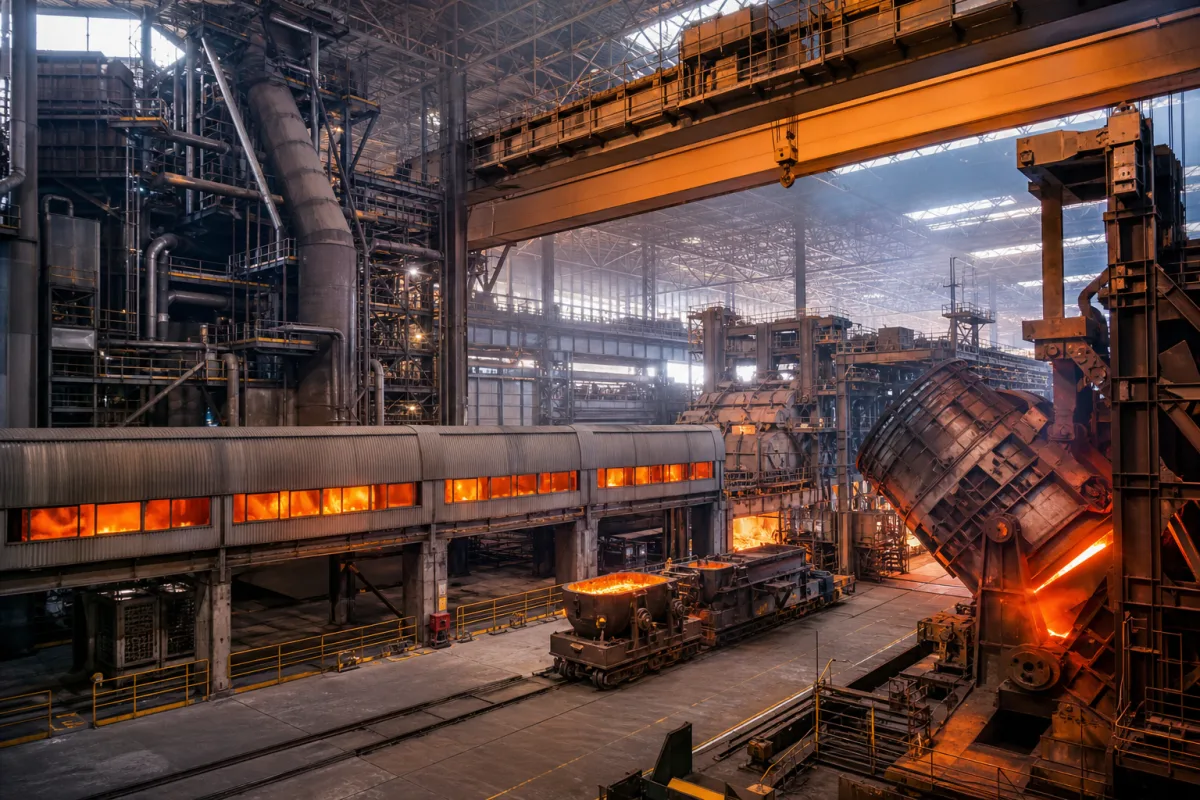
Integrated blast furnace–basic oxygen furnace steelmaking system: the BF–BOF route as one plant
The whole integrated route from coke and sinter to liquid steel · energy at each stage per tonne, 13.6 GJ per tonne of hot metal in the blast furnace, about 24 GJ and 2.3 t CO₂ per tonne of crude steel for the route
An integrated blast furnace and basic oxygen furnace (BF–BOF) system is not one machine but a chain of plants on one site: coke ovens and sinter or pellet plants prepare the burden, the blast furnace reduces ore to liquid hot metal, torpedo or ladle cars carry the hot metal to the melt shop, and the converter blows it with oxygen into steel, with gas cleaning and energy recovery around both furnaces. Because the stages are coupled, the energy and emissions of the system are set by the whole chain; in the stage figures below the blast furnace carries the largest share.
Integrated BF–BOF steelmaking as a coupled system: cokemaking, ore agglomeration, blast furnace ironmaking, hot metal transfer and basic oxygen steelmaking, with their energy use and CO₂ intensity per tonne. The converter vessel itself, its trunnion ring, hood and emission control are covered on the Basic oxygen furnace vessel page; oxygen lance cooling water skids on the Oxygen lance cooling water system page; the furnace itself on the Blast furnace page and hot metal transport on the Hot metal torpedo car page. Electric arc furnaces are covered on the Electric arc furnace page; EAF and direct-reduction routes appear here only as comparisons.
CNFX editorial research · Sources checked October 12, 2026 · 3 sources
Coke ovens, blast furnace and converter: where the energy goes per tonne along the chain
The US Department of Energy's bandwidth study of US iron and steel making gives energy intensity for each stage, current typical and state of the art; the blast furnace dominates.
The study gives a theoretical minimum for blast furnace ironmaking of 9.81 GJ per tonne of hot metal (iron nearly saturated with carbon), and 10.2–10.4 GJ/t when impurities, slag and coke ash are included. It notes that in 2010 about 24% of US BOF inputs were scrap rather than pig iron, that there were about 15 BF/BOF steelmaking facilities operated by five companies in the US, and that BOF energy is lost through radiation and conduction from the vessel, unrecovered off-gas heat and calorific value, and iron lost to slag and dust. [1]
Editorial calculation: the state-of-the-art blast furnace figure is 0.69 GJ/t, about 5%, below current typical, while the current typical figure is 3.82 GJ/t above the theoretical minimum. The negative state-of-the-art BOF figure means the converter becomes a net energy exporter when its off-gas and steam are recovered. The stage figures use different tonnages (coke, hot metal, liquid steel) and cannot be added directly.
−0.35 GJ/t, with gas recovery, dry gas cleaning and steam recovery [1]
Per tonne of liquid steel
For a system study or quotation, state annual liquid steel output, hot metal ratio and scrap share in the converter charge, coke and burden sources (own coke ovens, sinter, purchased pellets), and which gas and heat recovery units (top-gas turbine, converter gas recovery, coke dry quenching) are in scope.
02
Route totals: about 24 GJ and 2.3 t CO₂ per tonne of crude steel, against 0.7 t for scrap-based EAF
Route-level figures put the integrated chain against the other ways of making steel.
IRENA attributes the route's energy and emission intensity to its reliance on coal, coke and other coke products as reductant and energy source. [2]
Editorial calculation: at about 2.3 against 0.7 t CO₂ per tonne, the integrated route emits a little over three times as much CO₂ per tonne of crude steel as the scrap-based EAF route in the 2023 figures cited by IRENA; its 24.2 GJ/t is about 14% above the 2021 all-route average of 21.31 GJ/t.
When comparing proposals or plant data with these benchmarks, state the system boundary (whether coke, sinter, pellets, oxygen and power generation are inside), the tonnage basis (hot metal, liquid steel or crude steel cast) and the year.
03
Data for an integrated BF–BOF system study or enquiry
Paste it into your enquiry below or into an email to a maker, then replace every bracket.
Output: [liquid steel t/year; product mix]
Burden: [ore type; sinter, pellets or lump; coke source]
Blast furnace: [inner volume; hot metal t/day; blast temperature; injection]
Hot metal transfer: [torpedo or ladle cars; distance; desulphurisation]
Converter: [heat size; number of vessels; scrap share]
Recovery: [top-gas turbine; converter gas recovery; coke dry quenching]
Targets: [energy GJ/t; CO₂ t/t; system boundary]
Explore company information and manufacturing capabilities, then discuss the scope of your project with a relevant supplier.
Share this page
Compiled and source-reviewed by the CNFX editorial team.
Each manufacturer above links to the page on that company's own website where the product is listed, with the date we checked it. How we source and review
· Page last updated 13 October 2026
Buyer questions
How much energy does a blast furnace use per tonne of hot metal?
The US DOE bandwidth study gives 13.63 GJ per tonne of hot metal as current typical for US blast furnaces and 12.94 GJ/t as state of the art. [1]
What is the CO₂ intensity of BF–BOF steel?
IRENA, citing worldsteel, gives about 2.3 t CO₂ per tonne of crude steel cast for the BF–BOF route in 2023, against about 0.7 t for scrap-based EAF. [2]
Can a basic oxygen furnace be a net energy producer?
The DOE study's state-of-the-art figure for BOF steelmaking is −0.35 GJ per tonne of liquid steel when off-gas and steam are recovered. [1]
Sources and what still needs a direct check
Sources checked 2026-10-12. The DOE bandwidth study (2015) uses US 2010 data and cited references; IRENA cites worldsteel's 2023 figures; worldsteel publishes its own sustainability indicators.