Industry-Verified Manufacturing Data (2026)

Blade Tensioning System

Based on aggregated insights from multiple verified factory profiles within the CNFX directory, the standard Blade Tensioning System used in the Machinery and Equipment Manufacturing sector typically supports operational capacities ranging from standard industrial configurations to heavy-duty production requirements.

Technical Definition & Core Assembly

A canonical Blade Tensioning System is characterized by the integration of Tensioning Screw/Actuator and Tension Indicator (optional). In industrial production environments, manufacturers listed on CNFX commonly emphasize Alloy Steel construction to support stable, high-cycle operation across diverse manufacturing scenarios.

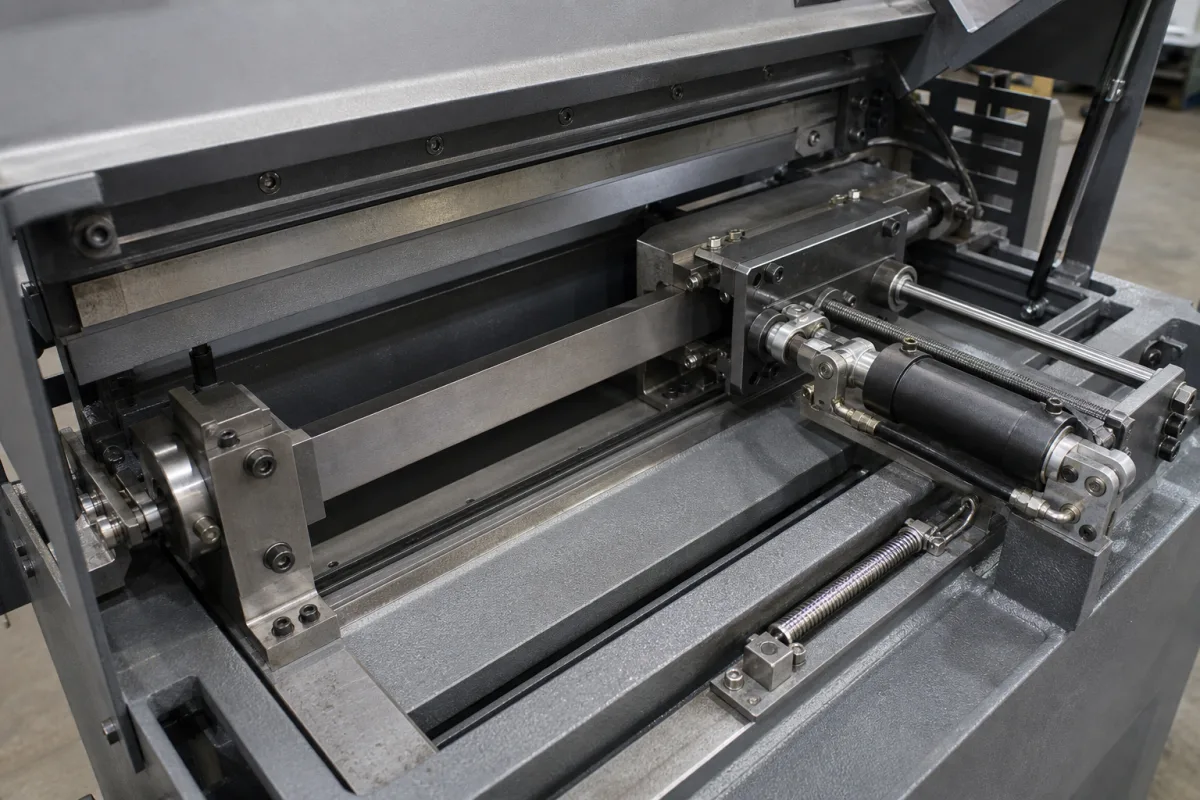
A mechanical system designed to apply and maintain precise tension on oscillating blades to ensure optimal cutting performance and blade stability.
Product Specifications

Technical details and manufacturing context for Blade Tensioning System

Definition
The Blade Tensioning System is a critical component within the Oscillating Blade Assembly that regulates and sustains the appropriate tension force on the cutting blade. It ensures the blade remains taut during operation, preventing deflection, vibration, and premature wear, which directly impacts cutting accuracy, surface finish quality, and operational safety in various industrial cutting applications.
Working Principle
The system typically employs a tensioning mechanism (such as a screw, spring, or hydraulic/pneumatic actuator) to apply a controlled pulling force to the blade. This force is calibrated to counteract operational stresses, thermal expansion, and material fatigue, maintaining the blade within its optimal tension range throughout its service life. Adjustments can be made to compensate for blade wear or different material cutting requirements.
Common Materials
Alloy Steel, Stainless Steel, High-Strength Spring Steel
Technical Parameters
  • Tension force per unit width of the blade, defining the operational stress state. (N/mm or lbf/in) Per Request
Components / BOM
  • Tensioning Screw/Actuator
    Applies the primary tensioning force to the blade via mechanical or powered means.
    Material: Alloy Steel
  • Tension Indicator (optional)
    Provides a visual or electronic readout of the current blade tension.
    Material: Steel/Plastic with gauge
  • Mounting Bracket/Frame
    Secures the tensioning system to the oscillating blade assembly structure.
    Material: Cast Iron or Steel
Engineering Reasoning
150-450 N tension force, 0.1-0.3 mm blade deflection
Tension force exceeds 550 N or drops below 100 N, blade deflection exceeds 0.5 mm
Design Rationale: Hooke's Law elastic limit exceeded causing permanent deformation (yield strength > 550 MPa), Hertzian contact stress > 1.2 GPa causing surface fatigue
Risk Mitigation (FMEA)
Trigger Thermal expansion coefficient mismatch (α_blade=11×10⁻⁶/K vs α_frame=23×10⁻⁶/K)
Mode: Tension loss of 40-60% at ΔT=50°C due to differential expansion
Strategy: Invar alloy tension rods (α=1.2×10⁻⁶/K) with Belleville washer compensation stack
Trigger Vibration-induced fretting at 85-120 Hz resonance
Mode: Thread loosening with 0.02-0.05 mm backlash accumulation per 10⁶ cycles
Strategy: Nord-Lock wedge-locking washers with 30° wedge angle and preload > 80% of yield

Industry Taxonomies & Aliases

Commonly used trade names and technical identifiers for Blade Tensioning System.

Applied To / Applications

This component is essential for the following industrial systems and equipment:

Industrial Ecosystem & Supply Chain DNA

Complementary Systems
Downstream Applications
Specialized Tooling

Application Fit & Sizing Matrix

Operational Limits
pressure: 0 to 10 bar
temperature: -20°C to 120°C
tension force range: 50 to 5000 N
blade oscillation frequency: 0 to 100 Hz
Media Compatibility
✓ Metal cutting fluids ✓ Water-based coolants ✓ Industrial lubricants
Unsuitable: High-concentration abrasive slurries
Sizing Data Required
  • Blade length and material
  • Required cutting force
  • Oscillation frequency and amplitude

Reliability & Engineering Risk Analysis

Failure Mode & Root Cause
Tension Loss
Cause: Creep in tensioning components (e.g., springs, bolts) due to cyclic loading and thermal expansion, leading to reduced blade contact pressure and potential slippage.
Component Fatigue Fracture
Cause: High-cycle fatigue from vibration and resonance in the blade system, exacerbated by improper tensioning or misalignment, causing cracks in tensioning hardware (e.g., fasteners, brackets).
Maintenance Indicators
  • Audible high-frequency vibration or rattling during operation, indicating loose components or resonance issues.
  • Visual misalignment or uneven blade wear patterns, suggesting tension imbalance or system degradation.
Engineering Tips
  • Implement predictive maintenance using vibration analysis and thermal imaging to detect early signs of tension loss or fatigue before failure.
  • Use torque-controlled tensioning tools and follow manufacturer specifications for preload, and periodically re-tension after initial run-in to compensate for creep.

Compliance & Manufacturing Standards

Reference Standards
ISO 9001:2015 - Quality Management Systems ANSI B11.19 - Performance Requirements for Safeguarding CE Marking - Machinery Directive 2006/42/EC
Manufacturing Precision
  • Bore Diameter: +/-0.01mm
  • Surface Flatness: 0.05mm per 100mm
Quality Inspection
  • Torque Calibration Verification
  • Non-Destructive Testing (NDT) - Magnetic Particle Inspection

Factories Producing Blade Tensioning System

Verified manufacturers with capability to produce this product in China

✓ 96% Supplier Capability Match Found

P Project Engineer from Australia Jan 25, 2026
★★★★★
"Testing the Blade Tensioning System now; the technical reliability results are within 1% of the laboratory datasheet."
Technical Specifications Verified
S Sourcing Manager from Singapore Jan 22, 2026
★★★★★
"Impressive build quality. Especially the technical reliability is very stable during long-term operation."
Technical Specifications Verified
P Procurement Specialist from Germany Jan 19, 2026
★★★★★
"As a professional in the Machinery and Equipment Manufacturing sector, I confirm this Blade Tensioning System meets all ISO standards."
Technical Specifications Verified
Verification Protocol

“Feedback is collected from verified sourcing managers during RFQ (Request for Quote) and factory evaluation processes on CNFX. These reports represent historical performance data and technical audit summaries from our B2B manufacturing network.”

13 sourcing managers are analyzing this specification now. Last inquiry for Blade Tensioning System from Brazil (1h ago).

Supply Chain Compatible Machinery & Devices

Automated Assembly Line System

Integrated production system for sequential component assembly operations

Explore Specs →
Automated Powder Coating System

Integrated industrial system for applying dry powder coatings to metal substrates.

Explore Specs →
Centrifugal Pump Impeller

Rotating component that transfers energy to fluid in centrifugal pumps.

Explore Specs →
High-Precision CNC Laser Cutting Machine

Computer-controlled industrial machine using focused laser beams to cut sheet metal with micron-level accuracy.

Explore Specs →

Frequently Asked Questions

What materials are used in the Blade Tensioning System?

The system is constructed from durable materials including alloy steel, stainless steel, and high-strength spring steel for optimal performance and longevity in industrial environments.

How does the Blade Tensioning System improve cutting performance?

By applying and maintaining precise tension on oscillating blades, the system ensures blade stability, reduces vibration, and delivers consistent, high-quality cuts in manufacturing applications.

What components are included in the Blade Tensioning System?

The system includes a tensioning screw/actuator, optional tension indicator, and mounting bracket/frame, providing a complete solution for industrial blade tension management.

Can I contact factories directly on CNFX?

CNFX is an open directory, not a transaction platform. Each factory profile provides direct contact information and production details to help you initiate direct inquiries with Chinese suppliers.

Get Quote for Blade Tensioning System

Request technical pricing, lead times, or customized specifications for Blade Tensioning System directly from verified manufacturing units.

Your business information is encrypted and only shared with verified Blade Tensioning System suppliers.

Thank you! Your message has been sent. We'll respond within 1–3 business days.

Need to Manufacture Blade Tensioning System?

Connect with verified factories specializing in this product category

Add Your Factory Contact Us
Previous Product
Blade Holder/Spindle
Next Product
Blade/Louver Assembly