Powder coating lines · Booth extraction and explosion limits, earthing of parts, cure window by object temperature, oven safety
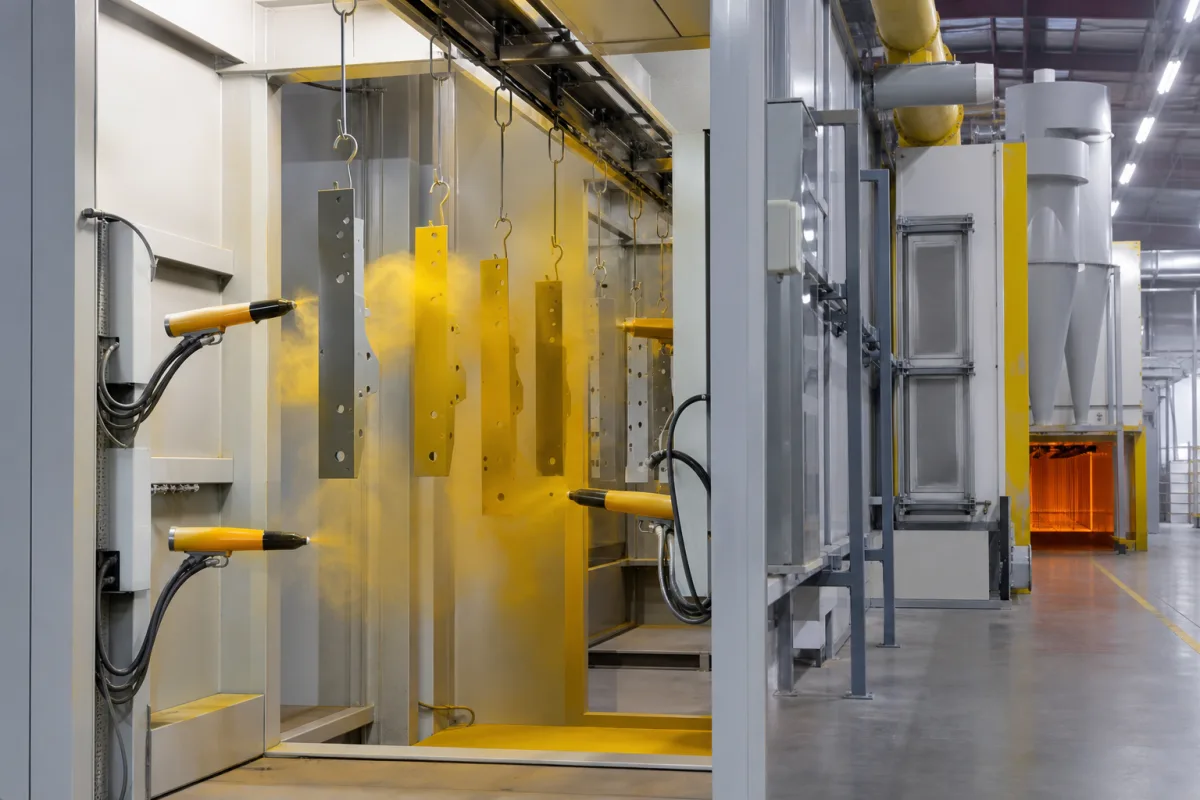
An automated powder coating system is a line in which parts on an overhead conveyor are pretreated, sprayed with electrostatically charged dry powder by automatic guns in an extracted booth, and then cured in an oven. Ask three things first: whether booth extraction keeps powder well below its explosion limit at full gun output, how parts are earthed through hooks and conveyor, and whether the oven brings your thickest parts to the powder's cure temperature for long enough.
Conveyorised electrostatic powder coating lines for metal parts, including pretreatment, automatic spray booths with recovery, curing ovens and conveyors. Powder coating services, fusion-bonded epoxy pipe coating lines, liquid paint lines and stand-alone manual guns are outside this page.
CNFX editorial research · Sources checked October 11, 2026 · 4 sources
CEPE's safe powder coating guide (2020) states that "the lower explosion limit of typical powder coatings" (LEL), calculated under DIN EN ISO 8130-4, is between 20 and 80 g/m³, and that booth ventilation must keep the average powder concentration at no more than 50% of the LEL, or 10 g/m³ where no reliable LEL is known. Following DIN EN 16985, average concentration is the mass of powder used divided by the volume of air extracted over the same period. [1]
CEPE asks for the application unit to be marked with its extraction capacity and the maximum number and capacity of guns, checked regularly against actual powder use. It notes that fine dust from cyclone final filters has a minimum ignition energy of 3–10 mJ and strongly discourages recycling it, states that "Typical powder coatings usually have an ignition temperature of approx. 420-470 °C" with exposed surfaces limited to two-thirds of the minimum ignition temperature, and recommends a fire detector interlocked to powder supply and ventilation, plus flame detection for automatic booths with open recovery. [1]
Editorial calculation: 8 automatic guns each delivering 200 g/min use 96 kg of powder per hour; holding the average at 10 g/m³ needs at least 96,000 / 10 = 9,600 m³/h of extraction, and twice that to stay at 5 g/m³. Gun output is an assumed example; use your guns' maximum delivery. [1]
Give the supplier the largest part size and weight, line speed and hanging pitch, throughput, substrates and pretreatment, powder types and colour-change frequency, number of guns and their output, recovery and filter design, oven fuel and temperature, and the site's electrical and compressed-air supply.
02
Earth every part through hooks and conveyor
CEPE identifies inadequate earthing as a main electrical hazard and states that metal objects being coated should have a resistance to earth not exceeding 10⁶ Ω, as should floors and surfaces operators touch. Contact between workpiece, jigs and conveyor should be designed and regularly tested, jigs cleaned of coating build-up, and earthing monitored automatically where practicable. [1]
CEPE also calls for equipotential bonding of all booth components, conveyors and the high-voltage generator, conveyors designed to minimise swinging, and only spray guns, their cables and powder hoses inside the booth. [1] IGP's datasheet recommends a gun voltage of at least 50 kV for its powder. [2]
03
Build in the interlocks US workplace rules require
The US OSHA spray finishing standard, 29 CFR 1910.107, sets performance rules for powder coating: exhaust ventilation must keep the atmosphere below the lowest explosive limit of the powders applied, non-deposited powder must be removed through exhaust ducts to the recovery cyclone or receptacle, powder must not be released to the outside atmosphere, and drying, curing or fusion equipment falls under the NFPA 86A oven standard (1969 edition as referenced). Areas must be kept free of powder accumulation on ledges, beams, pipes, hoods, booths and floors, cleaned without raising dust clouds. [3]
For fixed electrostatic equipment the standard requires approved apparatus, transformers, power packs and controls outside the spraying area, automatic grounding of the electrode system whenever it is de-energised, a posted safe distance between goods and electrodes of at least twice the sparking distance, goods carried on conveyors and rigidly supported against swinging, and no hand manipulation of goods. Automatic controls must cut power to the high-voltage transformer without time delay and signal the operator if the ventilation fans stop or fail, the conveyor stops, a ground or imminent ground occurs on the high-voltage system, or clearance falls below the safe distance. [3]
For electrostatic fluidized beds it limits equipment surface temperature in the coating area to 150 °F (about 66 °C), requires conductive objects within the electrodes' influence to be grounded, hangers cleaned regularly with contact made at sharp points or knife edges where possible, and the electrical equipment interlocked so it cannot run unless the ventilation fans are running. [3] Editorial note: ask the supplier for the interlock list and a test record showing each trip condition cuts the high voltage, alongside CEPE's 50%-of-LEL extraction check and 10⁶ Ω earthing limit. [1]
04
Cure by object temperature, not oven setting
IGP's datasheet for a low-temperature polyester powder gives a cure window by object temperature: 15–25 minutes at 160 °C, 10–20 minutes at 170 °C, or 8–15 minutes at 180 °C, tested at 60–80 μm, and recommends practical trials with the actual part and oven. [2]
CEPE recommends checking ovens with temperature sensors spread over the full effective width and height, using the largest components with the thickest walls as the reference for reaching cure temperature and hold time. Ovens should be at least 1 m from the spraying installation, have air movement low enough not to blow powder off before it fuses, and conveyor ovens should cut or reduce heat if the conveyor stops. Gas- and oil-fired ovens need explosion relief directed away from the spray area. [1]
Editorial calculation: to give a part 10 minutes at 170 °C object temperature, the time in the oven's hot zone must also cover the part's heat-up; at a line speed of 2 m/min, every extra 5 minutes of heat-up adds 10 m of conveyor in the oven. [2][1]
05
Automatic lines, aluminium-profile lines and part-specific lines on the listed pages
Listings range from general automatic lines with pretreatment, booths and ovens to horizontal and vertical lines for aluminium profiles and lines built for specific parts such as brake back plates.
06
Check the automatic gun's charging data, air settings and Ex rating
Gema's operating instructions for the OptiGun GA03 automatic powder gun list a nominal output voltage of 100 kV, negative polarity with positive optional, a maximum output current of 100 µA, protection type IP64 and marking II 2D, temperature class T6 in zone 21 and T4 in zone 22, ignition protection Type A to EN 50177, an operating range of 0–40 °C, a maximum surface temperature of 85 °C and a weight of 600 g. [4]
For set-up Gema recommends base values of 4 Nm³/h total air with a 50% powder share, and a starting powder output setting of 60%, chosen against the desired layer thickness; it notes that powder output depends on powder type and total air, and advises against an overly high powder volume for efficiency. It warns that all electrically conductive parts within 5 m of the coating booth must be grounded. [4]
Editorial calculation: 8 such guns at 4 Nm³/h of total air each need about 32 Nm³/h of conveying air before rinsing air, booth cleaning and filter pulsing; ask the supplier for the full compressed-air balance. The gun's 100 kV exceeds IGP's recommended minimum of 50 kV for its powder. [4][2]
07
Pretreatment, guns, extraction, fire detection, curing oven and conveyor
Four of the six rows carry a safety duty from CEPE or OSHA rather than a performance figure: the 50%-of-LEL extraction limit, the interlocked shutdown, the oven temperature survey and part earthing through the conveyor. [1][3]
Part
Role
Fix in the order
Pretreatment
Cleans and converts the surface; depends on substrate. [2]
Carry and earth parts; hold safe distance from guns. [1][3]
Load, speed, earthing checks.
08
Part size, cure temperature, film thickness, gun output and voltage for a powder line
IGP's datasheet supplies the cure, film-thickness and gun-voltage figures here; recovery efficiency, power draw and compressed-air demand are not in the reviewed sources and must be quoted for your parts. [2]
11 companies list this product among what they make. Company figures are quoted from each
company's own website; every card states where the relationship came from.
Hangzhou Color Powder Coating Equipment Co., Ltd.
Manufacturing site to be confirmed for the order
Lists automatic powder coating lines with pretreatment, booths and ovens.
Explore company information and manufacturing capabilities, then discuss the scope of your project with a relevant supplier.
Share this page
Compiled and source-reviewed by the CNFX editorial team.
Each manufacturer above links to the page on that company's own website where the product is listed, with the date we checked it. How we source and review
· Page last updated 13 October 2026
Buyer questions
How much extraction does a powder booth need?
CEPE requires average powder concentration at no more than 50% of the LEL, or 10 g/m³ if unknown; e.g. 96 kg/h of powder needs at least 9,600 m³/h (editorial calculation). [1]
How well must parts be earthed?
CEPE says metal objects being coated should have a resistance to earth not exceeding 10⁶ Ω. [1]
What cure schedule does powder need?
It depends on the powder; IGP's datasheet gives 8–15 min at 180 °C or 10–20 min at 170 °C object temperature for one product. [2]
When must an electrostatic powder system cut its high voltage?
29 CFR 1910.107 requires automatic, no-delay disconnection if ventilation fails, the conveyor stops, a ground occurs on the high-voltage system, or clearance falls below twice the sparking distance. [3]
What voltage and current does an automatic powder gun deliver?
Gema's OptiGun GA03 instructions list a 100 kV nominal output voltage and 100 µA maximum output current, with IP64 protection and ATEX marking II 2D for zones 21 and 22. [4]
Sources and what still needs a direct check
Sources checked 2026-10-11. CEPE is the European paint industry association; its guide summarises European standards. 29 CFR 1910.107 is the US OSHA rule for spray finishing including powder coating. IGP is a powder maker and its cure window is for one product.