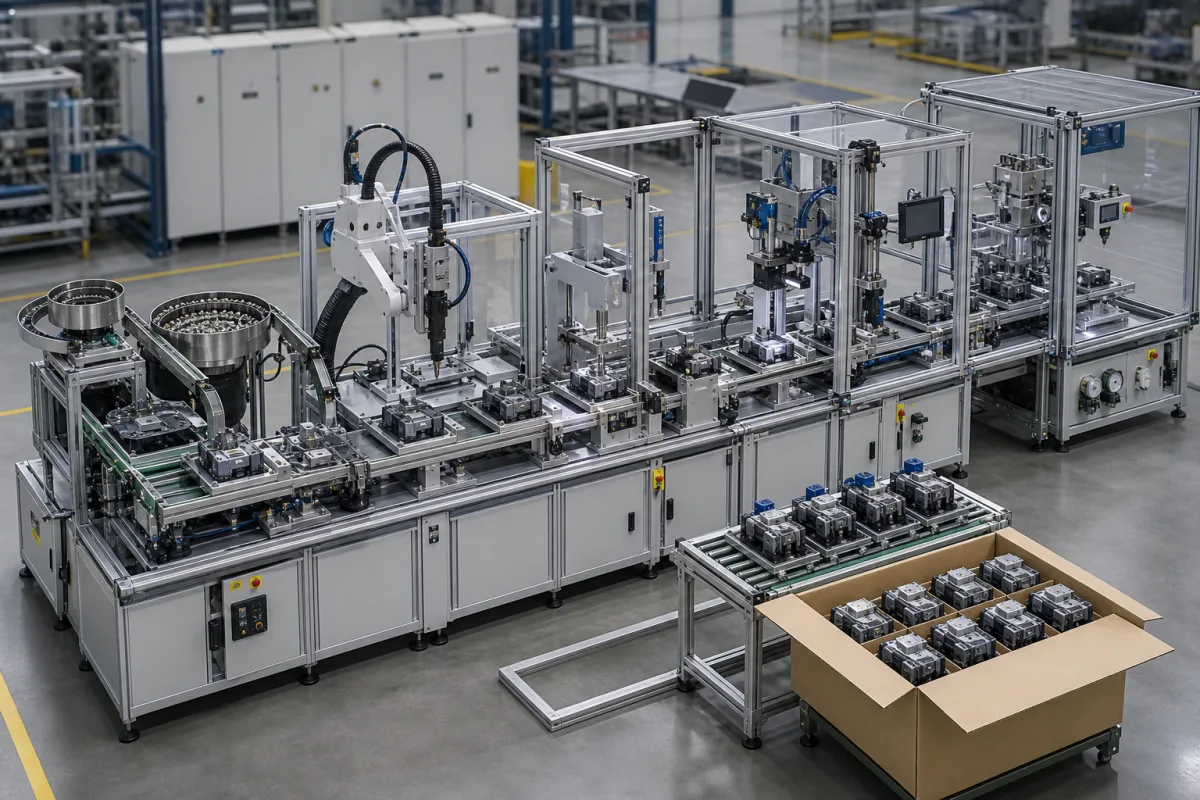
Automated assembly line on workpiece pallets (multi-station transfer line)
Multi-station assembly line on workpiece pallets · pallet size and load, conveyor speed, takt time, parts feeders and station cycle
An automated assembly line of this kind moves each product on a workpiece pallet (carrier) along a transfer conveyor through a series of stations that feed, place, press, screw, test and unload parts, with vibratory or other feeders presenting components in a fixed orientation. Ask three things first: what size and weight of pallet the transfer system carries and at what speed, what takt time the line must meet, and whether each station and each feeder can keep within it.
Multi-station automated assembly lines in which products ride on workpiece pallets or carriers through feeding, joining and testing stations. Single-function assembly machines are covered on the Automatic O-ring assembly page and similar machine pages; standalone conveyors, robots and PCB assembly services are outside this page.
CNFX editorial research · Sources checked October 12, 2026 · 4 sources
Size the workpiece pallets and the transfer conveyor
Bosch Rexroth's key data for its TS 2plus transfer system show the limits a pallet line is designed within: workpiece pallets from 160 × 160 mm to 1,200 × 1,200 mm, tailored to the product, with a pallet mass of up to 240 kg; pallets made as a steel or aluminium carrying plate or as an open frame of aluminium profiles; conveyor media of belt, toothed belt, flat top chain, accumulation roller chain or Vplus chain; conveyor speeds of 6, 9, 12, 15 and 18 m/min; and a section load of up to 200 kg/m in accumulation. [1]
For stations needing precise stops, Rexroth's linear-motor TS 2Booster reaches a stop position with an accuracy of up to 0.015 mm without an additional positioning unit, at speeds of up to 4 m/s (240 m/min) and acceleration of up to 4 g, and pallets can pass on the fly between it and the belt system. [1]
Editorial calculation: a 1,200 mm pallet at the full 240 kg puts 240 ÷ 1.2 = 200 kg on each metre of an accumulation section, exactly the stated section limit, so a queue of the largest, heaviest pallets leaves no margin. At 18 m/min (0.3 m/s), moving a pallet 1.2 m to the next station takes 1.2 ÷ 0.3 = 4 s, which counts inside each station's cycle. [1]
Give the supplier the product and its parts list, assembly sequence, takt time or output per shift, pallet size and weight with fixture, number of variants and changeover, station processes (feeding, pressing, screwing, testing), feeder rates and part orientation, accuracy at the stops, traceability, safety guarding, floor space and utilities.
02
Balance the stations and feeders to the takt time
The Lean Enterprise Institute defines takt time as the available production time divided by customer demand: a factory operating 480 minutes a day with demand of 240 units a day has a takt time of two minutes, and the purpose is to match production precisely with demand. [2]
Parts feeders must present components at least as fast as the stations use them. Hoosier Feeder lists its vibratory feeder bowls, which orient and discharge parts in a repeatable position for assembly, at rates up to 250 parts per minute in bowl sizes from 6 to 42 inches, with options such as tooling changeover, sound enclosures, inline tracks and hoppers. [3] RNA Automation describes a stepped aluminium bowl feeder that sorts automotive clips and discharges them axis vertical, barbed head uppermost, at 60 parts per minute, and gives its standard EcoType range for simple, free-flowing parts feed rates of up to 200 parts per minute. [4]
Editorial calculation: with an assumed 450 minutes of available time per shift and demand of 4,500 assemblies per shift, takt time is 450 × 60 ÷ 4,500 = 6 s; with the 4 s pallet move above, each station has about 2 s for its process, so slower processes need to be split across stations or doubled. A part used once per assembly is then needed at 10 per minute, well within the 60 parts per minute of the clip feeder described. [2][1][4]
03
Pallets, transfer conveyor, stops, feeders and line control
The pallet is what the stations work on, so its fixture and the stop that locates it set the accuracy every station can reach.
Takt, stop accuracy, conveyor speed and pallet load for a pallet line
Cycle time per station has to fit the takt including the pallet move; the conveyor speeds and stop accuracy here come from one transfer system and show the range to ask about.
Explore company information and manufacturing capabilities, then discuss the scope of your project with a relevant supplier.
Share this page
Compiled and source-reviewed by the CNFX editorial team.
Each manufacturer above links to the page on that company's own website where the product is listed, with the date we checked it. How we source and review
· Page last updated 13 October 2026
Buyer questions
How is takt time calculated for an assembly line?
Available production time divided by customer demand; the Lean Enterprise Institute's example is 480 minutes and 240 units, giving two minutes. [2]
How large and heavy can workpiece pallets be?
Bosch Rexroth lists TS 2plus pallets from 160 × 160 to 1,200 × 1,200 mm and up to 240 kg. [1]
How fast do vibratory bowl feeders feed parts?
Hoosier Feeder lists rates up to 250 parts per minute; RNA describes a clip feeder at 60 parts per minute. [3][4]
How fast do pallet conveyors run?
Rexroth lists TS 2plus speeds of 6, 9, 12, 15 and 18 m/min. [1]
Sources and what still needs a direct check
Sources checked 2026-10-12. Bosch Rexroth, Hoosier Feeder and RNA Automation describe their own transfer and feeding equipment; the Lean Enterprise Institute defines takt time.